Notice: Function _load_textdomain_just_in_time was called incorrectly. Translation loading for the content-views-query-and-display-post-page domain was triggered too early. This is usually an indicator for some code in the plugin or theme running too early. Translations should be loaded at the init action or later. Please see Debugging in WordPress for more information. (This message was added in version 6.7.0.) in /home2/englita2/public_html/blogebg/wp-includes/functions.php on line 6170
Notice: Function _load_textdomain_just_in_time was called incorrectly. Translation loading for the js_composer domain was triggered too early. This is usually an indicator for some code in the plugin or theme running too early. Translations should be loaded at the init action or later. Please see Debugging in WordPress for more information. (This message was added in version 6.7.0.) in /home2/englita2/public_html/blogebg/wp-includes/functions.php on line 6170
Notice: Function _load_textdomain_just_in_time was called incorrectly. Translation loading for the gravity-forms-pdf-extended domain was triggered too early. This is usually an indicator for some code in the plugin or theme running too early. Translations should be loaded at the init action or later. Please see Debugging in WordPress for more information. (This message was added in version 6.7.0.) in /home2/englita2/public_html/blogebg/wp-includes/functions.php on line 6170 Webinars | Blog EBE | Page 2
Skip to content
English Book Education is pleased to invite you to another professional development event organised by Oxford University Press.
The online event will answer the following questions:
What is EMI and in what contexts is it used (students, teachers, types and locations of institutions)?
What are global skills and why are they important?
Oxford Day Online will equip participants with practical ideas for brining L1 into an EMI programme and ways of assessing global skills in a regular ELT context.
16:00-16:10 Introduction 16:10-17:10 Session N1: The Use of L1 in EMI 17:20-18:10 Session N2: Assessing Global Skills 18:10-19:30 Q&A
Session N1. The Use of L1 in EMI
Many people consider that using the students’ first language in the English Medium Instruction (EMI) classroom to be wrong. However, there are many arguments for incorporating it, even if these might at first seem counterintuitive. In this session we will establish what we mean by EMI and its varied context, we will then look at the benefits of using the first language, and see how it can best be incorporated.
Session N2. Assessing Global Skills
For learners to succeed in the 21st century they need to develop a set of global skills which enable them to go beyond what the traditional school subjects can offer. The incorporation of global skills is to some degree already present in most ELT classrooms. However, if we really wish to promote and develop global skills in our learners we need to be clear about what successful use of these skills looks like and how we can assess them. This session addresses these issues and identifies how you can incorporate these into your current teaching practice.
Ushapa Fortescue is a Graduate of Manchester Metropolitan University, has a CELTA, a Teacher Training certificate for the Post 16 sector and is a certified trainer for the Oxford Teachers’ Academy courses. With over 18 years of varied teaching experience both in the UK and abroad, the combination of qualifications means that in the UK she has taught in statuary primary and secondary schools, post 16 adult education, private language schools, Further Education Colleges and UK Universities.
Erika Osváth, MEd in Maths, DTEFLA, is a freelance teacher, teacher trainer, materials writer and co-author with Edmund Dudley of Mixed Ability Teaching (Into the Classroom series, OUP). Before becoming a freelance trainer in 2009, she worked for International House schools for 16 years in Eastern and Central Europe, where she worked as a YL co-ordinator, trainer on CELTA, LCCI,1-1, Business English, YL and VYL courses, and Director of Studies. She has extensive experience in teaching very young learners, young learners and teenagers.
Join National Geographic Learning event exclusively for Georgia!
With the move to online teaching over the past 18 months, the flipped classroom model as a way of facilitating a blended approach has grown in popularity. Indeed, it could be argued that it is a necessity to ensure successful learning in an online environment. In this session we’ll start by defining what exactly we mean by a blended classroom and the benefits that using a flipped approach can have. We’ll then look at how this can work on a practical basis with examples taken from National Geographic Learning’s Life 2nd Ed. and Perspectivesseries.
See the details of Heads or Tails? event exclusively for teachers in Georgia below:
Find out more about National Geographic Learning titles
Perspectives is a four-skills series that teaches learners to think critically and to develop the language skills they need to find their own voice in English. The carefully-guided language lessons, real-world stories, and TED Talks motivate learners to think creatively and communicate effectively. In Perspectives, learners develop an open mind, a critical eye and a clear voice. Every unit explores one idea from different perspectives, encouraging learners to evaluate new information, develop their own opinions and ideas, and express those ideas confidently in English.
Bring the world to your classroom with Life, Second Edition, a six-level integrated-skills series with grammar and vocabulary for young adult and adult English language learners. Through stunning National Geographic content, video, and engaging topics, Life inspires a generation of informed decision-makers. With Life, learners develop their ability to think critically and communicate effectively in the global community.
English Book Education is pleased to announce that Macmillan Education is starting the 4th season of the Advancing Learning Academic Programme and orginising Advancing Learning Roundtable Discussion: Education for Sustainable Development and Citizenship on the 28th of October.
Educators play an important role in shaping young minds to create a fairer and more sustainable vision for our future. In this special roundtable discussion, the speakers will be addressing issues such as diversity, sustainability and global citizenship in an ELT context, while exploring ways in which teachers can implement these important areas into their teaching.
Zarina Subhan originally qualified as a scientist, she has been working in the field of ELT for over 30 years. She has taught at all levels, in both private and government institutions and worked worldwide as a teacher and teacher educator. Having worked in the science, educational and development sectors, her interests are the neurology of learning; CLIL; continuing professional development for teachers; inclusive and sustainable education.
——————————————————————————————————————–
Harry Waters has been involved in English teaching for over 14 years. His passion for teaching and obsession with the planet led him to create Renewable English an online English course, providing free classes and materials aimed at raising climate change awareness across the globe. Harry is also a passionate teacher trainer. He describes himself as an imperfect environmentalist with a love of flags and funky second-hand shirts.
——————————————————————————————————————–
Matthew Hayes, BA (Oxon), MA (SOAS), is a doctoral researcher at the Institute of Education in London. His current research concerns Global Citizenship Education in English language textbooks and he has previously written on Robert Kennedy and the Cuban Missile Crisis. Matthew is also Managing Director of Lean Library, the library services provider owned by SAGE Publishing.
——————————————————————————————————————–
Mariela Gil holds a Master’s degree in TESOL and a dual Bachelor’s degree in Linguistics and Psychology from the University of Southern California. She taught ESL in the U.S. and EFL in Thailand and Mexico before joining Macmillan Education. During her career in publishing, Mariela has held the positions of Academic Consultant, Field Editor, Commissioning Editor, and currently, Publisher for the American English Pre-Primary and Primary segment and Global Methodologies.
——————————————————————————————————————–
Jessica Gedamu drives Springer Nature’s global diversity, equity and inclusion strategy as Director Global DEI. Before joining Springer Nature in 2018, Jessica worked as a DEI consultant, trainer/facilitator and project leader and supported companies in various industries in change processes towards more diversity in leadership. Jessica earned a BSc and M.A. in International Business Administration in Rotterdam and Berlin, as well as an M.A. in Gender and Diversity Competence from Freie Universität Berlin.
Pearson Educational Forum is back with a great selection of webinars designed for ELT teachers. Join us from 25th to 27th August and enjoy the practical sessions hosted by Pearson popular ELT experts and teacher trainers.
25th August will spin around teaching teenagers, 26th August will inspire teachers working with kids and 27th August will encourage you to try out tips on teaching adults. Each day will give you the opportunity to meet our consultants and experts in the Pearson Coffee Room if you seek answers to questions concerning Pearson educational solutions.
Topic: Education in flux: lessons learnt or lessons wasted?
Trainer: Anna Kolbuszewska
What awaits mainstream education in the near and not-so-near future? In this session we will look at trends which the pandemic has brought into focus, and we will try to look into the crystal ball to see if anything about education in the next 30 years is going to be what we are used to or rather what we are hoping for.
Topic: Embracing Isolation by Enhancing Student Autonomy
Trainer: Philip Warwick
One of the few benefits is that online learning has shifted the focus more on the students and encouraged them to become more autonomous and take personal charge of their learning – it is important that teachers embrace this and encourage learners not to lose their newfound autonomy when they return to more classroom-based instruction. In this session we’ll look at what true autonomy is and how teachers can support and build on it to help students create a personalised learning platform that will improve success regardless of the format.
Topic: Finding the Formula for Successful Assessment in Stressful Times
Trainer: Philip Warwick
One of the results from the previous year is that students facing their final school leaving exams have been affected more than most. Worried and anxious that they will not be as well prepared through remote learning as they would have been with in classroom work, these students should give us pause for thought and allow us to reflect constructively about exam preparation and whether we could make it more productive and efficient for learners regardless of the medium of instruction. This session will look at practical ideas that teachers can use to prepare students to successfully pass tests in both online and face-to-face learning.
Topic: The Golden Rules of Effective Teaching – how to engage your teenage students
Trainer: Magdalena Kania
While trying to balance different teaching contexts, from online to offline or even both at the same time, we need reliable tools and techniques to help you achieve students’ core aims of building language skills and passing exams.
In my session, I will show you how using a whole range of flexible resources can help you increase your impact on your students’ learning. I will also share some versatile tips and ideas that can be woven seamlessly into your lesson making it engaging and language rich.
Topic: Teaching Young Learners online: a recipe for success
Trainer: Michael Brand
Teaching Young Learners online is challenging us in new ways. We’re adapting our methodology and learning new technical skills. We’re finding new ways to engage our students and to make sure they’re learning. In short, we’re looking at how to reduce the distance that’s been created between our students and us.
In this session we’ll look to develop a recipe for success for teaching Young Learners online. You’ll leave with principles, strategies and practical activities for productive and enjoyable online lessons with your young learners.
Topic: Go with the Flow. The Power of Routine with My Disney Stars and Friends
Trainer: Dorota Tolsdorf
Conducting English lessons with preschool children may seem challenging. Teachers need to cater for all the kids’ needs such as movement, fun, games, the love of singing and dancing – but is this enough? You will come away with lots of hands-on tips on how to work with new vocabulary and structures. I will demonstrate a set of universal techniques for songs and stories. We will sample many interactive, low-prep and ready to use tasks that you can use in your classroom the very next day. Let me show you how to make your lessons FLOW!
Pleasure, enjoyment, and amusement a day take the stress away. Or at least bring it down to a bearable level. Being long-time experts in education and testing we believe we do know a thing or two about both exams and children – how they learn, what they need and what they are afraid of. As a result, we have managed to move young learners’ assessment to a whole new level by combining exam reality with fun and having a good time. Let’s talk about how we have done this.
Topic: All the Cs: Introducing, Building and Consolidating Future Skills
Trainer: Nick Perkins
Future Skills are skills generally believed to be important for students’ future success. Although, interestingly, none of them are actually new; successful people have always known about and used them. Future skills are often grouped into four categories: Communication, Collaboration, Creativity and Critical Thinking. In English Code, Pearson’s innovative ELT series for primary, these four categories have been optimised and clustered into what is known as a coding mindset. During this talk we will look at this concept and why it is vital that we use it in the primary classroom, as well as exploring how it is incorporated into English Code.
Topic: Lessons that really work – how to help your adult students flourish
Trainer: Magdalena Kania
Learning a language is not linear. Learners go through different phases when their learning goes smoothly and moments when they get stuck. What I have noticed throughout my teaching career especially adult learners can get discouraged by the downs. However, with proper tools and well-designed lessons we can help them to overcome the challenges and give them a lot of support in developing as learners.
In this session, I will present some universal tools, like an Active Book and other flexible resources that you can use in any teaching contexts, from online to offline or both. I will also give you some tips on how best to run lessons to help our students flourish.
Topic: Real Needs, Real Communication, Real Flexibility A Roadmap for Success
Trainer: Rob Dean
Wouldn’t you agree that every student is unique and every class is different? And that teachers need content that is flexible to adapt to their teaching situation and their students’ needs? And you need activities that engage your students whether you find yourself teaching remotely, in class or in a blended setting? This session will demonstrate ways in which we can address these questions – as well as to apply lessons learned from the pandemic – as we develop our students’ communication skills using crisp up-to-date topics along with activity ideas to take away and use in your very next lesson. The session will be illustrated with material taken from the Pearson course Roadmap.
Learning is a journey, but not an easy one. There are tests, mentors, friends, and foes along the way. All important, all to serve a purpose. All aimed at helping students to progress. Assessment plays a key role in this process, and when introduced appropriately, helps rather than hinders progress. Join us to discover the possibilities of the Pearson assessment portfolio and find the best fit for your teaching reality.
Topic: Developing not Just Practicing Employability Skills
Trainer: Iwonna Dubicka
Becoming and staying employable is tough in today’s competitive workplace. In this talk we will look at how Business Partner not only helps learners practise language skills in a business context, but also develops business skills alongside essential communication skills, providing them with the tools to be employable. I would like to share my experiences as a teacher and author with reference to different levels from the Business Partner series.
Grab a cup of tea or coffee and visit Pearson Coffee Room where our ELT consultants are waiting for you to provide you with information about Pearson latest solutions for teaching English everywhere, whether it is at home, in the classroom or in the workplace. Discover our range of support, tools and resources for primary and secondary schools; for private language schools and academic students as well as adults, designed to support you every step of the way and help your every student to flourish.
We are pleased to invite you to Back to School webinar series organized by Macmillan Education from 10th to 16th August 2021. Live webinars involving ready-to-use resources, tips and practical strategies and key themes such as mindfulness, formative assessment, tools and approaches to hybrid learning and much more will fill you with new energy, new ideas and new strategies to help you get a fresh start for the upcoming school year.
——————————————————————————————————————–
Date: 10 August 2021
Topic: Introducing Mindfulness: practical tools to help with anxiety & burnout
Abstract: Breathworks hands-on workshop will introduce you to the benefits of mindfulness practice, both experientially and as described by research. You will learn techniques, including a simple breathing practice, which you can start using straight away whenever the going gets tough.
Trainer: Karen Liebenguth is an accredited mindfulness teacher, mindfulness supervisor, accredited master coach and facilitator. She is an accredited and associate mindfulness trainer with Breathworks and offers tailored mindfulness & coaching programs for the workplace. Karen set up Green Space Coaching & Mindfulness in 2008 to foster personal and professional development, self-leadership and mental resilience.
Topic: Formative assessment online, hybrid or face-to-face
Abstract: With the new academic year just around the corner, this
session aims to get you thinking about best practices for formative assessment.
We’ll start by defining this type of assessment and discuss why it is a key
ingredient to any English course, whether it be online, hybrid or face-to-face.
Then we’ll look at a wide variety of practical techniques and activities that
can be easily implemented with students of various ages / levels.
Trainer: Ethan Mansur is the author of the teacher’s book for the 4th edition of Ready for B2 First. He currently teaches at International House Madrid, where he participates in the professional development program. He has an MA in Applied Linguistics and TESOL from the University of Leicester.
Topic: Key Tools and Approaches to Hybrid Learning
Abstract: What is the most effective way to approach hybrid learning?
How can the teacher make a hybrid lesson more student focused? In this talk
Russell will deal with these issues looking at both an approach to hybrid
learning as well as a review of some of the most useful technologies. This is a
talk full of practical ideas, focusing on easy to use technologies and
approaches to hybrid learning. If you are looking for ideas and tools to use,
then this is the ideal talk.
Trainer: Russell Stannard is a multi award-winning Educational Technologist and founder of www.teachertrainingvideos.com. He received awards from the British Council ELTONS, the Times Higher and the University of Westminster for his work in the use of ICT in education. He is especially known for his work in using technology to enhance feedback, teaching online and blended/flipped learning.
Topic: Motivating Learning Online for all Students
Abstract: While most teachers are now more confident teaching with
technology and online, many teachers are still reporting that student
motivation remains a challenge. In this interactive webinar, Anna Hasper
explores the concept of motivation and highlights the importance of shifting
away from teachers motivating learners to student-generated motivation and
finding ways to ignite the fire from within.
Trainer: Anna Hasper is a primary-trained ELT teacher from New Zealand, currently based in Dubai. She has worked as a teacher of young learners and adults and is a teacher trainer on Cambridge accredited courses, face to face and online.
Topic: Designing and Organising Project Work Online
Abstract: A successful language learner does not only know the right
vocabulary and grammar but is also able to complete authentic, real-life tasks
and projects. Join this webinar to discover how to design and organise project
work online to help your learners practise their language skills, boost
creativity, improve collaboration, develop critical thinking and communication
skills. I will explain how to set up, conduct and evaluate engaging online
tasks and projects. I will also offer the essential selection of apps and ICT
solutions to support you and your learners on the path to success in online
project work. Join in!
Trainer: Łukasz Olesiak, an experienced ELT and CALL teacher at the Institute of Modern Languages at the Pedagogical University of Cracow and a teacher trainer for Macmillan Education. His professional interests focus on using digital technologies in English Language Teaching and methods of ELT.
Abstract: Assessing project work can be a difficult process when
teaching in-person lessons, but it can be especially difficult when we are
teaching in a virtual environment. How can we ensure that the outcomes of
project work, as well as the skills needed to successfully engage in these
types of tasks, are meaningfully assessed, online and offline? This webinar
aims to explore the outcomes and skills we can assess during project work as
well as the practicalities of how we can do this in our various settings.
Participants will be provided with solutions and suggestions that they can take
back to their schools and use with their own students.
Trainer: Joanne Mitten has worked in both the UK Post Primary Sector
(English Literature Teacher) and the Irish English Language Teaching sector
since 2009. As part of her current role with ATC Language Schools, Joanne has
developed extensive young learner syllabi and short courses and she has
delivered training on materials writing, pastoral care and the practicalities
of overhauling academic programs.
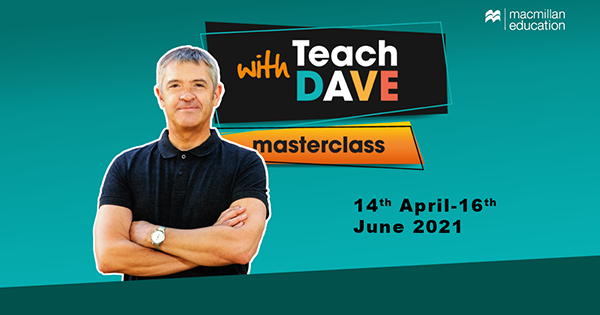
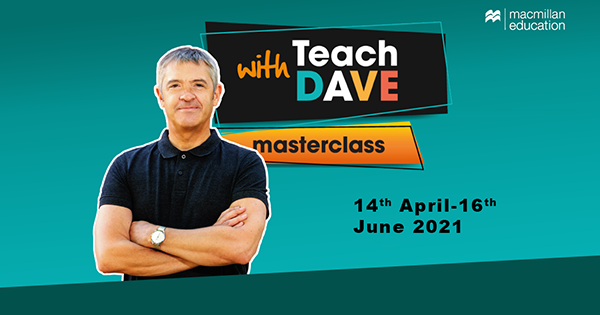
We are delighted to announce the exclusive teacher development programme
created by a world-leading teacher trainer and teacher of teenagers, Dave Spencer. The programme starts on 14th April 2021.
Take part in tailor-made sessions
and receive loads of great ideas and inspiration on how to teach teenage
students in a motivating, modern and effective way. Be in the chance to join an
exclusive event with Dave and the
experts from the Norwich Institute for
Language Education.
The participation in the Teach with Dave Masterclass is completely free, so don’t wait any longer! Download a pre-session task and register for all the sessions:
Keep calm and carry on teaching teenagers! The keys to managing and
motivating teens
Abstract
Teaching teenagers can be incredibly challenging on one hand, but immensely rewarding on the other. To get the most out of the experience, I’ll be sharing some of my ideas about how we can best manage and motivate secondary classes, considering key issues such as mixed abilities, discipline, online learning and effective lesson planning, suggesting both general approaches and concrete classroom activities. We will also examine what teenagers themselves think makes a great teacher.
On closer examination – The keys to preparing teens for exam success
Abstract
Exams and tests are part of
everyday life for secondary students, whether they be regular evaluation exams,
external exams to gain a qualification in English, or university entrance
exams. This session will investigate both the positive and negative impact that
exams can have on our students and then go on to explore ways to help them to
pass their exams with flying colours whilst remaining positive and motivated,
and avoiding exam ‘tunnel vision’.
Learning for life – The keys to preparing teens for life in and outside
the classroom
Abstract
In this session we will look at
how to prepare teenagers for life in the 21st Century. We will look at how and
why we should teach Life Skills, Thinking Skills, and Social and Emotional
Learning. The ultimate aim of teaching these various skills is to help
teenagers to cope with the pressures of life at school and university and also
to succeed and blossom in life beyond the classroom.
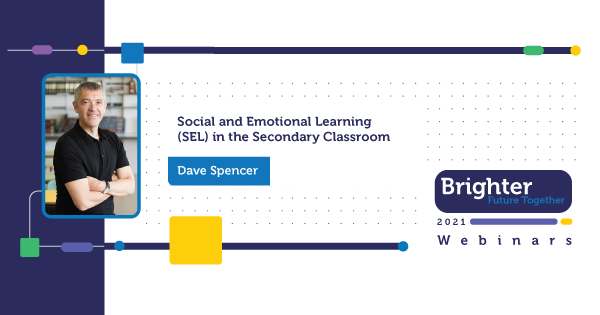
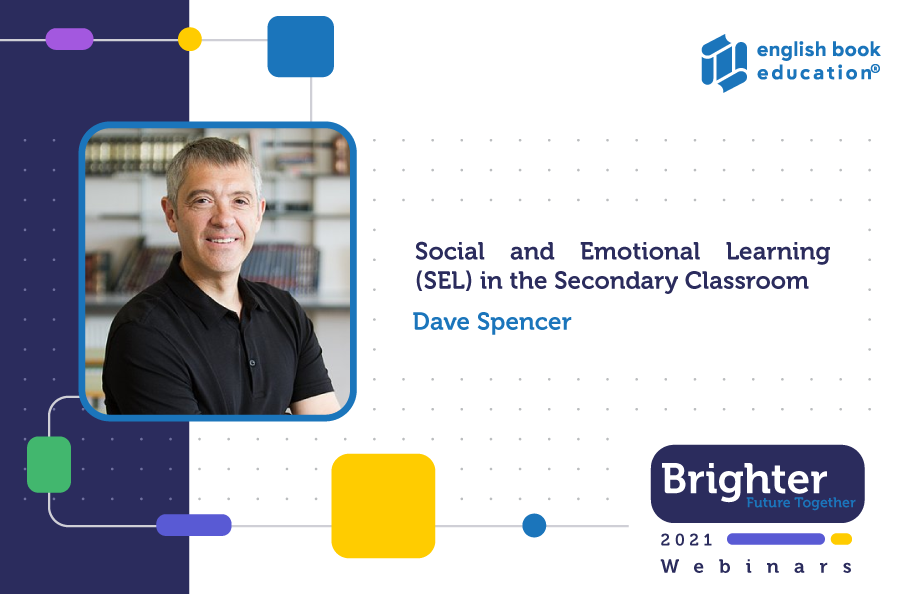
3 მარტს Macmillan Education მართავს ონლაინ სემინარს თემაზე ‘Social and Emotional Learning (SEL) in the Secondary Classroom’.
სემინარს გაუძღვება Gateway-ის კურსის ცნობილი ავტორი და ტრენერი, David Spencer.
თუ გსურთ დაეხმაროთ თქვენს მოსწავლეებს თვითშეფასების ამაღლებასა და სტრესის მართვაში, ასწავლოთ, თუ როგორც გახდნენ უფრო გონებაგახსნილი და კომუნიკაბელური, აღნიშნული სესია აუცილებლად დაგეხმარებათ.
ამავდრულად, ონლაინ სემინარზე წარმოდგენილი იქნება პრაქტიკული მაგალითები
Macmillan Education-ის ახალი კურსიდან “Gateway
to the World“, რომელიც საშუალო სკოლის მოსწავლეებისთვის არის განკუთვნილი.
აირჩიეთ თქვენთვის სასურველი დრო და გაიარეთ რეგისტრაცია.
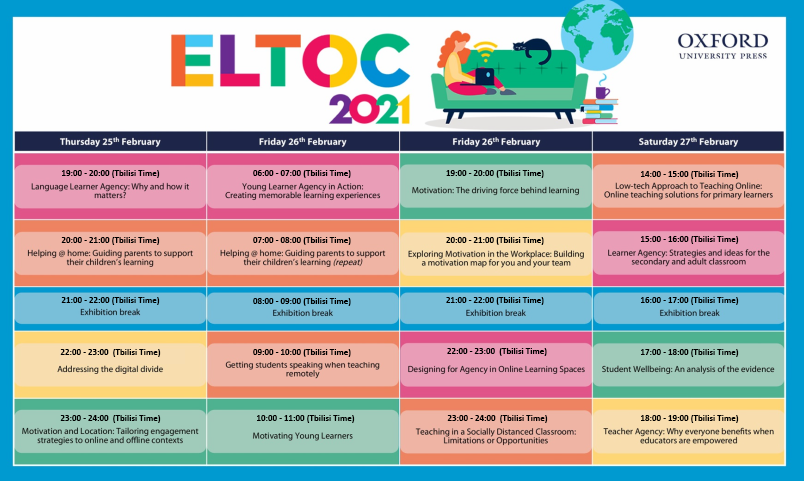
This talk presents Language Learner Agency as a key focus for language teachers when preparing learners for the challenges and opportunities beyond the classroom when teaching. It outlines what Learner Agency is, what it is not and how it operates. It also considers the challenges that language teachers may have in promoting learner agency before it concludes with some possible solutions.
25th February – 20:00 – 21:00 Tbilisi time
Vanessa Reilly – Helping @ home: Guiding parents to support their children’s learning
In this session we will look at how we can support parents in the new role they now need to play in their child’s learning. We will consider techniques and tools that children can be trained to do in class time for use at home and provide practical suggestions for helping to get parents engaged and working alongside you for the benefit of their children.
The presentation will describe what a digital divide is before considering what we can do to overcome it and help bridge the gap, so that we do not simply return to ‘business as usual’. It will propose how we can use this rare opportunity to innovate and build on the all too difficult lessons learnt through 2020. Without doing so we cannot realistically move forward and truly prepare our students for the uncertain world we find ourselves in.
25th February – 23:00 – 24:00 Tbilisi time
Nick Thorner – Motivation and Location: Tailoring engagement strategies to online and offline contexts
Keeping students engaged has been a particular concern for those of us teaching online, but it is a challenge under any circumstances. During this discussion we will outline 3 key drivers of motivation and explore how each can be affected by online and classroom environments. Participants will gain a series of practical strategies to help teachers improve levels of engagement.
26th February – 06:00 – 07:00 Tbilisi time
Kathy Kampa – Young Learner Agency in Action: Creating memorable learning experiences
What does Learner Agency look like in your young learner classroom? How do you give students opportunities to make choices, express their ideas, and learn with greater independence? What strategies can you use to assess learning in a way that empowers young learners? Join OUP author and young learner teacher Kathleen Kampa in a lively session that includes practical hands-on strategies you can use immediately in the physical classroom and online.
Teachers know that motivated students are better learners. We can see when our students are engaged in learning, but we don’t always know why something works or how to recreate it intentionally. In this presentation we’ll look at different types of motivation to better understand the why and then look at examples from teachers’ classrooms around the world to understand how to create more engaging learning experiences for our young learners. We’ll focus on practical strategies and activities that work equally well in face-to-face or online classrooms and discuss how to use the same engaging activities for assessment.
26th February – 19:00 – 20:00 Tbilisi time
Charlotte Murphy – Motivation: The driving force behind learning
By helping to engage those students who are losing their motivation to learn, we are also supporting teachers who are losing their motivation to teach. So, please join me in recognising the importance of motivation, and its driving force behind learning.
26th February – 22:00 – 23:00 Tbilisi time
Paul Driver – Designing for Agency in Online Learning Spaces
In this session we will explore the fundamental role of agency in online learning and teaching. Drawing on both theory and practical examples, I will describe how pedagogy, assessment for learning, design and technology can become drivers and facilitators of teacher and learner agency. We will weigh the advantages and drawbacks of real-time versus asynchronous activities, discuss digital tools, and consider the changing role of the teacher. I will conclude with some tips and suggestions for designing opportunities for agency in your online teaching practice.
27th February – 14:00 – 15:00 Tbilisi time
Joon Lee – Low-tech Approach to Teaching Online: Online teaching solutions for primary learners
In our session, we will explore how successful online teaching can be achieved through low-tech solutions. We will examine simple and practical methods for teachers to keep the focus, attention, and participation levels high with their primary learners, while reaching the academic goals.
Project Based Learning: From first steps to project purism
Many language teachers are attracted to project work in theory, but feel they don’t have the time or resources to make projects work in practice. This webinar will showcase different types of projects, helping teachers decide which type best fits their classroom, and address practical considerations such as availability of resources and time constraints.
Intercultural Competence and Citizenship: How 2020 has taught us it is more important than ever
In this webinar, we will explore how English language educators can improve their students’ intercultural competence and citizenship. The English language classroom is the ideal place to teach these essential global skills, preparing students to become successful 21st century citizens.
This webinar will equip managers with knowledge and strategies to help their teams increase their resilience to change. The techniques will also help people to feel more supported whilst working remotely, which is critical in our current environment.
Assessing online: Adapting our assessment practices to the new normal
In this session, we’ll look at some of the key challenges of online assessment. We’ll consider how technology and alternative approaches to assessment can provide practical solutions to some of these challenges while also enriching our teaching and offering deeper insights into our students’ learning.
Managing mixed abilities and utilising Assessment For Learning in the primary classroom
Whether returning to the classroom, continuing to learn online, or a combination of the two, our students will now be more mixed in their abilities than usual. In this webinar, we will be looking at ways of re-engaging our students as efficiently and effectively as possible, ways of involving parents in their children’s learning, and using assessment for learning to meet the specific needs of the primary learner.
How can school leaders effectively manage and support teachers remotely? In this webinar, we will discuss several ways that managers can lead their teams remotely, whilst keeping effectiveness and quality standards high. We will explore some of the key challenges of this period and look at some practical suggestions to overcome these.
In this session we will start by defining what inquiry-based learning is and discussing its benefits. We will then move on to look at the difficulties teachers face in implementing this approach. Finally, the main part of the session will focus on overcoming these difficulties and giving practical advice for its implementation in the language classroom.
Teaching Advanced Level Learners in the ELT Classroom
How do we keep advanced level learners challenged and inspired? What support is there for teachers who feel pressure in creating level-appropriate lessons? This session will highlight some issues that might arise, both for the students and teachers, and will explore an array of solutions to combat them. You will gain practical tips and advice to help you develop your own approaches.
Flipped Teaching with Primary Students: It’s not just about more homework
Many teachers will soon be teaching blend of offline and online lessons. This practical session will look at some of the approaches we can use for blended teaching, consider which activities are suitable for primary students to complete independently, and discuss how to link independent learning to our face-to-face classes.
Picking Up the Pieces: assessment for learning and managing mixed abilities in the ‘new normal’ classroom
This webinar will look at assessment-for-learning techniques such as observation, discussion, and self-assessment. Teachers can use these techniques to assess students’ holistic needs and develop their strengths using exploratory, collaborative, and open-ended learning processes. We will also explore ways we can use assessment to support learners with different needs while also maintaining group cohesion and harmony.
The purpose of this session is to introduce language teachers to key concepts in language assessment literacy (LAL) and practical approaches to dealing with the demands of language assessment in the language classroom. In the session, we will discuss important concepts such as test purpose, validity and reliability, washback and test fairness.
Language Teacher Wellbeing: What Educational Leaders Can Do
This webinar explores how educational leaders can enhance language teachers’ wellbeing. We will examine the characteristics of positive institutions and propose proactive measures to help teachers expand their autonomy, work with others, and respond positively to reforms and innovations, especially during the difficult times we are living in.