Category Archives: Teacher Resources

Winners – Easter Competition 2024

სააღდგომო გათამაშების გამარჯვებულები 2024

This gallery is dedicated to winner schools that participated in Easter Competition 2024!

We would like to, once again, congratulate and thank our participants for their efforts, hard-work and team building.

Teachers – we thank you for being part of this competition – we are proud of you for being educational treasure seekers.
Please see album of your school, down below:


Halloween 2023

ჰელოუინის გათამაშება 2023

This gallery is dedicated to winner schools that participated in Halloween Competition 2023!

We would like to, once again, congratulate and thank our participants for their efforts, hard-work and team building.

Teachers – we thank you for being part of this competition – we are proud of you for being educational treasure seekers.
Please see album of your school, down below:


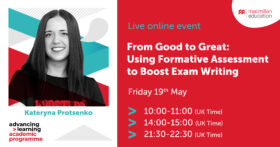
Using Formative Assessment to Boost Exam Writing

Looking for ways to help your students take their exam writing to the next level? One of the best ways to boost writing scores is with the power of formative assessment. In this webinar we’ll explore the principles and best practices for formative assessment of writing, techniques for providing feedback, and ways of using assessment results to drive instruction.

The event will take place live 3 times on Friday 19th May.

Register for the time that best suits your busy schedule!

13:00 – 14:00 session

17:00 – 18:00 session 

01:30 – 02:30 session

About our speaker

Kateryna Protsenko is Head of Tutoring at Promova, a one-stop solution for all language learning needs. Having been in English language teaching for over 15 years, Kate has worked as a Cambridge CELTA / Delta trainer, materials writer, manager for several language learning organizations, and has co-authored an exam preparation coursebook. She is passionate about learning and teaching, loves a good challenge, and is constantly looking for ways to expand her horizons and pick up new ideas from various industries.

Winners – Easter Competition 2023

სააღდგომო გათამაშება 2023

This gallery is dedicated to winner schools that participated in Easter Competition 2023!

We would like to, once again, congratulate and thank our participants for their efforts, hard-work and team building.

Teachers – we thank you for being part of this competition – we are proud of you for being educational treasure seekers.
Please see album of your school, down below:


დარეგისტრირდი და შემოგვიერთდი

დარეგისტრირდი და შემოგვიერთდი

When They Say They Can’t, You Say Yes

Your heart breaks. Yet again, your student is giving you a myriad of reasons why they ‘just can’t do this’. Your thoughts race trying to find the perfect phrase to motivate and build your student’s esteem but nothing works. Multiple studies have shown that positive affirmations can backfire when a person does not believe the affirmation they are repeating; it can actually make the negative self-talk worse. For a positive affirmation to work, we must internally know that we are actually capable of what we may be worried about. In the case of your students’ negative self-talk, they can’t imagine that they can do it.

What do you do when a student is speaking negatively about themselves?

Believe it or not the worst phrase you can use when a student is in the midst of self-doubt is a positive one like, ‘No, you’re not dumb, of course you’re smart.’ Instead always meet them where they’re at, be with them and try to understand what they are feeling. For most of us, the worst thing that somebody can say when we’re feeling angry or upset is that we’re wrong, because that just adds to the negative feelings. It adds to the negative feelings because, in that moment when someone denies what we are feeling by trying to be positive, we feel alone and misunderstood.

What can you do to help your student? How do you address negative self-talk?

Get used to answering with ‘yes and …’ This helps the student who is stuck to see that what they are thinking may be correct and there are other ways to see it as well. For example, if they say they do not want to try anymore because ‘they can’t learn English’, you can respond with ‘Yes, and right now it is really hard and you feel disappointed that you keep getting the answer wrong. I am here to help you practise and feel the hard feelings. With practise, your English will get better.’

Give them time and space to calm down when they are in the midst of a big feeling. Try to stay calm and breathe for them. Try not to speak or give direction when you see that their body and thinking brain is overwhelmed with the emotion they are experiencing. Slow down. Give space. Be present to their pain. Repeat. Your loving response will help them understand that all emotions can be managed no matter how big they get.

Sometimes negative self-talk is general and not specific to a task in the classroom. In those cases, always remember you can’t ask them ‘what happened?’ or ‘why do you feel this way?’ They may not know when they are overwhelmed by big emotions and negative self-beliefs. You are the one that helps your student process and figure it out because their body and mind are overstimulated and that is why the negative thoughts creep in. After a difficult incident of negative self-talk with a student, ask yourself these questions and they will help you guide and help your student moving forward.

  • How was their body – Tired? Hungry? Thirsty? Did they move/exercise today?
  • What happened right before the incident?
  • What happened a day before the incident?
  • What is happening in the future that may be changing and they may be anticipating?

Asking yourselves these questions will help you figure out what or why they are feeling so defeated.

Negative self-talk is difficult to manage. This is especially true when you can see the potential of your student. It can feel overwhelming for you as the teacher since a student who self-deprecates is not ready to learn. By definition, this student is keeping you from doing your work. However, if you slow down and take the time to speak to your student and remain curious about why they may be feeling bad, you will build both your relationship with your student and their well-being.

Exploring culture through children’s eyes

What do young children enjoy doing? Playing, singing and listening to stories! Integrating culture into classroom activities with young learners is not only about teaching content: what music people dance to or what food people eat in other cultures. It is mainly about planting the seed of curiosity, cultivating interest and positive attitudes by engaging in cultural activities, and celebrating children’s own culture as well as others’. In this sense, the teaching of cultural awareness involves helping children to develop an open mind that will stay with them throughout their lives. This article focuses on traditional children’s culture, namely songs, stories and games, as a starting point for fostering cultural sensitivity from a young age.

One of the best ways of bringing other cultures closer to young children is through natural and meaningful activities they enjoy engaging with in their daily lives. People in every culture in the world have their childhood songs, rhymes, stories and games, and so a good starting point is to integrate elements from traditional children’s culture that may be familiar in their own context. Although songs, stories and games vary across cultures, they are all designed to achieve similar aims and convey similar types of messages.

We want to help children become aware that other cultures exist, and in what ways these cultures are similar or different to their own. So that children do not become culture-blind, and to discourage any possible feelings that a difference in culture is wrong, we can use classroom activities to help children to recognize that although people are different, diversity is not bad: it’s just different. We can also help children to recognize not only the differences, but also the similarities, in cultures around the world, particularly those connected to childhood. 

Teachers can provide many opportunities for children to interact with other cultures within the walls of their classrooms. The more exposure to other cultures they have, the more children will acknowledge these similarities and differences; this will help them to become open-minded and accepting of others and challenge the idea that we all look the same, eat the same food, dress in the same way and speak the same language all over the world.

Songs and rhymes

Many traditional songs and nursery rhymes have been adapted to be sung in different languages as a form of entertainment or for learning important lessons. Teach songs and rhymes that you think children will recognize, having heard them in a different language at home or school: songs like ‘Three Elephants Went Out One Day’, ‘Incy Wincy Spider’, ‘Twinkle Twinkle Little Star’, or ‘Head, Shoulders, Knees and Toes’. Ask your learners which songs their families sing with them at home or which they have heard at school, and allow them to share their versions. If children can relate to a song because they know the tune of it already, they can quickly pick up the new lyrics in a different language with its own sounds, rhythm and stress patterns.

Learning traditional songs and rhymes will also help learners as they grow older, because it will help them to understand references to the songs and rhymes in popular culture. Developing children’s cultural literacy in this way will therefore help them to comprehend written and audio-visual texts in the future.

Stories

The same thing happens with stories, with many stories being similar in a variety of languages, sometimes with slight variations which can be interesting to explore and compare. Little Red Riding HoodGoldilocks and the Three Bears or Hansel and Gretel are stories that children may know in another language already.

Tell stories that originated in other cultures and languages, like Anansi stories, The Blind Men and the Elephant, or How the Tiger Got its Stripes (and other African tales). Give your learners the opportunity to tell short folktales from their own culture, in English, or even make up their own ‘How the… got its…’ story. Providing opportunities to hear, read or tell these kinds of stories brings children closer to other perspectives and helps them to understand important issues that might be similar or different to those that are tackled in their own culture.

An example from my context is the picture book Handa’s Surprise, by Eileen Browne, which is a powerful story with great insights into a culture different to our own. It has beautiful illustrations, vibrant characters and a storyline which provides a stimulus for discussion about how some aspects of our lives in Argentina differ from Handa’s in Kenya. Where does Handa live? How do you know? How does it look different to where we live? What is she wearing? Why is Handa carrying a basket on her head? Have you seen these animals in our country? Which fruit have you tried? If a boy or girl from our country was the main character, what would she/he look like, what would he/she be doing and what other characters would appear in the story? Compare illustrations in the picture book to real photographs. Blindfold volunteers and have them taste the different fruit in the story. Talk about which songs, stories and games Handa probably sings, reads and plays in her country. Learn about Handa’s country and culture. Then, invite a child to become Handa, sitting in the ‘hot seat’ while the rest of the class ask ‘Handa’ questions: Where do you live? What is your house like? What animals are there in your country? What do you like to eat? How do you greet? What languages do you speak? Exercises like this allow children to experience something new with an open-mind, and start to become aware of the different elements that compose culture.

Put these storybooks on display in the classroom so that cultural variety is visible in the environment and children get used to seeing cultural elements that are different to their own.

Games

Something children from all around the world have in common is that they love playing games: traditional games, playground games, skipping games, choosing games and board games are just perfect for children to engage first-hand with culture. Teach your class to play games that children play in other countries, and encourage them to reflect on similar ones they play in their own context: tag; hopscotch; jump rope; hide and seek; duck, duck, goose; rock, paper, scissors; What’s the time Mr. Wolf?

A sense of belonging and inclusion in the world begins in childhood, and teachers can make the most of their young learners’ inherent curiosity about the world around them. Children are usually interested in learning about other children their own age. Although songs, stories and games may vary across cultures, through them children can learn to see how cultures — and children just like them in other places around the world — are not really that different in the end. Celebrate the benefits of diversity, respecting multiple ways of living, and honour differences as well as similarities to promote cultural sensitivity, respect and tolerance. Children need, and want, to feel that they belong. Give them this gift by allowing them to embrace culture through their own eyes, as well as seeing the world through the eyes of others. 

How teachers can model leaderships skills for their students

In this fourth article in our Career Skills series, teacher trainer, lifecoach and ELT author Rachael Roberts explores the leadership skills that teachers have. She also looks at how teachers can become leadership role models for their students.

You may also like to read the following articles by Rachael: 

Leadership skills are in demand

Leadership skills are not just for ‘the boss’. Workplaces are becoming less and less hierarchical, and as people are more likely to work in small teams, a greater number of employees need to possess leadership skills. 

As teachers, we can play a key role in helping students to develop these skills. I would argue that we can demonstrate this to them by showing how such skills are useful in working with others in the workplace and elsewhere through our own behavior.

However, when I asked teachers attending my recent webinar on teaching leadership skills to ELT students if they saw themselves as a leader. Quite a few said ‘no’. 

Teachers do indeed have a variety of roles. These include resource, facilitator, listener, provider of feedback, assessor, organizer – to name just a few. Many of these roles are absolutely not about standing at the front and ‘leading’ the students off down a pre-determined path. It is likely that those teachers who felt they weren’t leaders preferred to see themselves as facilitating, rather than leading.

That said, there are many different ways to be a good leader. And they don’t all involve being extrovert, charismatic and firmly in charge. It’s just as important to be empathic, creative, flexible, supportive, patient, a good listener, tactful and even humble. All qualities of a great teacher. 

Showing our students how to be leaders

As teachers, we have the opportunity to provide good role models for our students and show them how to lead others in different ways. 

We can demonstrate a willingness to listen carefully to others. At the same time, we can show a willingness to recognize that not everyone sees the world in the same way. These are both cornerstones of developing empathy.

As leaders and teachers, we can encourage creativity and flexible thinking. For example, asking them to come up with as many solutions as possible, rather than just one answer. By being willing to change our own plans when a better alternative presents itself, we can demonstrate this to students. 

We can also model trustworthiness and integrity by keeping our promises. In turn, by showing our trust in them and gradually handing over more responsibility and opportunities to take initiative, we can encourage this in our students. 

And, finally, through being willing to admit and face up to our own mistakes, we can our students the value of self-awareness and humility. We can show that being able to learn from our mistakes is a sign of strength, not weakness.

Think back to the teachers you remember from your own school days. Which ones had the most positive effect on you, and why? In what ways did they model and encourage you to develop leadership skills? 

Source: Pearson Education

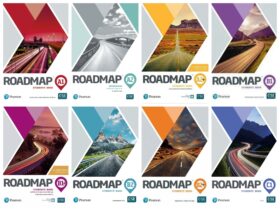
ROADMAP

Roadmap is a new, eight-level general English course for adults that recognizes every class is different, every learner is unique.

Roadmap’s rich content and flexible organization allows teachers to personalize their lessons to give learners the specific language training they need to progress. 

Discover Roadmap

  • enable learners to make fast, measurable progress
  • personalize teaching using different routes through the course
  • develop reading, writing and listening skills with extensive practice and strategies
  • deliver successful lessons with materials that are easy to use and fun to teach
  • get students practicing out of class with the mobile app

Learning English is a journey and the final destination is the ability to speak confidently and fluently. Roadmap provides the direction you need to get your learners where they want to go

Digital tools to support students and teachers

For students

  • The mobile app gives students an opportunity to practice anytime, anywhere, with extra grammar and vocabulary exercises to consolidate language points.
  • MyEnglishLab provides online practice for students, class management for teachers and a gradebook to review performance. 

For teachers

  • The presentation tool gives teachers a fully interactive version of the Students’ Book and Workbook with integrated audio and video to use at the front of class.
  • The resources teachers can access online include full teaching notes, photocopiables, audio and video and an assessment package. 

Student’s Book

  • Ten units with three main input lessons link to three Develop your listening, reading and writing skills lessons
  • An English in Action lesson in each unit covers key functional language with video clips and worksheets
  • In each main lesson the Grammar, Vocabulary and Pronunciation lead up to a speaking task based on GSE learning objectives
  • Audio, video, scripts, word lists available online

Workbook

  • Additional grammar, vocabulary and functional language practice activities
  • Additional reading, writing and listening practice activities
  • An answer key at the back of the book allows learners to check their answers

Teachers Components:

  • Teacher’s Book
  • Test Generator
  • Presentation Tool
  • Teacher’s Digital Resources

——————————————————————————————————————–

Buy this book at English Book Education Bookshop:

Address:

Tbilisi 14 Chavchvavadze Avenue; 92 Vepkhistkaosani Street, 3 m/r Didi Dighomi, Tbilisi, Georgia

Batumi: Brothers Zubalashvili and Baratashvili Street

Pearson Educational Forum 2021

We are delighted to invite you to the Pearson Educational Forum – live online training – webinars on the 20th-21st of April.

Pearson webinars are free trainings dedicated to teachers and educators that allow you to receive a certificate of participation without leaving your home. Participation in the webinar require registration on a dedicated platform or joining a thematic group.

Session 1: Presence at a distance – building a sense of community in online education – with Alastair Creelman

Date: 20th of April

Time: 13:00 – 14:00 (Tbilisi Time)

Abstract

As the covid-19 crisis continues there is increasing focus on how to develop online teaching from simple content delivery to collaborative learning and co-creation. How can we foster a sense of community in our classes and facilitate greater socialization between students? In this session Alastair Creelman from Linnaeus University in Sweden will discuss some of the lessons learned from the last year of online education and give examples of tools and methods that can help to reduce the feeling of distance and isolation that many students feel today.

Register for this session: 

https://pearson.zoom.us/webinar/register/WN_vmGdtINjRkeO9h1hQIz47w 

Session 2:  Control Shift – how to help your adult students meet their potential – with Magdalena Kania

Date: 20th of April

Time: 14:10 – 15:10 (Tbilisi Time)

Abstract

What is the role of a teacher in a modern online class? Is the teacher still a sage on the stage or rather a guide on the side? Are students capable of growing linguistically without being spoon-fed by teachers?

In this session I will focus on the role reversal that can or even should take place in our virtual classrooms, especially when working with adult learners. I will present some digital tools and resources that can help you adapt this ‘control shift’ to your teaching and give some tips on how best to run online lessons to help our students meet their potential.

Register for this session:

https://pearson.zoom.us/webinar/register/WN_l5WjGMYZTAW7Eb38z0o0kw

Session 3: Small Steps, Big Results – how to maximise your online lessons with older teens – with Magdalena Kania

Date: 21st of April

Time: 16:25– 17:25 (Tbilisi Time)

Abstract

To achieve our goals, we must establish firm habits and stick to them. Difficult as it may seem, all you need to do is to divide the goal into manageable steps. Keeping in mind that small, consistent steps add up to big results, we can adapt this approach to our teaching and shape our lessons in such a way that each and every minute spent online counts.

In my session I will show you how using an interactive e-book and some other digital tools can help you maximize your students’ learning without overburdening them. I will also share some practical tips and ideas from my own online teaching experience.

Register for this session:

https://pearson.zoom.us/webinar/register/WN_sIAiKKiaTwSLlOOS7wmc6g

All participants will receive a certificate of attendance and a digital goody bag of quality materials.

Thank you for cooperation!

English Book Education

C1-C2 Preparation Course for the International Certificate (PTE General)

C1-C2 Preparation Course for the International Certificate (PTE General)

English Book Education is organising a C1-C2 Preparation Course for the International Certificate (PTE General).

Date April – June 2021
Course starts In the week of 12th April 2021
Test dates Oral test: 5-19 June Written test: 19 June
Teaching mode Online  
Course days Monday & Wednesday Tuesday & ThursdayWednesday & Friday Thursday & Saturday Saturday & Sunday
Hours 40
Lessons 2 per week (2-hour lessons)

The course is designed to prepare students for the International Certificate (PTE General Test) on C1-C2 level. It includes 20 lessons focused on developing language skills, practising grammar and vocabulary and improving test-taking strategies.

The course is based on PTE General Skills Booster, which is included in the course fee. Beside of general English lessons, the students work on Practice Tests. After completing the course, the participants can take an official test, both Spoken and Written and get a certificate which is accepted around the world by universities, ministries of education and employers as proof of English language proficiency.

The course will be conducted by Nata Gugushvili, an experienced English language teacher and ELT trainer.

Course + textbook fee: 700 GEL (The fee will be divided into 2 installments)

Note: 20 % discount for Teachers’ Union members.

Test fee (optional): 350 GEL

Please follow the link to register:

https://form.123formbuilder.com/5850631/form

For more details, download the Course Brochure.

Registration Deadline: 10th of April