Tag Archives: Teaching English

Using Digital Tools To Help Teach Refugees

ferramentas-de-marketing-digital-ideias-que-vendem

Nick Bilbrough, the founder of the Hands Up Project, which has just recently been granted charity status, has been teaching English through Skype to children in refugee camps for the past two years. It all started with a group of children in a library in Gaza, but has by now expanded to include camps in other parts of Palestine and even into Jordan.

“One of the things we’re concerned with is developing global citizens”, says Nick. “It’s not just about learning a language; it’s about enabling people to communicate with other children in other countries and, by that, the idea of becoming a global citizen.”

Most of his course relies on storytelling. As the students’ access to English resources is limited, they haven’t had many opportunities to talk with people outside their own country. Thus, as Nick explains, storytelling is “one of the most effective ways … of exposing learners to natural spoken language.” This is especially true for low-level learners, as they can still get involved in the process despite their lack of language skills.

Teaching via Skype has been a fairly unique experience for Nick. “It’s very different working in an online environment because you feel that there is a distance between you and the student. You almost want to jump out of the screen”, he jokes. Power cuts and other interruptions are common in the Gaza strip, but he’s used to it by now. He also thinks that there are advantages to this approach, as there are a lot of opportunities for creative teaching, like using puppets or zooming on twigs so that they “showcase trees” when he’s telling some particular story.

Though “the students in refugee camps often don’t have the opportunity to use English naturally to communicate with people who don’t speak their own language, the Hands Up Project is an extraordinary way of connecting people who would otherwise never be exposed to each other”, concludes Nick.

“Exploiting Digital Tools to Teach Languages to Refugees”, Nick Bilbrough. Cambridge University Press, 5 April, 2017, P4

Tiger Time – English time is Tiger Time!

TT_banner


Welcome to Tiger Time!

Tiger Time is a vibrant, six-level primary course based around different settings and characters which grow and change with the students, reflecting their evolving interests and needs.

Units contain humorous stories told through different genres, which use everyday language as well as catchy songs, chants and raps at the lower levels. Within each unit lessons are carefully structured focusing first on vocabulary, grammar and skills, and building to CLIL, culture and projects, allowing children to practise and consolidate their learning throughout the unit. Each unit ends with a review, encouraging active communication.

Written with classroom management in mind, activities are practical and well-staged. The accompanying Presentation Kit and Teacher’s Resource Centre help teachers create dynamic lessons, which cater to diverse classroom situations. The Student’s Resource Centre provides a home-school connection offering extra activities and support.

Components for students:

  • Student’s Book
  • Activity Book
  • Student’s Resource Centre
  • Student’s eBook

Components for teachers:

  • Teacher’s Book
  • Flashcards
  • Teacher’s Resource Centre
  • Presentation Kit
  • Class Audio CDs
  • Student’s eBook

Authors

Carol Read and Mark Ormerod

Source : www.macmillanenglish.com

Grammar Goals – Go for Gold!

SBCOVERSrgb72DPI_2

Welcome to Grammar Goals

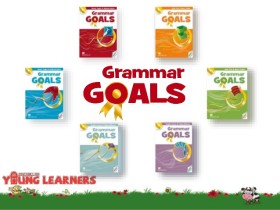
Grammar Goals is a new six-level grammar series for children aged 6-12 years. It presents and practises grammar in lively and meaningful age-appropriate contexts that reflect pupils’ real lives and interests. Linked to the Cambridge and Trinity external exam syllabuses, Grammar Goals offers regular exam-style practice tasks in the Pupil’s Books.

The visually appealing nature of the course ensures that grammar is presented in a child-friendly format that keeps pupils actively involved in learning the language form, function and meaning. The careful staging of the units provides three levels of challenge and success – bronze, silver and gold – helping students reflect on their progress and aim for higher goals.

Key features:

  • Clearly contextualised language makes grammar pratice meaningful.
  • Interactive grammar boxes break down form and clarify use.
  • Carefully graded activities build confidence and accuracy.
  • Cross-curricular topics link grammar to everyday life and teach pupils about the world around them.
  • Activities develop young learner competences, such as thinking and interpersonal skills.  –
  • A separate writing syllabus teaches key skills and strategies.
  • Exam-style activities practise task types from the Cambridge English: Young Learners English tests.
  • Step-by-step lesson notes with extra, mixed-ability and extension activities provide extra teacher support.

GRAMMAR GOALS

Authors:

Nicole Taylor and Michael Watts and Julie Tice and Dave Tucker and Angela Llanasand Libby Williams

Source :  www.macmillanyounglearners.com

Dramatic Results

breaking-bad-sti-news


Dramatic results

Roleplaying activities in classes can benefit students in many ways. This fact is well known among experts. In such activities, students can practice new words while using English more naturally than in grammar exercises. However, it’s usually hard to organise big roleplaying activities, like entire drama projects (mostly because of not having enough time or money), which is unfortunate, because these projects can be very good for children. They get a chance to meet new friends and improve their self-esteem.

Of course, the lack of time can really be a problem, but drama projects don’t have to be very complicated. All it takes is children that are willing to participate. Even if they’re shy, they can still work off-stage as script writers; as long as they’re working in English, they’ll benefit from the activity.

Picking the drama to stage can be tricky. You can find a huge number of scripts, especially those adapted for English learners, but it’s also possible to have the students write their own play. This is incredibly important and beneficial for their English education, since they’ll be able to express their ideas using vocabulary that they find themselves.

Everyone can get involved. Even those that are still beginners can have roles that require more movement and less speaking. The only requirement is for everyone to feel like they’re participating and having fun.

It’s also important to make the children discuss the project throughout the process. Ask them questions about their characters and the situations they find themselves in during the play. This gives the children an opportunity to become familiar with the vocabulary of their characters.

However, don’t forget that drama projects don’t just involve English. The children have to act instead of just memorizing lines, they have to be comfortable with moving on the stage, and, most importantly, they have to be confident on the stage.

Drama project preparation also gives teachers a chance to “sneak in” some pronunciation practice. Since the atmosphere is more relaxed during rehearsals, students won’t be too embarrassed to practice some parts of pronunciation that they find difficult.

Naturally, many students have trouble memorizing lines, especially in English. A good idea is to not make the students remember their whole text in one rehearsal; instead, rehearse only scene by scene.

Using drama projects in English class can give you the chance to improve students’ pronunciation, vocabulary and even intonation without boring them. Though staging a play isn’t easy, it’s worth it.

Source : Hill, Trev. “Dramatic Results.” English Teaching Professional, March 2016, 30-32.

Welcome to Gateway 2nd Edition

gateway-2nd-edition-1-638


About

Learning for life

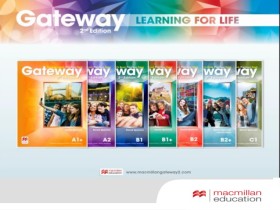
If you don’t know Gateway already, this secondary course by teacher and author David Spencer is designed to lead teenage students to success in both international and school leaving exams. Each unit offers plenty of exam style activities and preparation tasks as well as Exam success tips.  The course is designed to prepare students for further study and future employment.

Gateway 2nd Edition retains many of the features that made Gateway so popular.
The approach to grammar and vocabulary and the development of the four skills is carefully staged and are both teacher- and student-friendly.

Gateway 2nd Edition also has several exciting new features!

The Flipped classroom videos bring grammar points from the Student’s Book to life and help teachers find more time in lessons and add variety to their teaching. The videos are short grammar presentations that are linked to one of each unit’s Grammar guides. Students can watch the presentation at home and complete tasks in the Online Workbook or printable worksheets on the Resource Centre. The videos are a flexible teaching tool and can also be used for revision, when students miss a class, or with the whole class in lesson-time, for variety.

At the heart of each unit there’s a special Life skills section preparing teenagers for varied aspects of life.  Each Life skills area has its own tailor-made video featuring British teenagers, demonstrating the topic and ends with students performing a Life Task; an activity that has direct relevance to the students’ lives outside the classroom.

Gateway 2nd Edition provides material which helps to develop other areas of knowledge, as well as English language skills. It offers brand-new, up-to-date texts to motivate teachers and their students. Reading texts include Critical thinking questions to get students reflecting on what they’ve just read and personalise the topic of the text.


Find out more

Source : www.macmillangateway2.com

Integrated skills – Vocabulary : Phrasal verbs

-OSE-Skills-376x23_376

Phrasal verbs: Teaching phrasal verbs using equivalents/ definitions – tips and activities

Tips and activities for teaching phrasal verbs to intermediate students and above.
Introduction | Stage one | Stage two | Stage three | Stage four | Stage five

Anchor Point:introIntroduction

Many phrasal verbs can be said or written another way. This can be a Latinate one-word equivalent (to put out a fire is to extinguish a fire) or by a series of words (to get on well with someone is to have a good relationship with someone). Whether it is one or several words, many learners of English tend to favour the non-phrasal verb equivalent. This often makes them sound formal:

“Can I remove my shoes?” and sometimes inappropriate “Just a minute, let me extinguish my cigarette”.

It is important to point out to learners that phrasal verbs are often a more informal way of saying something, and as such they are more common in spoken English than in written English. When teaching phrasal verbs according to their equivalents, it is not enough just to have a simple matching exercise. There must be some opportunity to use the language.

In the lesson at the bottom of the page the phrasal verbs and their equivalents are all personalized with a Find Someone Who activity.

Aim: To present and practise 12 phrasal verbs

Level: Intermediate and above


Anchor Point:1Stage one

Distribute the worksheets and explain the Find Someone Who activity. The learners must go around the class asking each other questions to find a person who fits one of the sentences. When they find that person, they write their name in the space. Write the first two sentences on the board and elicit the question for each (Do you recover from illnesses very quickly? Do you often begin arguments with strangers?) Tell them that they cannot have the same name written down more than two times during this exercise. Instruct everyone to stand up and begin the activity.


Anchor Point:2Stage two

After five to seven minutes, stop the activity and ask learners to sit down. Do some feedback on the activity, asking what learners found out about each other. Tell them that today they are going to learn some phrasal verbs related to the Find Someone Who activity they have just completed.


Anchor Point:3Stage three

Distribute the second worksheet. Ask learners to match the phrasal verb to its equivalent. To help them, each phrasal verb is listed with some common collocations (words that go with other words). Tell learners that they can look at their original Find Someone Who worksheet for more help.

Answers: a) 8 b) 1 c) 2 d) 7 e) 9 f) 12 g) 10 h) 3 i) 4 j) 11 k) 6 l) 5


Anchor Point:4Stage four

Write on the board the following phrasal verbs: bump into, get over, launch into, get on well with, give back, put out, talk over, bring up, put off, take off, look into, take down. Tell learners to rewrite the completed sentences from the first worksheet (Find Someone Who) using the phrasal verbs on the board. Tell them that they must try to do this without referring back to the second worksheet.

Answers

____ gets over illnesses very quickly; ______ often launches into arguments with strangers;
 ____ borrows things but sometimes doesn’t give them back; _____ has looked into changing jobs/schools recently; _____ gets on well with his/her brothers and sisters; _____ was brought up in the countryside; ____ puts everything off until the last minute; ____ likes to talk things over before making a decision; _____ never takes down notes in class; _____ bumped into an old friend last week; ______ has put out a fire; _____ doesn’t take off their socks when they go to bed.

Stage five

Ask learners to write an original sentence about themselves using each of the phrasal verbs in their notebooks. Learners could do this for homework.

Source : www.onestopenglish.com

Catching up with the Trail blazers

132738-let-s-catch-up


Catching up with the Trail blazers

The Trailblazer Awards, run by the Society of Young Publishers in partnership with the London Book Fair, aim to highlight young publishing professionals in their twenties who have already done great things in the industry. The first ceremony was held in February this year, and the winners have been keeping busy since.

Ella Kahn and Bryony Woods (Diamond Kahn and Woods Literary Agency):

  Kahn and Woods won a joint award for their work at the Diamond Kahn and Woods Literary Agency, launched in 2012. According to Kahn, working at the agency has given her “the chance to work in close collaboration with authors, and to be involved with them in every step of the publishing process, rather than just one particular stage of it”. Since the awards, they’ve been signing new authors and brokering deals. Some of their children’s authors have already added to the agency’s success, with David Owen’s Panther shortlisted for the Sheffield Children’s Book Award. At the same time, however, they both agree that literary agents are finding life harder in recent years due to the rising popularity of self-publishing among authors. Yet, they remain optimistic. “There will always be demand for books and authors-and for agents who can negotiate the best deals in a fast-changing market and protect those authors’ rights and interests.”

Clio Cornish (Harlequin):

 For Cornish, an editor at Harlequin, being named as a 2016 Trailblazer “really was a genuine honour and career highlight.” Like Kahn and Woods, she hopes that publishing remains relevant. “Authors have an ever-increasing number of routes to market on offer–which means that, as publishers, we need to offer the best service possible.”


Nick Coveney (Kings Road Publishing & Blink Publishing of Bonnier Publishing Group):

  As the Head of Digital and Social Media at Kings Road Publishing and Blink Publishing, Coveney has a good understanding of the digital market. “We’re definitely going to see things change again in the ebook market soon,” he claims. Though mobile and cloud-based reading is growing at a slower rate in the UK than elsewhere, Coveney believes that there will be “a second of third-wave with ebook sales spiking, but when it’ll come and exactly what it will look like is hard to predict.”

George Burgess

 George Burgess, the Co-Founder of the Edtech Founders Exchange and Founder and CEO of the UK’s most popular exam preparation app company, Gojimo, was just 17 when he created his own A Level prep app. Now, only a few years later, one out of five A Level students uses Gojimo to revise. “It’s an honour to have been named a Trailblazer”, says Burgess. “I think it’s a testament to the innovative work we’re doing at Gojimo. Since winning the Trailblazer award we’ve been working hard to prep for the exam season. This included the development of our new product, Gojimo Tutor, which goes live this month, as well as improving our existing revision app. It is now being updated every three weeks and we’re already seeing a quarter of a million users revising with it each month, and that number will only continue to increase through June.”


Source : Kirkbride, Jasmin “Catching up with the Trailblazers’.” London Show Daily, April 2016, 27

Speakout

6a00d83452d45869e20147e14e7b73970b

Speakout – The real world in your classroom!

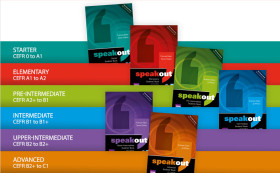
The award-winning course that invites you and your students to discover English as it is really spoken. Speakout builds up all the skills and knowledge students need to express themselves confidently in a real English-speaking environment.
Lessons cover all four skill areas as well as grammar and vocabulary. Each unit ends with a DVD lesson based around an extract from a BBC programme which provides a springboard for meaningful speaking and writing tasks.

Models of authentic English are also provided through ‘on the street’ interviews filmed by the BBC. MyEnglishLab is a flexible online tool that enriches learning, informs teaching and enhances your Speakout course ,Enriched Learning MyEnglishLab has a wide range of activities that are instantly graded and correlated to your Speakout course,Informed Teaching MyEnglishLab for Speakout gives teachers instant access to a range of invaluable diagnostic tools ,Flexible Solutions You can assign tasks to the whole class, groups of students, or individual students to help them reach their goals more effectively.

ActiveBook is the Students’ book in digital format with integrated audio and video from the course and includes: Easy navigation of the Students’ Book pages with zoom facility ,Video and audio available at the touch of a button Video Podcasts with accompanying worksheets,BBC programme clips that can be played in a DVD player or computer.

Authors : Frances Eales, JJ Wilson, Antonia Clare, Steve Oakes.

Read More http://product.pearsonelt.com/speakout1e/#speakout

Source : www.pearsonelt.com

Minimal Resources: Students’ Ideas

2710

Minimal resources: Students’ ideas

Run out of ideas yourself? Let your students come up with the ideas! Adrian Tennant provides tips and ideas for incorporating ideas from students in your lessons.

Some of the most productive lessons, and the most useful, can come from the learners. Here are some ideas of how you can incorporate ideas from your learners.

The student test

Most tests actually check what your students don’t know rather than what they do (unfortunately this is the very nature of most testing). However, it doesn’t need to be like this. Here is an idea to make the whole process far more useful.

  1. Divide your students into small groups (between 3 and 5 students is best).
  2. Ask the students to look back over what they have been learning (you might want to set a time limit).
  3. Then, ask the groups to write a test for the other students. The tests can then be exchanged and each group try another test. Once the tests have been done the original group can mark it.
  4. Finally, collect all the tests in and take a look at them – particularly at the questions, not just the answers.

Oops!

  1. Make a note of 8 sentences that contain mistakes that your students make – these can be from written work or from when they speak. You will need two pieces of paper (for larger classes you may need more).
  2. On one piece write down the eight sentences, but correct 4.
  3. On the other piece of paper write down the same eight sentences, but correct the four sentences that on the first piece of paper were left incorrect.
  4. Now divide your class into two groups and give each group one of the pieces of paper.
  5. Ask the students to work in their groups and decide which sentences are right and which are wrong.
  6. Tell the students to correct the sentences that are wrong. The students should make their own copies of the sentences.
  7. Next, put the students into pairs – so they are working with someone from the other group – and compare their answers.
  8. Finally, collate and discuss as a class.

A student dictogloss

  1. Find a suitable piece of writing from one of your students (sometimes it is fine to work with a piece that contains mistakes as these can become part of the focus of the activity. However, it is worth thinking about how the individual student may react to their mistakes being discussed by all the other students).
  2. Tell the students you are going to read out a short text.
  3. Ask the students to put their pens down and just listen.
  4. Read out the text once and then ask the students to note down all the words they can remember – this should be done focusing on key words and NOT trying to remember everything verbatim.
  5. Read out the text again and then ask the students to work in pairs and reconstruct the entire text. Then ask the pairs to compare their texts.
  6. Finally, compare their texts to the original and discuss.

An object feast

  1. 1st lesson: bring in a small object, or a photo. (For example, I would bring in a photo taken from a visit to the rainforest in South America. Another friend would take in a Boomerang they bought while on holiday in Australia). Tell the story behind the photo/object and then put the students into groups. Ask the students to write questions to ask you. Conduct a Q&A session.
  2. 2nd lesson: Ask the students to bring in an object or photo. If your class is large divide into small groups and get them to discuss their photos/objects. In small classes the whole activity can be done together.

Word limits

  1. Ask your students to choose 3 words that they have recently learnt and to write these words in their notebooks.
  2. Next, ask them to write 4 words that they associate with each of their ‘key’ words. Put students into pairs or groups and explain the task.
  3. Students should take it in turns to explain each of their key words to the other students in their group. However, when explaining they must not use the other words that they wrote down (those that that they associated with each key word). They must not mime, draw or resort to L1 either.
  4. Often students get better at explaining if they have to do it more than once. Therefore, after the first go put students into new groups and get them to repeat the activity.


The question box

  1. 1st lesson. Ask students to write down three questions (you could limit the focus or allow the questions to be about anything) that they would like answered. If you want, this can be done for homework. Put all the questions in a box.
  2. 2nd (and subsequent lessons). Put students in groups and ask each group to pick a question from the box. In their groups they should discuss the question (you might want to set a time limit. e.g. 10 minutes) before reporting back to the class. If there is one question of particular interest you might want the class to spend more time on it.

Our project

  1. 1st lesson. Put students into groups and explain that over the next X weeks/lessons they are going to be involved in a project. Give the groups 6 minutes to brainstorm project ideas and then two minutes to vote/choose which project their group will do. (Alternatively, ask students to think of projects on their own and then form groups where all the students have similar ideas).
  2. 2nd (and subsequent lessons). Devote a section of the lesson (from 10 minutes upwards) to the groups discussing their project. During this time they can set tasks for themselves, and each other, that can be done outside the class, discuss progress, exchange information etc.
  3. Note: It is important to have an outcome and time limit for the project. i.e. In 10 lessons time you will ‘present’ your project to the rest of the class.
    This type of project work is extremely motivating for many learners, especially those studying at school where classes are levelled by age, not ability.

    Source : www.onestopenglish.com

Methodology – Minimal Resources: Skills

role-playing


Minimal resources: Role-plays and discussion

ELT legend Scott Thornbury gives us some imaginative tips and ideas for using role-plays in lessons.

In the last instalment I looked at ways that dialogues could be set up in the classroom using minimal materials. An extension of dialogue-type interaction is the role play, in which the interactants get speaking practice by stepping outside their own character, job, and so on, in order to experience a wider range of situations than the classroom normally offers, and to explore other registers and domains of language use. Further along the line from controlled to free, discussions and debates provide learners opportunities to interact freely and spontaneously, to cope with unpredictability, and to voice opinions using language that is both complex and fluent.

Teachers are sometimes discouraged from setting up either role plays or discussions, because they think that they will need to provide elaborate resources, such as role cards, or preparatory reading texts, in advance. However, many of the most successful fluency activities require no materials at all. They simply draw on the learners’ own experience, knowledge, and imagination.

Here are a few materials-light ideas for role plays and discussions:

1. Choose a holiday

The idea is to set up a situation whereby students in pairs shop around for a package holiday, visiting different “travel agencies” (also pairs of students) in turn, and then making their decision. Divide the class into two – one half will be “shoppers”, the other half “agents”. Divide these groups again, into pairs. The agent pairs should be distributed around the room, and separated as much as possible from the shoppers. Tell the agents each to put together an attractive ten-day holiday package, including destination, itinerary, excursions, accommodation, and so on. (It is important, by the way, that all the holidays cost the same – fix a price in advance – so that the agents don’t simply undercut one another). Meanwhile, the pairs of shoppers decide what it is that they, personally, want out of their holiday, e.g. relaxation, adventure sports, shopping opportunities, etc. The shoppers then “visit” each agency in turn – seating should be arranged so that the shoppers can sit down when visiting the agencies. After sufficient time has elapsed for the an exchange of information, the shoppers all move round one, and the process starts again, until all the shoppers have visited all the agencies. Each pair of shoppers can then decide which holiday they will choose.

The format for this role play works for a number of different situations that involve shopping around. I have used it successively for a “choosing a school” scenario: each “school” puts together a policy on such things as discipline, homework, uniform, compulsory subjects, extra-curricular activities, even a school motto! Meanwhile, each pair of “parents” decide what kind of school they are looking for, for their “special needs” child. They then interview – and are interviewed by – the school’s representatives.

Other situations that lend themselves to this idea are: choosing a flatmate, choosing a wedding function, choosing a retirement village, and so on.

The beauty of this role play format – apart from the lack of materials – is that there is in-built repetition, as each pair of shoppers repeats its interaction with a new agent. Task repetition is an important factor in the development of fluency.

2. Alibis

This is an old favourite which, like the previous activity, is inherently repetitive. It also has an added game element, in that the participants have to try and outwit each other. The basic format starts with two students being “accused” of having committed some crime, such as a robbery in the institution where the class takes place, in a fixed period, say, between the hours of 10 and 11 in the morning on the preceding day. The two “accused” then have to establish an alibi, and they go out of the room to do this. The alibi needs to account for their actions only during the time period in question (anything before or after is irrelevant), and it is important to establish that they were together for all that time. While the accused contrive their alibi, the rest of the class can prepare generic questions, with the teacher prompting, if necessary, of the type: What were you doing…What did you do next? Did you meet anyone? What did you say? How much did it cost? Who paid? etc. The accused are then led in, one at a time, and have to answer the questions put to them. (It helps to establish the rule that they are not allowed to claim that they don’t remember). Any significant discrepancy in their answers means that they are, of course, guilty.

With large classes, Alibis can be played in groups, each group playing their own version of the game. Alternatively, (and so long as they are out of earshot) the two accused can be interviewed simultaneously by two different groups, and then exchange places.

A variant is Green Card, in which immigration officers interview, separately, two candidates who claim to be members of the same family (in which case, they have to answer questions about the other members of their immediate family – their names, age, and appearance), or who claim to be partners (in which case, they have to answer questions about their daily routine). Another variant of Alibis is UFO, in which two people are interviewed separately by The Institute of Paranormal Research about an encounter with aliens that they claim to have experienced.

3. Pyramid (or consensus) debate

The principle of this format is that at first individuals work in pairs to achieve consensus on an issue, and then these pairs try to convince other pairs, before forming groups of four, and so on, until the whole class comes to an agreement. For example, the teacher might set the class the task of devising some “class rules” with regard to such things as classroom etiquette, discipline, duties, homework, etc. First individuals draft a list of a maximum of, say, eight rules. They then compare in pairs, and draft a new list of eight rules, but one that they are both agreed on. This will normally involve some discussion and negotiation. Once they have their list they join forces with another pair, and the process begins again. Finally, the two halves of the class come together to agree on the definitive version.

Other ideas that work well in this format are ranking tasks – e.g. the five most important people in history; the ten best pop songs of all time; the eight things I would take to a desert island; the six school subjects that should be compulsory, and so on. Or students take a bare statement and qualify it in such a way as to make it acceptable. For example:

– Children should be beaten.
– Smoking should be banned.
– Anyone should be allowed to adopt children.