Tag Archives: teachers

All kids deserve the best, wherever they grow up!

Linda Cliatt-Wayman has spent her career working in low-income, low-performing schools — the same Philly schools she grew up in. In her TED Talk, she shares her approach to doing right by kids who deserve the best.
If you’re going to lead, lead. “What happens in a school and what does not happen in a school is up to the principal, I am the principal, and having that title required me to lead.That meant stepping up and taking charge.I was not going to be afraid to address anything that was not good for children, whether that made me liked or not.”

So what? Now what? “There were many excuses for why Strawberry Mansion was low-performing and persistently dangerous,” says Cliatt-Wayman. “Only 68 percent of the kids come to school on a regular basis, 100 percent of them live in poverty, only one percent of the parents participate, many of the children come from incarceration and single-parent homes, 39 percent of the students have special needs.Teaching was centered around small groups of students to try and ensure they got their needs met in the classroom.”

If nobody told you they loved you today, you remember I do, and I always will. “If someone asked me my real secret for how I truly keep Strawberry Mansion moving forward, I would have to say that I love my students and I believe in their possibilities unconditionally. When I look at them, I can only see what they can become, and that is because I am one of them,” says Cliatt-Wayman. My reward for being non-negotiable in my rules and consequences is their earned respect. I insist on it, and because of this, we can accomplish things together,” she says.

We have to make sure that every school that serves children in poverty is a real school — a school that provides them with knowledge and mental training to navigate the world around them,” Cliatt-Wayman concludes.

[button color=”grey” size=”medium” link=”http://ideas.ted.com/all-kids-deserve-the-best-wherever-they-grow-up/” ]Source[/button]

Fresh Starts for Hard-to-Like Students

teach

By Dr. Allen Mendler: Author, speaker, educator

Even though your toughest students are just kids at the mercy of emotions they don’t understand or can’t control, it can be hard for a teacher to stay calm and not take these ongoing behavioral problems personally. My advice: it’s time to hit the reset button!

Tough kids are usually covering a ton of hurt. They defend against feeling pain by erecting walls of protection through rejection. Efforts to penetrate those walls by caring adults are generally met with stronger resistance expressed through emotional withdrawal and/or offensive language, gestures, and actions. Like a crying baby unable to articulate the source of its discomfort, these kids desperately need patient, determined, and affectionate adults with thick skin who refuse to take offensive behavior personally. Here are some ways to connect or reconnect with students who make themselves hard to like.


1. Express gratitude to your difficult students.

At a seminar that I gave at a school in Houston, one of the teachers talked about the turn-around in a boy from her class the year before who had been driving her crazy. She was determined to “love him even more” as her primary intervention. She initiated an “I need a hug” ritual by telling him that since she had no son at home to hug, she needed a “little boy hug” every day to get her day started in a happy way. She asked him to take the job, and every day, “little boy hugger” performed his function. Although challenges remained, mostly due to this child’s very unpredictable home situation, his classroom behavior showed substantial improvement.

Since hugging isn’t always appropriate, consider this strategy. For two weeks, try expressing something positive every day to each of your difficult students. Hard as it might be, make your first interaction each day something welcoming. For example, when a chronically late and uninterested student arrives, fight the temptation to ignore, tersely request a viable excuse, or hand out a late slip. Instead, make your first comment an expression of appreciation for coming. For example:

Carson, I was hoping you’d show up — and you did. Welcome! By the way, we’re on page 62.

Wait until there is no audience around before you express concern and/or give a consequence for the student’s behavior:

Carson, I am concerned that you continue to fall behind because you’re often missing part or all of class. Here’s your late slip, but much more important to me is knowing how I might help you get here on time. What’s going on?’


2. Use encouraging statements every day.

Words of encouragement get and keep students connected and motivated. Below are a dozen examples. Find an excuse to share at least a few of these every day.

You really hung in there by _______.

That was really cool.

Wow, you pushed yourself today, and it really worked out.

I was so impressed today when you _______.

It was awesome to see you _______.

That took some special effort.

I hope you feel proud about _______, because you should.

Thanks for putting a smile on my face when you _______.

It’s not easy to _______, but you are making it happen.

Your cooperation is really appreciated. Thanks.

That was flat-out good!

Congratulations! (And then be specific about what you are congratulating.)


3. Act toward your worst student the way you act toward your best student.

Who is your best-behaved or most motivated student? When you think about that student, what adjectives come to mind? When you interact, what comments come naturally? When the student makes a mistake, how do you usually react? For one week, try acting toward your worst-behaved or least-motivated student in the same way, and see what happens.

A teacher at an elementary school that I recently visited told me about Ken, a fifth grade student who had developed a bad reputation but was making an effort to turn things around. Transitions were especially difficult. Knowing there was going to be a substitute teacher the next day, Ms. Silver told Ken, “Tomorrow a sub is going to be here. I expect responsible behavior, and there’ll be consequences if I hear otherwise.” The sub reported that Ken was awful. When Ms. Silver returned, she told him that she was stuck between a rock and a hard place because, although she was proud of his overall progress, she was very disappointed with his recent behavior. When she asked him what he thought would be a fair consequence he said, “If I was a good kid in this school, what would you do?” She said that she would probably ask the student to explain what happened, why it happened, and what he thought a good consequence would be. Ken looked her straight in the eye and said, “Well, then that is what you should do to me.”


4. Send the parents a “positive postcard.”

Prepare an email or note home that briefly describes positive behavior or an achievement that you’ve recently observed. Show it to the student before sending it. If you haven’t seen positive behavior that you can genuinely acknowledge, write a positive note or email as if a behavior you are seeking has already happened. Show it to the student. Ask him or her to tell you when it would be a good time to send it.


[button color=”blue” size=”small” link=”http://www.edutopia.org/blog/fresh-starts-hard-to-like-students-allen-mendler” target=”blank” ]Source[/button]


 

8 Tips for Reaching Out to Parents

1. Avoid Doing Battle

Always log and take notes on parent phone calls, a good practice in case you need to recall the details of a conversation (or if one took place). When parents get overly angry, emotional or offensive (which rarely happens), end the conversation quickly but diplomatically: “I hear you’re upset, but I no longer feel comfortable speaking with you on the phone. We should meet face to face, but with an administrator also present.” Then, report it to your department chair. Sometimes, five percent of parents will consume 95 percent of your time.

2. Keep Email Timely and Brief

When you receive e-mail from parents, reply the very same day. By not responding in a timely fashion, you make your school and yourself look lazy and unprofessional. If the e-mail is anything beyond a simple request, like reminding Dato to meet for extra help after school, it’s always wise to avoid a detailed exchange and request a face-to-face meeting instead. It’s remarkably easy to misconstrue tone and meaning via e-mail, which heightens fears and emotions.

3. Post Assignments Online

Post at least two weeks’ worth of lessons and assignments online, and they are easily accessible to students and parents alike. Few things hurt a teacher’s reputation more than being perceived as unprepared and disorganized. Besides, parents should know what their child is studying, and students should have a clear idea of what they will be learning. On many occasions, this planning will also allow you to meet with parents and students in advance about how to prepare for more challenging assignments. Moreover, when students miss days of school, neither they nor their parents need to e-mail or call you about missed work.

4. Involve Parents in Their Children’s Education

Great teachers welcome parent support and curiosity. In conversations with parents, express how impressed you are with something in particular that Levani or Salome did or said, letting the parents see that you really know and care about their child. Sometimes, parents ask what they can do to help their child succeed — and it’s crucial that you lay out an approach involving their direct action. Enlist their help as another coach, not as a surrogate.

5. Prepare for a Successful Back-to-School Night

Early on, the best way to earn parent support is to run a successful back-to-school night — which, in many cases, can be a lot of fun. When speaking to parents, do your best to bring the same vigor and eagerness you bring to your students in the classroom. Love what you teach, and make that known not only by what you say, but also by how you say it. Be animated, talk excitedly about your classes. All the while, be careful not to monopolize the short time you have together. You want to hear from the parents. You want to learn their hopes and fears for their student, and how you can support them in your collective mission to help all kids meet their greatest potential.

6. Call Home to Report Good News

Parents rarely receive a positive call home. Twice a semester, make a point to call and tell them how impressed you are with something their student did or said. It’ll surprise you when parents nervously answer the phone, as if a student did something wrong. They are all the more relieved and proud when you have just good news to report. These calls let parents know that you care as much about recognizing success and improvement as you do about spotting struggle and weakness. These calls also reassure parents that you’re not out to make life more difficult for their child, that you’re fair in your assessments and feedback, and that you genuinely want to see students succeed.

7. Look Professional

Nothing spells “unprofessional” more than a messy-looking teacher, especially when meeting with parents. Since you never know when you might run into a parent, it’s a good idea to come to school looking neat and professional. This is an even wiser move for younger teachers looking to earn authority in the classroom.

8. Participate in After-School Activities

This could be anything from coaching to attending as a spectator. You will enjoy interacting with parents on a daily basis. You’ll not only speak about how their child is doing athletically, but emotionally and academically as well. This rapport may help you realize how to communicate more effectively with teens, both on the field and inside the classroom.

The Heart of Teaching: What It Means to be a Great Teacher

What does it mean to be a great teacher? Of course credentials, knowledge, critical thinking, and all other faculties of intelligence are important. However, a great teacher should be much more than credentials, experience and intelligence.

What lies in the heart of a great teacher?

You are kind: a great teacher shows kindness to students, colleagues, parents and those around her/him. My favorite saying is “kindness makes the world go around”. It truly changes the environment in the classroom and school. Being a kind teacher helps students feel welcomed, cared for and loved.

You are compassionate: Teaching is a very humanistic profession, and compassion is the utmost feeling of understanding, and showing others you are concerned about them. A compassionate teacher models that characteristic to the students with her/his actions, and as a result students will be more open to understanding the world around them.

You are empathetic: Empathy is such an important trait to have and to try to develop in ourselves and our students. Being able to put yourself in someone’s shoes and see things from their perspective can have such a powerful impact on our decisions and actions.

You are positive: Being a positive person, is not an easy task. Being a positive teacher is even harder when we’re always met with problems with very limited solutions. However, staying positive when it’s tough can have such a tremendous positive impact on the students and everyone around us. Looking on the bright side always seems to help make things better.

You are a builder: A great teacher bridges gaps and builds relationships, friendships, and a community. Teachers always look to make things better and improve things in and outside of the classroom. Building a community is something a great teacher seeks to do in the classroom and extends that to the entire school and its community.

You inspire: Everyone looks at a great teacher and they want to be a better teacher, they want to be a better student, even better, they want to be a better person. A great teacher uncovers hidden treasures, possibilities and magic right before everyone’s eyes.

5 Powerful Questions Teachers Can Ask Students

Many would agree that for inquiry to be alive and well in a classroom that, amongst other things, the teacher needs to be expert at asking strategic questions, and not only asking well-designed ones, but ones that will also lead students to questions of their own.

[box type=”shadow” align=”aligncenter”]

Keeping It Simple

Asking straightforward, simply-worded questions can be just as effective as intricate ones. With that in mind, if you are a new teacher or perhaps not so new but know that question-asking is an area where you’d like to grow, start tomorrow with these five:


1. What do you think?

This question interrupts us from telling too much. There is a place for direct instruction where we give students information yet we need to always strive to balance this with plenty of opportunities for students to make sense of and apply that new information using their schemata and understanding.


2. Why do you think that?

After students share what they think, this follow-up question pushes them to provide reasoning for their thinking.


3. How do you know this?

When this question is asked, students can make connections to their ideas and thoughts with things they’ve experienced, read, and have seen.


4. Can you tell me more?

This question can inspire students to extend their thinking and share further evidence for their ideas.


5. What questions do you still have?

This allows students to offer up questions they have about the information, ideas or the evidence.[/box]

In addition to routinely and relentlessly asking your students questions, be sure to provide time for them to think. What’s best here, three seconds, five, or seven? Depending on their age, the depth of the material, and their comfort level, this think time will vary. Just push yourself to stay silent and wait for those hands to go up.

Also be sure to vary your tone so it genuinely sounds like a question and not a statement. When we say something in a declarative way, it is often with one tone and flat sounding. On the other hand, there is a lilt in our voice when we are inquiring and questioning.

To help student feel more comfortable and confident with answering questions and asking ones of their own, you can use this scaffold: Ask a question, pause, and then invite students to “turn and talk” with a neighbor first before sharing out with the whole group. This allows all to have their voices heard and also gives them a chance to practice their responses before sharing in front of the whole class.

David Spencer: MOTIV8: Eight Key Factors in Motivating Teenage Students

On Saturday the 8th of November, English Book in Georgia, in conjunction with the Ministry of Education and Macmillan Education held a conference discussing “English Language and Economic Development in the Globalized World”.

One of the speakers, David Spencer, talked about “Motiv8: Eight Key Factors in Motivating Teenage Students ”.

During his talk, Spencer referred to the article below. We’d like to provide it for you today, so that you can review your notes and introduce these ideas to your classrom or school.

[divider]

MOTIV8: Eight Key Factors in Motivating Teenage Students

David Spencer

Tbilisi, Georgia

8th November 2014

 1.) Personalisation

For students to communicate comfortably in another language, it’s important to create an atmosphere of personal trust in the classroom, where students feel at ease talking about their lives.

Activities:

  • Talking T-shirts: Ask students to bring to class (or simply describe) one, two or three T-shirts that have some personal significance to them. They give a short presentation to the class explaining the significance. This allows the students to learn about each other in a relaxed, interesting away.
  • Selfies: After the holidays or weekend, draw two or three simple rectangles on the board. Ask students to imagine that this is the screen of their mobile phone. They should draw ‘selfies’ or photos of their holiday/weekend. Then they show their ‘photos’ to a partner. Their partner asks them Yes/No questions to find out about what they did.

2.) Challenge

 If you treat teenagers as if they know nothing, they’ll act as if know nothing. Try to challenge students in terms of grammar, vocabulary, texts, and interesting content. Think also about having open-ended activities for fast finishers to avoid bored, potentially disruptive students.

Activities for fast finishers:

  • Rose-Rise-Rice…: Students continue the list by changing one letter (any letter) at a time. E.g. Rose-rise-rice-nice-nine-fine-…
  • The Three Letter Game: Write three letters on the board. Students think of as many words as possible containing those three letters, in any order. Remind them that word formation can help them. Example answers for the letters RTN: train, north, natural, naturally, unnatural, presentation…


3.) ‘Do-ability’

Give teenage students structured activities that help to make difficult things easy, or do-able.

Activity:

  • Madlib story:

Ask students to write down:

1. a country   2. a boy’s name – famous, fictional, unusual…   3. a girl’s name– famous, fictional, unusual…   4. a city   5. a verb in the past simple (+ object if necessary)  6. an animal   7. a superhero   8. a place   9. a type of food   10. a number

Then give them a skeleton text below to put their words into. Let them compare texts. Then analyse the linkers and use those linkers as a structure for the students’ own text.

[box type=”shadow” align=”aligncenter” ]This story took place in (1) _______. It all began when (2) _______ met (3) _______. They decided to go to (4) _______. Lots of things happened there. First they (5) _______. Then they saw a big (6) _______. The (6) _______ attacked them but just at that moment (7) _______ came and rescued them. (7) _______ took them to (8) _______ and they ate (9) _______. In the end, (2) _______ married (3) _______ and they had (10) _______ children.[/box]


4.) Engagement

The main thing we need in any class is that the students are engaged and active in our activities. Enjoyment is an important factor.

  • Kim’s Game: Show the students 15 objects (on a tray/in a photo). Give students time to memorise the objects, then take them away. Students, in pairs, try to remember what they saw. Then show the same objects again, but having taken away three or four. Can they identify the missing objects?


5.) Progress / 6.) Success

Help students to see the progress they’re making. Do regular progress checks, guiding them to extra practice if they need it. Include cumulative practice and revision throughout the year.

Activity:

  • Rewriting a low-level reader: Give B1+/ B2/B2+ students a simplified reader at A1/A1+/A2 level. Ask them to ‘improve’ short sentences by adding linkers, relative pronouns, and conjunctions.


7.) Variety

Make sure there is variety of skills and language work, interaction, task types, and media. Activities that are out of the ordinary will help to keep the students’ interest.

Activities:

  • Mime the picture: Ask for a volunteer to come to the front of the class. Secretly show them a photo. The students should adopt the same position as the person in the photo. The rest of the class ask the student Yes/No questions to discover what exactly is in the photo.
  • Alphabet Cards: Distribute the cards to the class.

(a) Spell words. Students who have a letter that appears in the word come to the front of the class and position themselves to spell the word correctly.

(b) Call out a category. Students have to think of a word beginning with their letter for the category. They hold up their card and say the word. If they can’t, they lose a point.


8.) Teacher Motivation

Activity:

5 Strategies to Ensure Student Learning through Reteach and Enrich (R&E)

reteach_enrich

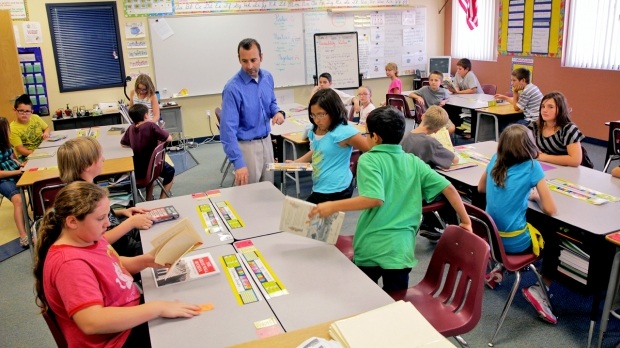
Mesquite Elementary School, in Tucson, Arizona, attributes much of its turnaround in student performance — and their ongoing success — to their Reteach and Enrich program. Within the first year of implementation, even before teachers had worked out all the kinks, Mesquite went from a “performing” school (as labeled by the state of Arizona) in 2002 to an “excelling” school, the highest ranking, in 2003. The school has maintained an “excelling” status ever since.

The goal of the program is to give students the opportunity to master essential skills and knowledge before they move on to the next level. Here’s the approach:

  1. Each week has defined curricular objectives.
  2. Teachers assess students on those objectives at the end of the week.
  3. Based on assessment results, teachers assign students to either reteach or enrich sessions for the following week.
  4. Beginning the following Monday, students attend either a 30-minute reteach or enrich session every day.
    • Reteach: Teachers reteach objectives using different lessons for students who need additional time for mastery. The teacher whose students performed best on the previous week’s assessment teaches that week’s reteach students. Students stay with that teacher for the daily half-hour sessions the whole week to minimize transition.
    • Enrich: Teachers expand on objectives for students who have mastered the basics. Students in the enrich class rotate to a different teacher each day so they can experience varying teaching styles as well as learn with different peers.

Reteach and Enrich (R&E) is highly replicable; every school in the Vail School District has implemented the program, and it continues to lead to improved student performance. However, there are some essential elements that are key to making it work.

1. A Common Curriculum Calendar

R&E depends on a shared set of clearly defined curricular objectives that are scheduled out for the entire year. This means that for any given week within each grade, all the teachers are teaching the same objectives. However, they are not necessarily teaching the same way; the instructional approach is left up to each individual teacher. The calendar keeps them on track by setting the pace so that teachers know that by year’s end they will have taught — and students will have learned — all the essential standards. Says Vail superintendent Calvin Baker, “When we hold students accountable for very specific standards, and we expect all of them to know that standard, then we hold ourselves accountable for getting that job done.”

2. Dedicated Time

Everyday at Mesquite, from 12:30 p.m. to 1 p.m., the whole school is involved in R&E. In addition to this daily half hour, R&E requires time for teachers to review and assess student data as well as plan instruction to meet each child’s needs, both generally and within the program. At Mesquite, each grade has dedicated common planning time for teachers while their students are in “specials” (e.g., P.E., computer lab, library time, and so on).

To fit all that in, time management is also of the essence, right down to classroom transition time. For R&E, all the students transfer from their regular classroom to their assigned reteach or enrich room in under a minute, thanks in part to the convenient setup of their classrooms around a common area (see video below).

3. Collaboration

Collaboration is a key part of Mesquite’s culture and is essential to R&E. Students rotate to different teachers during R&E, so every teacher must know every student in his or her grade level. Teachers share information about their students’ progress so that all the teachers in a grade level share ownership of every child’s education. They plan together and share resources and lesson plans that have been successful, and they seek insight from one another on lesson plans that were less effective.

4. Formative Assessments and Data Analysis

Early on, the teachers at Mesquite created their own weekly assessments; now there is a team of teachers at the district level that writes them. The assessments are short — usually just five questions on one objective — but they provide consistent insight into students’ progress so that teachers can address any needs promptly. Diane Samorano, Mesquite’s student achievement teacher, tracks the assessment data and the data from schoolwide screenings and quarterly benchmarks. She meets with the teachers every two weeks to review the latest results, to identify students who are struggling, and to help teachers plan instruction accordingly.

5. Involved and Informed Leadership

In order to address a variety of student needs, teachers must have access to resources, and principals must know what’s going on in the classroom. Katie Dabney, principal at Mesquite, routinely visits classes, converses with students, and attends every data meeting for all grades. “As instructional leader, I have to stay on top of the data and be actively involved in searching for students who are at risk or need an extra challenge.”