Tag Archives: assessment

Fewer Exams in Education System

matric-exams

Ben Fogle writes an interesting article about examination system and the way out of stress influenced by constant exams!

Government plans to introduce national tests for seven-year-olds shows just how far our exam obsession has come. Our kids now face constant assessment as politicians attempt to measure the success of schools. Children have become tiny cogs in a box-ticking government machine. Education has lost its way.

Let’s be honest, some people are better suited to exams than others in the same way that some of us are more sporty or arty.

There are a few of us whose minds turn to putty under pressure. Exams left me feeling worthless and lacking in confidence. The worse I did in each test, the more pressure I felt to deliver results that never came. When I failed half my A-levels, and was rejected by my university choices, I spiralled into a depression.

The wilderness rescued me. I have been shaped by my experiences in the great outdoors. Feeling comfortable in the wild gave me the confidence to be who I am, not who others want me to be.

It’s time to turn everything on its head and classrooms inside out.

That’s why, instead of pumping time and money into exams, we should focus on wellbeing and encouraging our children to connect with the natural world. I’m not suggesting the abolition of the exam system, but we could certainly cut back to allow more time for children to explore the world around them.

It doesn’t need a huge investment either. Even if you don’t have immediate access, wilderness camps and schools are waiting to receive inner-city children. Part of the beauty of wilderness schooling is that the overheads are very low. You want a classroom? Build a shelter from nature’s store. You want to eat? Forage for it.

And evidence shows connecting with nature really works. Free play in the outdoors is good for social and emotional development, improves self-awareness, and makes children more co-operative. A study by the American Medical Association in 2005 concluded that: “Children will be smarter, better able to get along with others, healthier and happier when they have regular opportunities for free and unstructured play in the out-of-doors.” There is also scientific evidence that the wilderness can reduce hyperactivity and has a soothing effect on children, especially those suffering from attention deficit disorder.

We’ve got it all wrong. We need to bring positivity, health and wellbeing back into our schools. It’s time to turn everything on its head and classrooms inside out.

Why are we still using teaching systems that rely on cramming information to be regurgitated in exams?

I want an education system that works inside out. The outdoors becomes a weekly topic – encompassing geography, environment, resourcefulness, home economics, science, and maths – undertaken outside. Classes could be in an inner-city park, scrubland or garden.

As my own children step on to the conveyor belt, I am determined to give them a rounded education. I am in a fortunate position to share some of the wonders of the wilderness with my own kids. But we all have a responsibility to ensure every child has access to the same life-enhancing opportunities. The government should think long and hard before launching another budget-sapping exam and think about investing in the health and wellbeing of future generations.

Source: https://www.theguardian.com/teacher-network/2015/dec/17/we-need-fewer-exams-and-more-wilderness-in-education

5 Strategies to Ensure Student Learning through Reteach and Enrich (R&E)

reteach_enrich

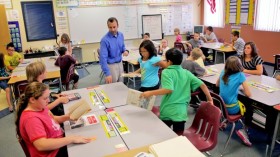
Mesquite Elementary School, in Tucson, Arizona, attributes much of its turnaround in student performance — and their ongoing success — to their Reteach and Enrich program. Within the first year of implementation, even before teachers had worked out all the kinks, Mesquite went from a “performing” school (as labeled by the state of Arizona) in 2002 to an “excelling” school, the highest ranking, in 2003. The school has maintained an “excelling” status ever since.

The goal of the program is to give students the opportunity to master essential skills and knowledge before they move on to the next level. Here’s the approach:

  1. Each week has defined curricular objectives.
  2. Teachers assess students on those objectives at the end of the week.
  3. Based on assessment results, teachers assign students to either reteach or enrich sessions for the following week.
  4. Beginning the following Monday, students attend either a 30-minute reteach or enrich session every day.
    • Reteach: Teachers reteach objectives using different lessons for students who need additional time for mastery. The teacher whose students performed best on the previous week’s assessment teaches that week’s reteach students. Students stay with that teacher for the daily half-hour sessions the whole week to minimize transition.
    • Enrich: Teachers expand on objectives for students who have mastered the basics. Students in the enrich class rotate to a different teacher each day so they can experience varying teaching styles as well as learn with different peers.

Reteach and Enrich (R&E) is highly replicable; every school in the Vail School District has implemented the program, and it continues to lead to improved student performance. However, there are some essential elements that are key to making it work.

1. A Common Curriculum Calendar

R&E depends on a shared set of clearly defined curricular objectives that are scheduled out for the entire year. This means that for any given week within each grade, all the teachers are teaching the same objectives. However, they are not necessarily teaching the same way; the instructional approach is left up to each individual teacher. The calendar keeps them on track by setting the pace so that teachers know that by year’s end they will have taught — and students will have learned — all the essential standards. Says Vail superintendent Calvin Baker, “When we hold students accountable for very specific standards, and we expect all of them to know that standard, then we hold ourselves accountable for getting that job done.”

2. Dedicated Time

Everyday at Mesquite, from 12:30 p.m. to 1 p.m., the whole school is involved in R&E. In addition to this daily half hour, R&E requires time for teachers to review and assess student data as well as plan instruction to meet each child’s needs, both generally and within the program. At Mesquite, each grade has dedicated common planning time for teachers while their students are in “specials” (e.g., P.E., computer lab, library time, and so on).

To fit all that in, time management is also of the essence, right down to classroom transition time. For R&E, all the students transfer from their regular classroom to their assigned reteach or enrich room in under a minute, thanks in part to the convenient setup of their classrooms around a common area (see video below).

3. Collaboration

Collaboration is a key part of Mesquite’s culture and is essential to R&E. Students rotate to different teachers during R&E, so every teacher must know every student in his or her grade level. Teachers share information about their students’ progress so that all the teachers in a grade level share ownership of every child’s education. They plan together and share resources and lesson plans that have been successful, and they seek insight from one another on lesson plans that were less effective.

4. Formative Assessments and Data Analysis

Early on, the teachers at Mesquite created their own weekly assessments; now there is a team of teachers at the district level that writes them. The assessments are short — usually just five questions on one objective — but they provide consistent insight into students’ progress so that teachers can address any needs promptly. Diane Samorano, Mesquite’s student achievement teacher, tracks the assessment data and the data from schoolwide screenings and quarterly benchmarks. She meets with the teachers every two weeks to review the latest results, to identify students who are struggling, and to help teachers plan instruction accordingly.

5. Involved and Informed Leadership

In order to address a variety of student needs, teachers must have access to resources, and principals must know what’s going on in the classroom. Katie Dabney, principal at Mesquite, routinely visits classes, converses with students, and attends every data meeting for all grades. “As instructional leader, I have to stay on top of the data and be actively involved in searching for students who are at risk or need an extra challenge.”