
Tag Archives: ministry of education and science
David Spencer: MOTIV8: Eight Key Factors in Motivating Teenage Students

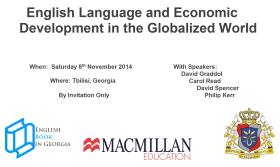
On Saturday the 8th of November, English Book in Georgia, in conjunction with the Ministry of Education and Macmillan Education held a conference discussing “English Language and Economic Development in the Globalized World”.

One of the speakers, David Spencer, talked about “Motiv8: Eight Key Factors in Motivating Teenage Students ”.

During his talk, Spencer referred to the article below. We’d like to provide it for you today, so that you can review your notes and introduce these ideas to your classrom or school.

[divider]

MOTIV8: Eight Key Factors in Motivating Teenage Students

David Spencer

Tbilisi, Georgia

8th November 2014

 1.) Personalisation

For students to communicate comfortably in another language, it’s important to create an atmosphere of personal trust in the classroom, where students feel at ease talking about their lives.

Activities:

  • Talking T-shirts: Ask students to bring to class (or simply describe) one, two or three T-shirts that have some personal significance to them. They give a short presentation to the class explaining the significance. This allows the students to learn about each other in a relaxed, interesting away.
  • Selfies: After the holidays or weekend, draw two or three simple rectangles on the board. Ask students to imagine that this is the screen of their mobile phone. They should draw ‘selfies’ or photos of their holiday/weekend. Then they show their ‘photos’ to a partner. Their partner asks them Yes/No questions to find out about what they did.

2.) Challenge

 If you treat teenagers as if they know nothing, they’ll act as if know nothing. Try to challenge students in terms of grammar, vocabulary, texts, and interesting content. Think also about having open-ended activities for fast finishers to avoid bored, potentially disruptive students.

Activities for fast finishers:

  • Rose-Rise-Rice…: Students continue the list by changing one letter (any letter) at a time. E.g. Rose-rise-rice-nice-nine-fine-…
  • The Three Letter Game: Write three letters on the board. Students think of as many words as possible containing those three letters, in any order. Remind them that word formation can help them. Example answers for the letters RTN: train, north, natural, naturally, unnatural, presentation…


3.) ‘Do-ability’

Give teenage students structured activities that help to make difficult things easy, or do-able.

Activity:

  • Madlib story:

Ask students to write down:

1. a country   2. a boy’s name – famous, fictional, unusual…   3. a girl’s name– famous, fictional, unusual…   4. a city   5. a verb in the past simple (+ object if necessary)  6. an animal   7. a superhero   8. a place   9. a type of food   10. a number

Then give them a skeleton text below to put their words into. Let them compare texts. Then analyse the linkers and use those linkers as a structure for the students’ own text.

[box type=”shadow” align=”aligncenter” ]This story took place in (1) _______. It all began when (2) _______ met (3) _______. They decided to go to (4) _______. Lots of things happened there. First they (5) _______. Then they saw a big (6) _______. The (6) _______ attacked them but just at that moment (7) _______ came and rescued them. (7) _______ took them to (8) _______ and they ate (9) _______. In the end, (2) _______ married (3) _______ and they had (10) _______ children.[/box]


4.) Engagement

The main thing we need in any class is that the students are engaged and active in our activities. Enjoyment is an important factor.

  • Kim’s Game: Show the students 15 objects (on a tray/in a photo). Give students time to memorise the objects, then take them away. Students, in pairs, try to remember what they saw. Then show the same objects again, but having taken away three or four. Can they identify the missing objects?


5.) Progress / 6.) Success

Help students to see the progress they’re making. Do regular progress checks, guiding them to extra practice if they need it. Include cumulative practice and revision throughout the year.

Activity:

  • Rewriting a low-level reader: Give B1+/ B2/B2+ students a simplified reader at A1/A1+/A2 level. Ask them to ‘improve’ short sentences by adding linkers, relative pronouns, and conjunctions.


7.) Variety

Make sure there is variety of skills and language work, interaction, task types, and media. Activities that are out of the ordinary will help to keep the students’ interest.

Activities:

  • Mime the picture: Ask for a volunteer to come to the front of the class. Secretly show them a photo. The students should adopt the same position as the person in the photo. The rest of the class ask the student Yes/No questions to discover what exactly is in the photo.
  • Alphabet Cards: Distribute the cards to the class.

(a) Spell words. Students who have a letter that appears in the word come to the front of the class and position themselves to spell the word correctly.

(b) Call out a category. Students have to think of a word beginning with their letter for the category. They hold up their card and say the word. If they can’t, they lose a point.


8.) Teacher Motivation

Activity:

English Language and Economic Development in the Globalized World

nov8confbanner

We are pleased to announce that on Saturday, the 8th of November 2014,  The Ministry of Education and Science of Georgia, will be holding a conference in collaboration with English Book in Georgia and Macmillan Education, entitled ‘English Language and Economic Development in the Globalized World’.

The aims of the conference are to explore English Language Teaching, its effects on the economic development of a given country and the best current modern practices for English Language Teachers. The event will also incorporate overviews of the current plans and innovations from The Ministry of Education and Science in Georgia.

This event is INVITATION ONLY.

We will have four speakers at this event:

David Graddol

David Groll

He is Director of The English Company (UK) Ltd which provides consultancy and publishing services in applied linguistics, with a special focus on English language and education policy. David worked for many years in the Faculty of Education and Language Studies at the UK Open University and during 2010-2011 was Visiting Associate Professor at City University of Hong Kong. He has been involved in ELT projects in China, India and Latin America since the early 1990s. In The Future of English? (1997) David set out a new agenda for understanding the growing importance of English as an international language. English Next (2006) English Next India (2010), and English Next Brazil (2014), provide overviews of English in global education – all published by the British Council. Profiling English in China: The Pearl River Delta (2013), for Cambridge English Language Assessment, examines public discourses and language landscapes in south China. (All these titles can be freely downloaded from the internet).

Plenary: English and Economic Development


Carol Read

carol read

Carol Read has over 30 years’ experience in English language teaching as a teacher, teacher trainer, academic manager and materials writer. She has taught students of all ages and levels, from very young children to adults. Carol’s main specialisation is in primary language teaching and she has run numerous teacher education courses and worked as an educational consultant in many different countries in Europe, Latin America and Asia.

Carol has published extensively in the field of teaching English to young learners, including course books, supplementary materials, online storytelling and CLIL projects, as well as many articles on primary ELT methodology. Her most recent publication, Footprints, is a fully-digital, primary coursebook series. Carol’s award-winning titles include 500 Activities for the Primary Classroom, which was Highly Commended in the ESU Duke of Edinburgh awards, and Bugs (with three co-authors), which won a British Council Innovation Award.  Carol is currently President of IATEFL (International Association of Teachers of English as a Foreign Language).

Plenary: Seven Ways to Promote Creativity in the Classroom


David Spencer

Dave Spencer

Dave Spencer began writing ELT courses for Macmillan in 1994. His latest series is Gateway, a multi-level course designed to prepare teenage students for school-leaving/university entrance exams.

After studying languages at Oxford University, Dave trained to be a Secondary School teacher at the University of York. He then moved to Spain where he has been living and teaching ever since. He continues to teach Secondary students every day, currently working at Colegio Europeo Aristos in Getafe.

At various stages of his career, Dave has also worked as Director of Studies at International House Serrano, Madrid (now Hyland Language Centre) and as a teacher trainer for IH London and the British Council in Madrid.

Plenary: Motiv8: Eight Key Factors in Motivating Teenage Students


Philip Kerr

Philip Kerr

Philip Kerr is a lecturer, teacher trainer and materials writer with over 25 years’ experience of English language teaching in a number of European countries. He currently lives and works in Vienna. His publications include the coursebook series Straightforward and Inside Out (both published by Macmillan).

Plenary: Learning Vocabulary: It Takes Two to Tango