Tag Archives: learning

Tips For Learning New Language


Image result for tips for learning new language

Jonathan “Jony Wilkinson”, the English rugby national team captain who drove his teams to victory in the 2003 and 2007 Rugby World Cup finals, shared some tips for learning a new language with Lauren Ward, a journalist at The Cambridge University Press. His own experience comes from transferring to Toulon in 2009, where he started learning French.

He says that his motivation for learning a new language was that “not knowing a language is an enormous limitation when expressing and sharing experiences”. He suggests to “get in amongst it and throw your best efforts” if you want to do the same. “For me, learning is not about remembering but about investing, experiencing and committing way beyond any type of fear or making mistakes. Keep hold of your excitement and passion. Don’t make it about right and wrong. It’s your energy and internal state that will create momentum”, he adds.

“From Toulon with love…”, Lauren Ward. Cambridge University Press, 5 April, 2017, P8

Changes in the children’s and YA book market

l-12550

Changes in the children’s and YA book market

According to Nielsen Book’s research, print books remain popular among young readers. Despite the accessibility of e-books, most readers aged 8-17 don’t use their smartphones and tablets to read, preferring print books.

It’s not all good news, however, since the research also showed that the proportion of readers aged 0-17 had dropped by another percentage point. Percentages are dropping fastest in boys aged 8-10. (At the same time, though, those considered “frequent” readers are actually reading more per week.)

Instead of reading, children aged 3-10 are increasingly turning toward online activities, such as YouTube and computer games. Watching TV on mobile devices is another popular activity, which increased by 13%(!) points in 2015 over 2014 as a weekly activity among 0-17 year olds.

The research also split up UK readers into four groups: the “Superfans”, the “Distractibles”, the “Potentials” and the “Antis”. The latter group tend to be male (aged 14-17) and don’t like reading at all, preferring to use YouTube, social media and texting instead. The “Superfans”, on the other hand, are more likely to be female and love reading. The “Potentials” are the largest group; they enjoy reading but only occasionally. Finally, the “Distractibles” are mostly male, who enjoy some reading, but still prefer the internet and physical activities.


Source : Henry, Jo “Changes in the children’s and YA book market.” London Show Daily, April 2016, 14

Open Mind

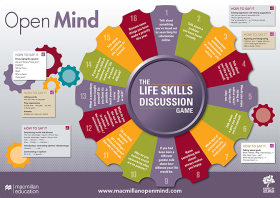
Open-Mind-life-skills-discussion-wheel-poster-image

Open Mind opens doors

Open Mind allows teachers and students to enjoy the best combination of digital and print material. This flexible new course combines language development with the crucial skills students need to be effective and adaptable for work and study.
Open Mind is a ground-breaking adult course that provides learners with the professional, academic and personal skills they need. Not only are language skills developed in the course, but also the important 21st-century skills that students need in order to have a better awareness of self and society, to handle the demands of their study and learning and to deal with challenges in their work and career.

The course offers a flexible combination of materials to ensure that students are learning from a variety of sources: content-rich reading texts, speaking and writing workshops, high-quality video, self-study Online Workbooks, and projectable Student’s Books. The series now comes with new Digital Student’s Books, optimised for tablets, for a smart and versatile learning environment.

Authors

Mickey Rogers and Joanne Taylore-Knowles and Steve Taylore-Knowles and Ingrid Wisniewska and Dorothy Zemach

Read More
: www.macmillanopenmind.com/about

Source : www.macmillanenglish.com

Crack down in China Worse and Worse

worse-and-worse

Crack down in China Worse and Worse

Despite its undeniable status as a global economic superpower, China has been heavily criticized in recent years for an apparent return to a Leninist-style leadership under Xi Jinping. Though the Chinese Communist Party has long been the only significant political force in the country, it abandoned the ruthless dictatorial style of Mao a while ago. However, Jinping’s style of government has raised fears that he’s actively working to restore the very same political philosophy that terrorized the country in the 1970s.

One of the General Secretary’s initiatives, the targeting of “tigers and flies” (corrupt officials and businessmen), has by now transformed into a mass political purge aimed at all those who oppose the government. The Party controls an extensive network of surveillance in the country, which has become even more active during this initiative. As a consequence, the media has found itself under even stricter censorship than before. In August 2015, a financial journalist for the business magazine Caijing was detained after having reported on government manipulation of China’s stock markets. He was forced to refute his own words on China Central Television.

The media hasn’t been the only victim, however. Religious minorities have been targeted, with “hundreds of crosses ripped from the steeples of Christian churches”. Even women’s rights activists and human rights lawyers have been affected.

At the same time, the domestic changes are perhaps less surprising than the foreign ones. The government is denying “unfriendly” foreign journalists entry into the country and blocking websites that disagree with the Party’s policies. Even more shocking is that instead of denying all this, the CCP publicly refutes Western liberal values, viewing them as obstacles to strong leadership and immediate economic growth.

The Central Commission for Discipline Inspection (CCDI) is the government agency in charge of overseeing the new anti-corruption campaign. It’s headed by Wang Qishan, an old friend of Xi Jinping, who essentially acts a grand inquisitor. Under Wang’s leadership, the agency has gained so much power that it’s allowed to hire and fire outside the Organization Department, which generally oversees high-level appointments. One reason for his agency’s success is of course the level of corruption that exists in the country; as officials are poorly paid, they often tend to accept bribes. As a result, they’ve had a lot of targets. Worryingly, their investigations seem to be above the law; they only stage show trials at the end of high-profile investigations. They’ve even designed a smartphone app that lets people upload photo and video evidence of officials violating the law.

For the Chinese themselves, this all is highly reminiscent of chilling rein of the Ming dynasty. The court went through several such agencies like the “Embroidered Guard” and the “Eastern Depot” (even a “Western Depot”, eventually), that gathered secret files on officials. Though Jinping’s approval rating is the highest of any world leader, the people are slowly realizing the danger he poses to even the most basic of freedoms. Heavy criticism is finally finding its way through the extreme censorship. Zhou Fang, a reporter for the New China News Agency, published an open letter criticizing censors for their violations of online freedom of expression. It was soon taken down, but not without causing a stir.

Jinping’s authoritarian style isn’t just a danger to China, of course. It directly affects everyone who depends on the Chinese economy. His aggressive foreign policies ensure that the Chinese economy will encounter many obstacles in its path to reformation. Though some are finally waking up to the threat, it could already be too late.


Source : Schell, Orville  “Crackdown in China: Worse and Worse.” The New York Review, April 2016, 12-14


A Positive Learning Experience

positive-classroom-environment

A positive learning experience

Teaching methods often change, but it’s always the students who can decide if they had a good learning experience. English teacher and writer Paul Bress recommends a few “dos and don’ts” for teachers.

Dos

  • The lessons should always be connected to the students’ interests. If a lot of them like movies for instance, teachers should try to talk about movies in class. This will make the learning process positive for the students.
  • Teachers should always allow their students to be creative. Of course, repeating exercises is very important, but it’s equally important to make the children practice their English in real world scenarios.
  • Teachers should always make sure that the tasks in class aren’t too difficult for their students.
  • Teachers should always make sure that their syllabus is clear to the students. Otherwise, the students may become confused and uninterested during the year.

Don’ts

  • Teachers should never get angry at their students. It’s important to try to understand students’ problems instead of yelling at them.
  • Teachers should never have favorite students. Though some students may seem smarter than others, that doesn’t mean that teachers should always have them respond to questions. Otherwise, the rest of the class will begin to dislike that student.


Bress, Paul. “A Positive Learning Experience” English Teaching Professional, March 2016, 36.

5 Strategies to Ensure Student Learning through Reteach and Enrich (R&E)

reteach_enrich

Mesquite Elementary School, in Tucson, Arizona, attributes much of its turnaround in student performance — and their ongoing success — to their Reteach and Enrich program. Within the first year of implementation, even before teachers had worked out all the kinks, Mesquite went from a “performing” school (as labeled by the state of Arizona) in 2002 to an “excelling” school, the highest ranking, in 2003. The school has maintained an “excelling” status ever since.

The goal of the program is to give students the opportunity to master essential skills and knowledge before they move on to the next level. Here’s the approach:

  1. Each week has defined curricular objectives.
  2. Teachers assess students on those objectives at the end of the week.
  3. Based on assessment results, teachers assign students to either reteach or enrich sessions for the following week.
  4. Beginning the following Monday, students attend either a 30-minute reteach or enrich session every day.
    • Reteach: Teachers reteach objectives using different lessons for students who need additional time for mastery. The teacher whose students performed best on the previous week’s assessment teaches that week’s reteach students. Students stay with that teacher for the daily half-hour sessions the whole week to minimize transition.
    • Enrich: Teachers expand on objectives for students who have mastered the basics. Students in the enrich class rotate to a different teacher each day so they can experience varying teaching styles as well as learn with different peers.

Reteach and Enrich (R&E) is highly replicable; every school in the Vail School District has implemented the program, and it continues to lead to improved student performance. However, there are some essential elements that are key to making it work.

1. A Common Curriculum Calendar

R&E depends on a shared set of clearly defined curricular objectives that are scheduled out for the entire year. This means that for any given week within each grade, all the teachers are teaching the same objectives. However, they are not necessarily teaching the same way; the instructional approach is left up to each individual teacher. The calendar keeps them on track by setting the pace so that teachers know that by year’s end they will have taught — and students will have learned — all the essential standards. Says Vail superintendent Calvin Baker, “When we hold students accountable for very specific standards, and we expect all of them to know that standard, then we hold ourselves accountable for getting that job done.”

2. Dedicated Time

Everyday at Mesquite, from 12:30 p.m. to 1 p.m., the whole school is involved in R&E. In addition to this daily half hour, R&E requires time for teachers to review and assess student data as well as plan instruction to meet each child’s needs, both generally and within the program. At Mesquite, each grade has dedicated common planning time for teachers while their students are in “specials” (e.g., P.E., computer lab, library time, and so on).

To fit all that in, time management is also of the essence, right down to classroom transition time. For R&E, all the students transfer from their regular classroom to their assigned reteach or enrich room in under a minute, thanks in part to the convenient setup of their classrooms around a common area (see video below).

3. Collaboration

Collaboration is a key part of Mesquite’s culture and is essential to R&E. Students rotate to different teachers during R&E, so every teacher must know every student in his or her grade level. Teachers share information about their students’ progress so that all the teachers in a grade level share ownership of every child’s education. They plan together and share resources and lesson plans that have been successful, and they seek insight from one another on lesson plans that were less effective.

4. Formative Assessments and Data Analysis

Early on, the teachers at Mesquite created their own weekly assessments; now there is a team of teachers at the district level that writes them. The assessments are short — usually just five questions on one objective — but they provide consistent insight into students’ progress so that teachers can address any needs promptly. Diane Samorano, Mesquite’s student achievement teacher, tracks the assessment data and the data from schoolwide screenings and quarterly benchmarks. She meets with the teachers every two weeks to review the latest results, to identify students who are struggling, and to help teachers plan instruction accordingly.

5. Involved and Informed Leadership

In order to address a variety of student needs, teachers must have access to resources, and principals must know what’s going on in the classroom. Katie Dabney, principal at Mesquite, routinely visits classes, converses with students, and attends every data meeting for all grades. “As instructional leader, I have to stay on top of the data and be actively involved in searching for students who are at risk or need an extra challenge.”