Tag Archives: For Professionals

Starting A Business? You Need These 3 Basics

The decision to start a business is exciting, but don’t get caught up in the fairy tale. If you want your business to succeed for the long-term, have these three essential elements in place.

1. Enough capital for six months. The time it takes to turn a profit will vary between industries and individual businesses, but the rule of thumb remains the same: have enough cash in the bank to survive for six months or more before you launch. Developing a realistic personal and business budget can help you survive the first few months, and sticking to this budget will be crucial to success.

Develop a list of potential expenses early on so that you have a good idea of what monthly bills plus extraneous expenditures will add up to and how this spending will affect your bottom line. Know that you may not receive a paycheck for months or even years after launch, so a hefty cash reserve will ameliorate the growing pains of starting a business.

2. Marketing and sales strategies for early-adopters. Coming up with an outstanding product or service is great, but your business will likely fail without those crucial first few customers. Develop a marketing plan with an allotted marketing budget that will get your product or service in front of key early-adopting clients. From the start, prepare ways to engage with and nurture clients to develop a loyal base.

Next, build your sales infrastructure: think about sales contracts, proposals, product listings or anything that a client will see when he or she wants to purchase from your company.

3. Endurance. I tell people this all the time: one of the hardest parts about being an entrepreneur is having the stamina to keep up with the daily demands of running your business. A lot of people mistakenly think that it will be a walk in the park.

Sure, there are major benefits such as working for yourself, having a flexible schedule and enjoying the successes of your hard work. But each benefit comes at the cost of putting your own capital and reputation on the line.

Before starting your own business, make sure you can mentally and physically ensure the journey. Be prepared to work long days, do things that are outside of your comfort zone, make personal sacrifices, work hard for what you believe in and dedicate yourself fully to the businesses success. If you aren’t in it 100 percent, the business won’t achieve its full potential.

8 Steps to Make Things Happen Now in Your Business

Successful people dream, plan and envision what they want in life and business just like anyone else.

The difference between the highly successful and the moderately so, though, is that the former do all they can today to ensure a prosperous tomorrow.

To prevail, be willing to take 100 percent responsibility for your personal and business development and create balance so there’s nothing your future self will regret not having tried.

1. Shape your destiny

Don’t let other people define your purpose. You’re the engineer in charge of designing your business life.

When you become clear about who you are and what you want, you will have seized two of the most important guideposts along your career path.

Many fear assuming responsibility for shaping their destiny and shrink from it. This is one reason why not everyone achieves success at the highest levels.

People in business may go against you and judge you. To succeed, see this as beneficial. These counterforce’s force you to stand up for your beliefs.

2. Embrace change

Many people have poor work habits and not all have the will or fortitude to create healthier and more productive ones.

To look back on your life with pride, start changing unproductive habits now.

Be willing to be in a constant state of change as the unexpected unfolds in business. Change isn’t easy, but to be effective, you must embrace it.

Aim to be the most resilient version of yourself and expect exceptional results. Don’t wait for change to happen. Make it happen.

3. Keep moving

To be highly successful, view disappointments as “business-refinement opportunities.” With the wisdom acquired from letdowns, learn what you need to do to step up to the plate again and take another swing with clearer direction.

Quitting is the easiest way to avoid feeling bad or taking responsibility for frustrations in business. But to be successful and avoid future regret, don’t entertain blame or play the victim. Trust that whatever was lost will be replaced by something good or better and power on.

4. Lead authentically

Don’t waste energy trying to satisfy other people’s perceptions. Just be you.

When you are inauthentic and fake a role of success, you may fail. You will talk too much, be impatient and react negatively in high-pressure situations.

Pursue success not the need to impress. To be highly effective in business, communicate sensitively, directly and intelligently so others can hear you. Learn to listen intently so you can respond intelligently. You will learn more by listening than speaking.

5. Act now

To be successful, act now. Be fluid, risk taking, intuitive and prepared. The more prepared and knowledgeable you are about your business, the less fear you will have about making decisions. If you’re unsure in your knowledge or afraid to lose, you cannot succeed at the highest levels.

Having faith in yourself is integral to taking charge. Many develop different excuses for not taking action. To be successful in business, never assume you have more time than you do. Make every day count.

6. Keep a positive attitude

Just one person’s negative attitude has the power to reverberate throughout a business like an infection. Don’t be tolerant of negative attitudes: your own or others’.

Choose team members, employees and bosses wisely so you won’t later regret about not having safeguarded your business from toxic attitudes.

Select personal relationships wisely as well, as those will undoubtedly spill into your business life, influencing your attitude and focus.

7. Expect uncertainty

Business is fluid, so anticipate uncertainty at every turn. Make yourself adaptable to changing circumstances to secure existing opportunities and be open to new ones you might have missed by remaining rigid.

It’s wasteful to struggle with what you cannot control: Identify such areas in your business, accept them and tap other resources to find fresh ways to proceed.

For your success to blossom, be willing to consistently reinterpret your ideas, thoughts, plans and goals. Embrace not always knowing what will happen next.

8. Be healthy

It’s easy to get caught up in a fast-paced life and forget to care for the machine you live in. To be successful at the highest levels, don’t underestimate the value of good nutrition, exercise and rest. Your brain is the greatest computer you have and directly affected by what you ingest, exercise and the restorative powers of sleep.

When you care for your health, you are supplied with the necessary energy and focus for building your wealth, personally and professionally.

In conclusion, know that you alone are responsible for your success. Don’t expect others to build your business for you. Otherwise someone will take over and take you under. There’s no room in the house of success for complacency or remaining stuck too long.

If you spend too much time dreaming, planning or making others responsible but not leading your own way, you won’t arrive at the heights of business expansion desired. Don’t settle for average. Run a highly successful business.

High-achieving businesspeople are well-rounded focused individuals who care for their personal life ensuring it’s healthy so as to immerse themselves in their business and design it for prosperity.

These people are doers. They do not wait behind ideas they hope will materialize. They see what they want and are the architects of their business goals and ventures. They live without regret not putting off for tomorrow what can be done today.

10 Behaviors You Never See in Successful People

When you spend decades working with executives and business leaders, you really can’t help but observe what works and doesn’t work over the long haul. One thing that’s been noticed it that it’s not intrinsic characteristics or personal habits that determine whether you’re successful or not. It’s your behavior.

What is meant by “behavior?” It’s how you react under long-term stress. Whether you meet your commitments or not. How you interact with others. Your attitude toward customers. How hard you’re willing to work to do the job right. Whether you’re focused and disciplined or scattered and distracted. That sort of thing.

Now, there have been some pretty dysfunctional founders and CEOs who did well for themselves for a time. But sooner or later, usually when the pressure is on and things aren’t going so well, they exhibit self-destructive behavior that bites them where it hurts most. Sadly, they often take their businesses down with them.

If you want to make it big over the long-term, you might want to take a good, hard look in the mirror and see if any of these career-limiting behaviors describe you.

[box type=”shadow” align=”aligncenter” ]

Naivety

Granted, we all start out sort of wide-eyed and gullible, but the sooner you convert that to savvy and skeptical, the better your chances of coming out on top. The reason is simple: suckers and fools don’t win. Learn to question everything you read and hear and always consider the source.

Panic

High-pressure situations are common in the business world. Things almost never go according to plan and oftentimes they go terribly wrong. It comes with the territory. If you can’t override your adrenaline response and remain calm in a crisis, you’re sort of screwed.

Fanaticism

Passion is a big success driver, but when you cross that line and become over-the-top fanatical, that works against you. I’ve seen it time and again. It leads to a skewed perception of reality, flawed reasoning, and bad decision-making.

Laziness

Those who are driven to achieve great things also know one fundamental truth: It takes hard work over the long haul. That’s why they’re always so focused and disciplined. Most people are slackers. That’s why most people don’t achieve great things. Simple as that.

Quick-fix mentality

Steve Jobs said, “Half of what separates the successful entrepreneurs from the non-successful ones is pure perseverance” and if you’re not passionate about what you do, you won’t stick with it. Too many people want instant gratification these days. That’s not going to cut it.

Acting out

Whatever feelings you have trouble dealing with – jealousy, shame, inferiority, entitlement – transferring them to people you work with and acting out in anger won’t just make you and everyone around you miserable, it’ll kill your career, too.

Selfishness

If you act like the world revolves around you, you’d better have the talent to back it up. Even so, being overly self-centered will diminish your effectiveness. Business isn’t about you; it’s about business. It’s about your customers’ experience with your products. Remember who serves whom in the relationship.

Living in the past or future

Granted, we can learn from the past, but dwelling on it is self-destructive. Likewise, you can plan for and dream about the future, but if your actions aren’t focused on the present, you’ll never achieve your plans or your dreams.

Lighthearted indifference

You hear phrases like “whatever works,” “it’s all good,” and “no worries” a lot lately but you’ll rarely hear them from highly accomplished people. They may be a lot of things but apathetic is not one of them.

Oversensitivity

If you’re so thin-skinned that any criticism makes you crazy and every little thing offends you, you’re going to have a rough go of it in the real business world. There’s a good reason why business leaders usually have a good sense of humor and humility. It’s sort of a requirement. Don’t take yourself so seriously.[/box]

Book of the Week: Romance of the Thin Man and the Fat Lady by Robert Coover

Romance of the Thin Man and the Fat Lady

The male narrator opens by acknowledging “many stories have been told, songs sung, about the Thin Man and the Fat Lady,” suggesting in addition that they are a metaphor for male and female relations. Despite the conventional nature of the duo, they stand for something larger. “We are all Thin Men. You are all Fat Ladies.”

In this telling, the Thin Man and the Fat Lady are circus freaks, each driven to try to change his or her condition to please the other. The Thin Man wants to put on muscle while the Fat Lady wants to lose weight. Yet their boss, the Ringmaster, demands they maintain their extremes. When the Thin Man starts gaining weight and the Fat Lady starts losing it, the Ringmaster threatens to take action against them.

This book contains some of Coover’s best short stories:

  • Romance of the Thin Man and the Fat Lady
  • The Babysitter
  • A Pedestrian Accident

[button color=”blue” size=”small” link=”http://englishbookgeorgia.com/catalogue/shop/books-fiction-nonfiction-publishers/romance-of-the-thin-man-and-the-fat-lady/” target=”blank” ]Buy the Book[/button]

Success Will Never Come to Entrepreneurs Who Do These 10 Things

https://www.youtube.com/watch?v=tnopS4KuHoY

Whether we are talking about a football game, an election or an entrepreneurial journey, one thing is certain — there are going to be winners and there are going to be losers.

Want to stack the odds of being a successful entrepreneur in your favor? You can start by taking note of the following 10 things that you should never do.

1. Be jealous or envious

Seeing other people around you succeed should motivate you, even if they are your competitors. You should understand that every single person has the ability to become successful, and wasting time focusing on other people’s success or achievements will just sidetrack your own progress.

2. Look back

You are going to face hard times, difficult decisions and possibly even failure at some point. Don’t let small bumps in the road stop your forward progress. Find ways to maneuver around obstacles and continue to push forward, never looking back.

3. Make excuses

If you make a bad decision and screw up, own it. If something doesn’t work out as planned, don’t look for excuses. Search for the cause of the problem and chalk it up to a valuable business lesson. If you identify and own the problem you will not make the same mistake again. If you are constantly making excuses for your mistakes, you will continue to make them because you haven’t properly identified the root of the problem.

4. Stop learning

Your age, years of experience or level of success should never prevent you from learning. There isn’t a single person on this planet who knows everything. We can all continue to learn and be inspired from other entrepreneurs, whether they are billionaire household names or those just starting his or her entrepreneurial journey.

5. Associate with negative individuals

People who constantly make excuses, complain and have a negative outlook should be avoided like the plague. We all know people like this. No matter what you say or what the situation is, they always chime in with negativity. People like this are a cancer and their negative aura can rub off on you. Surround yourself with like-minded individuals that are as focused and determined as you are.

6. Wake up without a plan

Time management is a crucial part of being an entrepreneur. There are only so many hours in a day, so to be efficient you need to know what your goals are and what tasks you need to get done prior to starting your day. If you are scrambling to create a plan of attack every day you are going to be in trouble. End each day by mapping out the following day’s to-do list.

7. Be scared to make changes and adapt

You need to be willing and able to adjust your plan and overall strategy, because there is a very good chance that you will need to adapt to maintain success in the future. Imagine if Apple never adapted and just stuck to making computers? After releasing the iPod it started manufacturing smartphones, tablets and now are releasing its first wearable technology, the Apple Watch. Once just a computer company, it is now a consumer-electronics powerhouse.

8. Let your bark be bigger than your bite

Successful entrepreneurs don’t sit back and talk about what they are going to do. They plan, follow through and conquer. Nothing is going to get accomplished just by talking about it, and nobody is going to be impressed with words alone.

9. Focus solely on dollar signs and decimal points

Instead of chasing the money, focus on creating products and services that make a difference and provide value. If you do this, the money will come. I would be lying if I said the goal of my company wasn’t to make money, but focusing on providing a great service paves the path for the money to follow.

10. Let failure stop you

Most statistics state that eight out of every 10 new businesses fail. Successful entrepreneurs go into everything knowing that there is a chance of failure. If in fact they fail it is viewed as part of their growth and they keep plugging along.

James Dyson is a perfect example, as his first 5,126 prototypes were failures, but the 5,127th one worked and went on to become the top-selling vacuum in the U.S.A. He is now worth $4.5 billion because he never once let failure stop him.

4 Movies Every Entrepreneur Should Watch

Many entrepreneurs gain their knowledge from books that they have read over the years. Not only do books make an impression, but films also make a significant impression on them sometimes directly impacting and shaping their business philosophy.

The following four films fall into this category, and all entrepreneurs can find something of value to take from them:

1. Steve Jobs: The Lost Interview

One movie that first comes to mind as a good reference point for entrepreneurs is The Lost Interview of Steve Jobs. It’s a particularly helpful documentary for people who are interested in starting a technology company, but there are also valuable lessons here for all entrepreneurs. The beauty of the documentary is in its simplicity. In fact, it’s a stretch to even call it a documentary; it’s better described as a largely unedited, hour-and-a-half conversation with Steve Jobs.

Steve Jobs tends to be a controversial figure, to the point that even mentioning his name provokes strong reactions. However, strip away popular impressions of the man from the quality of what he has to say in this interview. In the film, Jobs talks very candidly, through a blend of personal anecdote and philosophy, about the core things necessary to start and run a successful company. One of the things that is memorable is his ability to focus on product quality and content as the single most important ingredients in a company’s success. While this seems obvious, he has an unusual ability to explain it clearly and in a manner that resonates. The interview also serves as a fascinating character study, having been conducted shortly after Apple fired him as CEO back in the 90’s. He speaks with remarkable candor in the film, making for a highly watchable and engaging documentary.

2. Tucker: The Man and His Dream

Another film that I’d recommend to entrepreneurs is Tucker, which stars Jeff Bridges as Preston Tucker, a car-manufacturing entrepreneur from the 40s. The movie, directed by Francis Ford Coppola, is less than a documentary but more than a typical Hollywood script. It gives a glimpse at the zeal and energy that true entrepreneurs possess. Tucker’s enthusiasm is electric and contagious in the film. On the flip side, the story also graphically, and somewhat depressingly, depicts the struggles that Tucker faced in trying to compete with the auto giants in Detroit. In a way, it can give the quintessential big-picture optic of what it’s like to dream and start a company, spanning across the full spectrum of emotions involved.

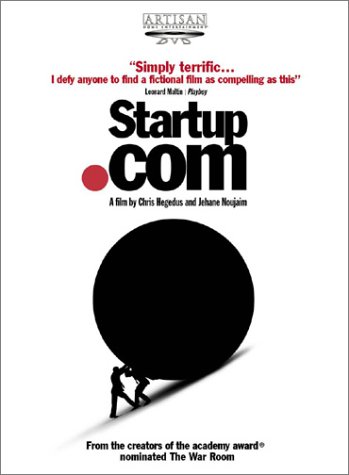
3. Startup.Com

Startup.com is a documentary about govWorks, a failed startup company from the dotcom-bubble era. The filmmakers were granted an astonishing level of access to the company and its leadership, providing a fly-on-the-wall perspective of a company’s meteoric rise and abrupt fall.

The film can, in many ways, be considered a companion to Paul Hawken’s Growing a Business. While Hawken provides a roadmap for running a business successfully, Startup.com is a one-stop shop in how not to start and run a business. The film portrays the company’s leadership as more concerned with fluff than substance, the antithesis of the Steve Jobs portrayed in The Lost Interview. We see the founders raising huge sums of money and hobnobbing with Bill Clinton, while, right under their noses, the company’s infrastructure and product quality is collapsing. Any experienced entrepreneur will totally empathize with the stupidity of the entrepreneurs (since we all have made similar mistakes), but somehow the mistakes are grandiose and larger-than-life in scope. There’s something in this film for every kind of entrepreneur. For seasoned business owners it may provoke a sense of self-reflection and humility, and budding entrepreneurs can learn from the mistakes made by the film’s protagonists.

4. Man on Wire

The last recommended film is, on a superficial level, totally unrelated to entrepreneurship. Man on Wire tells the story of Philippe Petit, a career tight-rope walker who wants to apply his trade on an extraordinary scale: walking from one of the World Trade Center’s towers to the other on a wire. The story involves the intricate plans among the conspirators to achieve this highly illegal and unsanctioned feat in the early 70’s. To any reasonable person, there’s no logical end point to Petit’s entire project. Even when he attempts to describe the motivation behind walking between the two towers, it sounds highly whimsical. He does it, simply, because he wants to. This may deeply resonate within many business owners, because, in a way, starting a business takes a similar mindset. As an entrepreneur, you have a song you want to sing, and you simply have to sing it, even if it makes no sense to anyone else. It’s comforting to know that there are others out there who share this kind of instinct.

Age and Experience Don’t Matter. Mindset Does.

Since the 1960s people have talked about “the generation gap,” the difference in ideas, opinions and behaviors that separates older from younger people.

The divide narrows or widens from time to time, but it’s always there, and at the moment it seems to be cutting through the workplace in a particularly complex way: Very soon, four generations will be working together or living under the same roof.

With retirement disappearing as a concept for more and more mature professionals who are having to work longer than they intended to supplement their pension, there are fewer job opportunities for those who are younger. That’s led not just to higher levels of youth unemployment, but also of a sense of unfulfillment among greater numbers of professionals around the world who suffer from increasing levels of stress and lack of purpose in their work.

When the baby boomers (born from 1946 to the 60s) and generation X (those born in the 60s and 70s) do come together in the workplace with the much younger millennials (the connected generation of “digital natives” born in the 80s and 90s), there are often tensions.

It will be interesting to see the new and very real challenges and opportunities arising when all these groups are joined by those among generation Z (those born from the mid 1990s onwards), who have never known a life without super-fast communication and unlimited access to media technologies, smartphones and online shopping.

The baby boomers and some in gen X often perceive their younger counterparts as having an unjustified sense of entitlement, with no real work ethic, and unwilling to “pay their dues” by starting at the bottom and working their way up.

At the same time, younger employees see their seniors as intransigent, inflexible and no longer best equipped to make the right decisions. Generations Y and Z expect to have knowledge at their fingertips and the independence technology gives them to be able to work anywhere and for whom they choose. Highly transient and mobile, they expect immediate responses from others.

However, because they prefer to sit behind and communicate through the screens of their PCs, laptops and smartphones, their under-developed ability to communicate face to face could put them at a disadvantage when it comes to managing staff, making presentations and connecting with those in other generations.

Whatever the relative truth of the matter, this can make for a challenging mix.

For many in this generation war, the young seem to be winning so far, with the millennials squeezing out the baby boomers and even gen X’ers in a battle of salary cuts as companies, cash strapped after the recent downturn, seek to rein in spending.

However, while age and lifestyle preferences are often seen as the major dividing line between us, I believe there’s one that’s even more important — mindset, something that goes beyond age, gender, education, wealth and geography.

It is by focusing on mindsets and values that I believe we can transcend the traditional generational descriptions that so often seem to create division rather than harmony and unity.

I see mindset and attitude as the real differentiator of talent in our world. But while it is crucially important, it’s something that, as yet, very few companies consider when recruiting or selecting staff.

In my book Corporate Escape: the Rise of the New Entrepreneur, I coined the terms SUPER– (negative) Generation and SUPER+ (positive) Generation to separate the two opposing mindsets I see prevalent in organizations and society as a whole, with SUPER being an acronym for the characteristic way in which each sees and approaches the world.

So those in the SUPER– Generation tend to be superficial, focused primarily on their possessions and external appearance. They have an ongoing need to purchase the latest gadgets and want whatever others have.

They are also unfulfilled, feeling “empty” because of an excessive focus on their appearance and “external” things, which don’t really satisfy their inner needs.

Consequently, with few real “anchors” in their lives, they feel left out and often become negative about the future. Without any sense of purpose or direction, this makes them pessimistic, as well as rather self-centered and egocentric. They believe the world is all about “them,” so they’re rarely willing to take responsibility for their behavior and actions or take ownership for their own success.

And since all this makes their lives less than happy, they are restless, always searching for the next “new thing.” Their world revolves around others and what is fashionable, superficial and temporary.

Unfortunately, a large percentage of those in any kind of work and experience fall well and truly into this category.

Then there are those who are members of that other club: the SUPER+ Generation.

These are individuals who don’t wait for things to happen, but who make them happen, which tends to make them more successful.

They aren’t frightened to stand out and be different, which means they are independent thinkers, often with an unconventional outlook and approach.

Driven to succeed, they are energetic and passionate about making a difference, which frequently comes through in their innately entrepreneurial approach to life, taking responsibility for their own actions.

Finally, they believe in making things happen through a collaborative approach, which is why they are relational, global thinkers who are able to see beyond “me” and “you” to “us.”

As an entrepreneur, business owner or manager, who would you want more of on your side?

Those in the SUPER+ Generation I suspect, because it’s they who will drive companies and societal evolution forward. They are the leaders of tomorrow.

And since this fundamental division between generations goes largely unrecognized, businesses continue to employ based on other criteria — normally the traditional CVs and cost — a short-term approach that can leave mature professionals with plenty of knowledge and industry experience standing on the wrong side of the door. However, given increasingly volatile, uncertain and complex economies and global markets, if you really want to make things happen in the best way, experienced heads are often still needed alongside the energy and new perceptions of those who are younger. You are created to work with others, to collaborate and learn together, not to be in constant opposition.

The great thing is that at any moment you have the power to create the professional world you want to be part of. One in which where you come from, your age and gender, or and what you have done before is less important than your vision of what is possible.

When the future is created one step at the time, isn’t it time to see beyond the generations?

[button color=”blue” size=”small” link=”http://www.entrepreneur.com/article/240013″ target=”blank” ]Source[/button]


Everything I Know About Business I Learned From My High School English Teacher

Everything I Know About Business I Learned From My High School English Teacher

By Norm Merritt

Since coming on board as co-CEO of a growing New York startup, I’ve increasingly found myself on the receiving end of one seemingly simple, yet surprisingly difficult to answer question:  “What defines a successful business person?”

The traits that matter the most are quite simple — and I actually learned all of them from my high school English teacher, Mrs. Miller. The lucky among us have had a teacher that played a pivotal role in shaping not only our work habits, but also our character. Mrs. Miller was a stern but caring teacher whose wisdom and high expectations continue to impact my work today. She encouraged me to:

Be dogged

For a long time, every English essay I submitted would come back liberally marked up with comments like, “Poor overall structure,” “insufficient evidence,” or “overly wordy.” After sitting me down and explaining in more detail where I was going wrong, Mrs. Miller would encourage me to implement the changes we had discussed instead of wallowing in defeat.

Any successful business person, from a small-business owner to a seasoned entrepreneur, experiences pitfalls. Picking yourself up and trying again after a defeat or setback is key to long-term success.

But intelligent

Unfortunately, after a round of quick edits, I’d often then receive an even worse grade than I received initially. The point? My English teacher believed that improvement wasn’t easy or an automatic function of repetition. If you wanted a better grade, you had to be willing to use your own mind, as well as work hard and fast.

The most successful business people I know put this in place every day: They are diligent and tenacious but also smart and selective in how they apply their efforts.

Be convincing

There is no greater asset in business than an ability to sell your vision to others. Whether dealing with customers, employees, managers, suppliers, journalists or venture capitalists, a successful outcome almost always depends on the same core competency that I picked up in Mrs. Miller’s English class — an ability to build a logical, well-structured narrative that persuades others of the merits of an argument.

The most impactful business people I’ve had the privilege of working with have the unique ability to think through a problem and only interject when he or she can marshal the relevant facts, statistics, insights, precedents, and comparables in support of a cohesive argument. These persuasive, thoughtful leaders are almost always the ones that actually move things forward, because people around them are convinced and inspired to act.

Be open

I had a lot of strong opinions in high school.  I still do. But Mrs. Miller taught me to appreciate one fundamental fact about English literature, life and business: There is rarely only one right answer.

Business building is a discovery process. Yes, it’s important to have a clear vision — and the drive to see it through — but the best business people are not blinded by their own passions and convictions. They remain open to a changing world and the experience and insight of others and are willing to make changes where necessary.

A successful career in business will call on a wide range of skills and require no small degree of luck — but when I want to remind myself of the basics, I always return to Mrs. Miller.

[button color=”blue” size=”small” link=”http://www.entrepreneur.com/article/241918″ target=”blank” ]Source[/button]


25 Tips for Having Meaningful Relationships

While technology has made it more convenient to keep in touch with the outside world, and even become re-acquainted with long-lost friends, it has also changed how we define relationships. Someone with 1,000 Facebook friends may think they’re a rock star. But, how many of those “friends” would be there to support them when they start a business or go through a personal crisis?

The more successful you are at relationships with your family, friends and customers; the more successful you will be in life with all of them.

Because of the hustle and bustle of the 21st century, it’s even more important than ever to have these meaningful types of relationships. Want to know how to achieve that? Follow these 25 tips.

[box type=”shadow” align=”aligncenter” ]

1. Be happy with yourself.

You may have heard this one before, and there is a reason for that – it remains the best place to start. As Michelle Maros so elegantly puts it in, Peaceful Mind Peaceful Life, “Your relationships outside will flounder if you don’t have unconditional love and compassion for yourself.”

2. Learn to listen and understand.

Throughout your life you’ve probably dealt with this problem. Your parents never listened. Your spouse never listens. Your boss just doesn’t understand, or listen. George P.H. notes in, Pick The Brain, that we can connect with people simply by listening to them, hearing them out without interruption, and doing our best to understand where they’re coming from.

3. Take the punch.

You can’t always take things personally. We all have bad days where we freak out, vent, or scream at those around us. My wife Kristy Rampton always tells me “There are few things in life less selfless than taking a punch every now and then from people who are having a bad day. Sometimes people just need to vent.” Get amnesia concerning the outbursts of others.

4. Follow-up.

If you feel like you’ve hit it off with someone, professionally or personally, don’t wait for them to get in touch with you. If you believe that there’s potential for a new relationship, then make sure that you follow-up. Keith Ferrazzi, author of “Never Eat Alone,” suggests that you should follow-up within 48 hours of the first meeting.

5. Be positive.

Here’s a quick question. Would you rather spend time with someone who is a downer or someone who is upbeat? Barbara Fredrickson, a psychologist at the University of North Carolina, backs up the obvious by stating, in Psychology Today, that positive emotions help us “broaden and build” relationships.

6. Grab lunch.

We’re all busy, but are you too busy to stop and eat? Probably not. Relationship expert Nate Bagley from Loveumentary believes that you should “make the time” to schedule a lunch with friend, acquaintance or family member. This action will yield great benefits.

7. Don’t be someone else.

Adrian Savage wrote in, LifeHack: “If you can’t trust yourself, why should others trust you?”

8. Take inventory of the relationships you have.

Some relationships are meant to be last for a long time. Other relationships may just linger because it’s familiar and feels safe. Take an inventory of the relationships and see which ones you would like to hang onto and the ones you can let go. Letting go of unnecessary relationships opens up the opportunity to let new relationships into your life.

9. Pick up the phone.

Texts, email and Facebook comments are great every now and then, but there’s nothing like having an actual conversation with someone. Don’t hesitate to pick-up the phone and give your friend or peer a call to check-in and see how they’re doing. It is a good idea to be respectful of the other person’s time. The actual conversation does not have to be lengthy. Take the time to pick up the phone or Skype chat that friend. It’ll go a long ways to maintaining and fostering strong relationships.

10. Find common interests.

It could be the same sports team, band, movie, job or extreme sport. No matter how big or small, finding a common interest is one of the best ways to establish a meaningful relationship.

11. Pay it forward.

You should want to give others something because you want to. Not because you have to. If you know someone who happens to be a great web-designer and you have another acquaintance who is need of a designer, then why not introduce them to each other? Did you run across an unusual shot glass that would fit in your friend’s collection? Could you quickly purchase it?

12. Don’t wait to be asked for help.

If you know that a colleague, friend or family member needs some sort of help, then jump in and offer your assistance before they ask. For example, if you know that they’re moving and you have the time, you can offer to help, even if your body will hate it the next day.

13. Learn to trust others.

Even if you were hurt by someone in the past, either professionally or personally, you have to learn to trust again. As George P.H. so bluntly puts it “ALL relationships – family, business, platonic – require trust.”

14. Be clear on what you want.

None of us like feeling disappointed. But, did you ever stop and think that maybe you didn’t get your needs filled because you didn’t specify what you really wanted? Even if it seems uncomfortable, always be honest in what you want or need.

15. Understand what’s really being asked.

Here’s another piece of advice from Steve Boyer. He suggests that “people will always ask different questions than the one they really want to be answered.” For example, an “employees typically ask how to be more successful when all they really want is to get a raise or promotion.” In other words, there a larger question waiting to be answered behind that initial question.

16. Respond quickly.

While you don’t have access to your phone or computer 24/7, there’s a good probability that you will at some point sooner than later. If someone emails or texts you a question or inquiry, respond to them ASAP. Wouldn’t you rather be known as the speedy responder than the person who never gets back?

17. Set calendar reminders.

We’re all busy bees, so it’s easy to lose contact with friends, colleagues, family members and acquaintances. To avoid a problem, use a set-up calendar reminder so that you can schedule a time to touch base with the people in life.

18. Identify and avoid interpersonal pitfalls.

There are plenty of qualities that can be detrimental to a relationship. The Counseling Center at the University of Texas lists the following:

      • Having unrealistic expectations of yourself, the other person, or the relationship in general.
      • Coming too close too soon, physically or psychologically.
      • Being negative about self, the relationship or life.
      • Being a rescuer, a martyr, a savior or a “perfect” person.
      • Trying to change the other person to suit your needs.
      • Being too self-centered, judgmental or always “right”.
      • Stockpiling strong feelings – anger, pain, sadness, neediness – and then pouring them all out at once.
      • Expecting the other person to be a mind reader, a fixer or always a rock of stability for you.

If you notice any of these tendencies in yourself, think about trying to change them. You may even need to get help from someone you trust so that you can avoid the inclination from going any further.

19. Don’t be judgmental.

Just because someone acts a certain way, behaves in ways we wouldn’t allow ourselves to or has differing opinions, it doesn’t mean that they’re beneath you, or less than you. Instead of passing judgment, why not ask them questions to find out why they have those opinions and interests. Besides learning something new, you may discover that you’re not that different after all.

20. Pick your locations and activities wisely.

Heading out to the bar to meet new friends sounds great in theory, maybe. But, you’ll most likely develop bar buddies. Are those really the people you can seriously rely on? While there’s nothing wrong with have acquaintances, try to spend time in places where there will be people with similar interests. If you’re into books, for example, then why not join a book club?

21. Be patient.

Building and maintaining a relationship takes time. During that time, you’re going to need patience to help cope with the daily frustrations of life. If you don’t have the patience to deal with life’s little aggravations, then how can you expect to have a durable relationship?

22. Make eye contact.

Research has long proven that “people who make eye contact are perceived as more, “likable and trustworthy.” Dr. Atsushi Senju tells the New York Times that, “A richer mode of communication is possible right after making eye contact.”

23. Don’t mumble.

Communication is a big part of relationships. So, why would you want to make conversations awkward or confusing because you can’t be understood? In case you weren’t aware, mumbling is also a “sign of covert anger, resentment, disrespect, or sadness.”

24. Laugh.

In case you weren’t aware, laughter is extremely contagious. Besides being beneficial for your overall health, it can also “strengthen our relationships by triggering positive feelings and fostering emotional connection.” Also, take an opportunity to laugh at yourself sometime.

25. Let it go.

Pick your battles wisely. Even if you disagree with someone or have the need to tell them “I told you so,” it’s best to move on and let it go. No one wants to hear a lecture.

[/box]

Inspirational Quotes


Deprecated: preg_match_all(): Passing null to parameter #2 ($subject) of type string is deprecated in /home2/englita2/public_html/blogebg/wp-includes/media.php on line 1893

Deprecated: str_contains(): Passing null to parameter #1 ($haystack) of type string is deprecated in /home2/englita2/public_html/blogebg/wp-includes/shortcodes.php on line 150

Deprecated: preg_split(): Passing null to parameter #2 ($subject) of type string is deprecated in /home2/englita2/public_html/blogebg/wp-includes/formatting.php on line 3492