Category Archives: Professionals

News For Professionals learn and so on

10 Qualities of Highly Successful People

The attributes here are shared by successful people everywhere, but they didn’t happen by accident or luck. They originate in habits, built a day at a time.

success-sign

1. Drive – You have the determination to work harder than most and make sure things get done. You pride yourself on seeing things getting completed and you can take charge when necessary. You drive yourself with purpose and align yourself with excellence.

2. Self-reliance – You can shoulder responsibilities and be accountable. You make hard decisions and stand by them. To think for yourself is to know yourself.

3. Willpower – You have the strength to see things through–rather than vacillate or procrastinate. When you want it, you make it happen. The world’s greatest achievers are those who have stayed focused on their goals and been consistent in their efforts.

4. Patience – You are willing to be patient, and you understand that, in everything, there are failures and frustrations. To take them personally would be a detriment.

5. Integrity – This should not have to be said, but it’s seriously one of the most important attributes you can cultivate. Honesty is the best policy for everything you do; integrity creates character and defines who you are.

6. Passion – If you want to succeed, if you want to live, it’s not politeness but rather passion that will get you there. Life is 10 percent what you experience and 90 percent how you respond to it.

7. Connection – You can relate with others, which in turns makes everything reach further and deepen in importance.

8. Optimism – You know there is much to achieve and much good in this world, and you know what’s worth fighting for. Optimism is a strategy for making a better future–unless you believe that the future can be better, you’re unlikely to step up and take responsibility for making it so.

9. Self-confidence – You trust yourself. It’s as simple as that. And when you have that unshakeable trust in yourself, you’re already one step closer to succeeding.

10. Communication – You work to communicate and pay attention to the communicators around you. Most important, you hear what isn’t being said. When communication is present, trust and respect follow.

No one plans on being mediocre; mediocrity happens when you don’t plan. If you want to succeed, learn the traits that will make you successful and plan on living them out every day.

Be humble and great. Courageous and determined. Faithful and fearless. That is who you are, and who you have always been.

SOURCE

Unique Learning – ინგლისური ენის კურსები!

მათთვის, ვისაც სურთ შეისწავლონ ზოგადი ან სპეციფიური ინგლისური, გაიუმჯობესონ არსებული ცოდნა ან/და მოემზადონ სხვადასხვა გამოცდებისთვის!

Unique Learning აცხადებს მიღებას შემდეგ კურსებზე:

  • Young Learners – 4-16 წლამდე მოსწავლეებისთვის
  • Adults – ინგლისურის კურსი ზრდასრულებისთვის
  • Intensive – მოკლევადიანი ინგლისური ენის ინტენსიური კურსები
  • ინგლისური ენის გამოცდების მომსამზადებელი კურსები – ერთიანი ეროვნული გამოცდები,TOEFL, IELTS და PTE
  • სპეციფიური კურსები – ბიზნეს ინგლისური, სინქრონული თარგმანის კურსები, სამედიცინო ინგლისური

კურსებზე ჩასაწერად არსებობს ორი გზა:

  • ეწვიეთ Unique Learning ოფისს და შეავსეთ ფორმა (გთხოვთ, წინასწარ შეათანხმოთ ვიზიტის დრო)
  • დარეგისტრირდით ვებ-საიტზე – შებრძანდით კურსების სექციაში და აირჩიეთ თქვენთვის სასურველი კურსი. ყოველი სექციის ბოლოს ნახავთ დარეგისტრირების ღილაკს და მიყევით ინსტრუქციებს

მიღება იწყება 25 აგვისტოს და დასრულდება 15 სექტემბერს.

კურსები ჩატარდება როგორც Unique Learning-ის მთავარ ოფისში (ჭავჭავაძეზე), ასევე დიდი დიღმის ფილიალში, რეგისტრაციის დროს სწავლის მსურველის მიერ შერჩეულ ადგილას.

UL

დამატებითი ინფორმაციისთვის გაეცანით Unique Learning ვებსაიტს ან დაუკავშირდით Unique Learning-ს.

საკონტაქტო ინფორმაცია:
2 181425
info@uniquelearning.ge
ჭავჭავაძის გამზ. #33ა

For Professionals: 4 Tips for More Productive Meetings

Meetings are a corporate oxymoron: an essential practice that generates groundbreaking ideas but also sucks the life out of a workforce. Employees waste away in conference rooms trying to pay attention to others give languorous presentations on mind-numbingly boring TPS reports and listening to overviews with no impact on his or her job function. Don’t do this to your employees.

meeting-room-prev1217769718W2VzN7

Here are four key considerations you can use to keep co-workers engaged and productive.

1. Be timely.
Meetings are major investments and should be expected to create a substantial return. Before holding a meeting, ask yourself if the opportunity cost of conducting the meeting is worth it — will the benefits exceed the cost? Additionally, meetings should be no longer than 45 minutes, as humans focus best within that timeframe. If the agenda clearly looks to take longer (it shouldn’t unless there are special circumstances), split the meeting into 45-minute periods with a rest in between.

2. Have an agenda that makes sense.
Not only do meetings take time, but they also impact the way we manage our time. Consider the frequency with which meetings are called around a specific project. Do you really need daily status updates or can it be shifted to weekly? Meetings take people out of their workflow and promote procrastination. Most workers see the half hour before and after meetings as dead time, because there isn’t enough time to dig into work tasks.

3. Be selective on who attends the meeting.
Only invite people capable of contributing to the discussion. This way, employees feel valued and are more likely to positively engage in the discussion. Employees need to understand that their time is more valuable than their presence at every meeting. Management is giving people more time to complete their work task — not diluting their value to the company. In fact, fewer meetings should increase interoffice communications and keep everyone informed.

4. Determine if you really need the meeting.
This is the ultimate question people should ask themselves. We live in a world of Skype, email, Wikis and a million other collaboration tools. These tools do not make all meetings irrelevant — particularly for those involving problem solving, brainstorming and other types of creative thinking — but they can be used to free up quite a bit of time if used effectively.

Source: CEO.COM

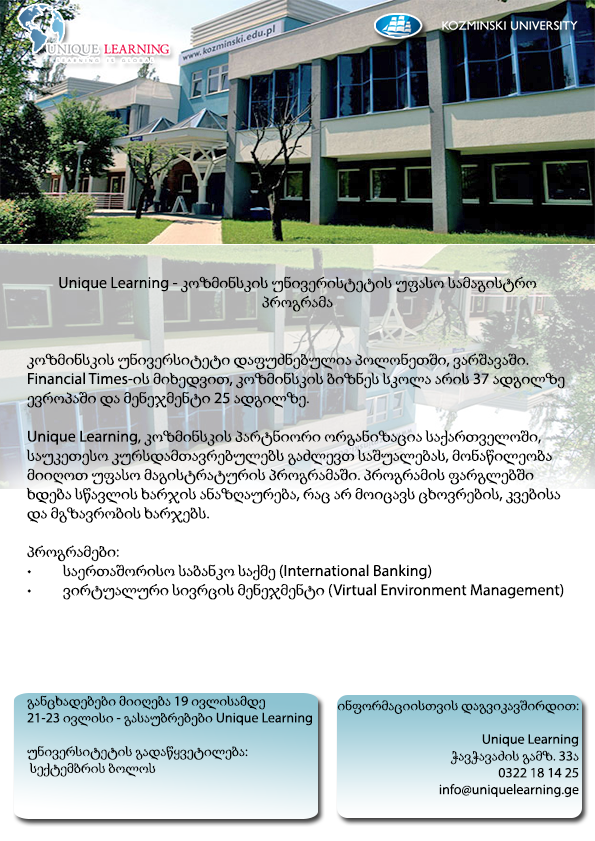
Unique Learning – კოზმინსკის უნივერსიტეტის უფასო სამაგისტრო პროგრამა

კოზმინსკის უნივერსიტეტი ვარშავაში გთავაზობთ ორ უფასო სამაგისტრო პროგრამას, რომლებშიც მხოლოდ საუკეთესო სტუდენტებს შეეძლებათ მონაწილეობის მიღება.

ადგილების რაოდენობა: 20
პროგრამები:

  • საერთაშორისო საბანკო საქმე (International Banking) – CITI Bank-თან და KPMG-სთან ასოცირებული პროგრამა, რომლის შედეგადაც საუკეთესო კურსდამთავრებულებს შეეძლებათ სტაჟირება გაიარონ ზემოთ ხსენებულ ორგანიზაციებში და შემდგომ გახდნენ შტატიანი თანამშრომლები
  • ვირტუალური სივრცის მენეჯმენტი (Virtual Environment Management)

კოზმინსკის უნივერისტეტი დაფუძნებულია პოლონეთში, ვარშავაში, 1993 წელს და სტუდენტებს სთავაზობს საუკეთესო სამაგისტრო პროგრამებს. Financial Times-ის მიხედვით, კოზმინსკის ბიზნეს სკოლა არის 37 ადგილზე ევროპაში და მენეჯმენტის სკოლა – 25 ადგილზე.

Unique Learning, კოზმინსკის პარტნიორი ორგანიზაცია საქართველოში, საუკეთესო კურსდამთავრებულებს გაძლევთ საშუალებას, მონაწილეობა მიიღოთ ამ პროგრამაში. პროგრამის ფარგლებში ხდება სწავლის ხარჯის ანაზღაურება, რაც არ მოიცავს ცხოვრების, კვებისა და მგზავრობის ხარჯებს. განცხადებები მიიღება 19 ივლისამდე. რეგისტრაციის გადასახადი არის 50 ლარი, რეგისტრაციის შემდეგ (21-23 ივლისის ჩათვლით) ჩატარდება გასაუბრებები, სადაც შეირჩევა საუკეთესო აპლიკანტები და მათი საბუთები გაიგზავნება კოზმინსკის უნივერსიტეტში. უნივერსიტეტის გადაწყვეტილება ცნობილი გახდება სექტემბრის ბოლოს.

მოთხოვნები და სხვა დეტალები იხილეთ აქ.

Kozminski Poster

3 Communication Fundamentals You Should Know

If you want to be effective at interpersonal communication in areas like managing conflict, negotiating, managing performance and coaching, here are three fundamentals – a theory and a two related skills – you really ought to know and be good at. The theory is attribution theory. And the skills are active listening and delivering feedback.

pmo-fact-find

The Theory

The theory is called attribution theory. It is about how we explain why other people do what they do. According to the theory, there either are external causes – e.g. the dog ate the homework – or internal causes, something about the individual or the group to which the individual belongs – e.g. he doesn’t get his work done because he’s lazy.

The truth is we often don’t know why someone does something. You should be aware of this theory because the best way to blow up a negotiation or a coaching session or almost any interaction with someone is to impute a negative motivation to something that person has done. Being wrong about it only makes the situation worse.

The Skills

Now that you know what attribution theory is, you know exactly what not to do when delivering feedback or when you are engaged in active listening: do not make attributions. Do not tell someone what he or she is thinking, feeling, or intending. Instead, pay attention to what the individual is saying and doing.

Feedback
The purpose of feedback is to give the feedback recipient information about his or her behavior that he or she can use to decide whether to continue that behavior or to change it in some way. When delivering feedback, instead of beginning with the impact of someone’s behavior and assuming the individual knows exactly what you’re talking about, begin by describing what that person did using specific behavioral language and then identify the impact of the behavior.

The point about language is important because the same behavior can impact different people in different ways. For example, behavior that some would call aggressive might look confident or arrogant to other people. That’s why it’s important to be specific about what the individual is doing. Please note that the words aggressive, confident and arrogant do not describe specific behavior. They describe someone’s interpretation of someone else’s behavior. They are attributions.

Active Listening
Most people think of active listening as going “uh huh” every now and then and paraphrasing. These are techniques intended to encourage the other person and to let them know you’re listening. The techniques work best if they support the actual goal of active listening, which is listening to understand.

Here’s how to become an active listener: Do not assume that your interpretations are their intentions. Do not use attributions. Paraphrase when the other person says something that appears important and then, if it seems appropriate, add on a response or a clarifying question. For example, “As I understand it now, your perspective on this topic is… Mine is different. I view the situation this way…” That gives the other person the opportunity to clarify your understanding of their position and to hear your view.
As with feedback, active listening is useful in most interactions with other people whether those interactions are personal or business related. And both skills are essential for things like negotiating, managing conflict, coaching and managing performance. They are not the only skills you’ll need, but without them, you will be much less effective. That’s why they are among the fundamentals of interpersonal communication.

Source: CEO.COM

Happy Birthday to Happy Birthday Song!!!

Did you know that today marks 155th anniversary of the day when this song was first sung? A song we heard thousands of times, in different languages and always on happy occasions!

Happy Birthday to you,
Happy Birthday, Dear Happy Birthday Song
Happy Birthday to you!


Here are some interesting facts about the song:

  • The song was published in 1893
  • The melody of “Happy Birthday to You” comes from the song “Good Morning to All”, which has been attributed to American siblings Patty Hill and Mildred J. Hill
  • According to the 1998 Guinness Book of World Records, “Happy Birthday to You” is the most recognized song in the English language
  • The combination of melody and lyrics in “Happy Birthday to You” first appeared in print in 1912, and probably existed even earlier
  • It has been sung in 143 movies, translated into at least 18 languages
  • Although the authors are believed to have earned very little from the song, reportedly it later generated about $1 million a year for its copyright owner
  • The Summy Company registered for copyright in 1935. There are still disputes about the copyright expiration dates.
  • Based on the 1935 copyright registration, Warner (company which owns the copyrights) claims that the United States copyright will not expire until 2030, and that unauthorized public performances of the song are technically illegal unless royalties are paid to Warner
  • One of the most famous performances of “Happy Birthday to You” was Marilyn Monroe’s rendition to U.S. President John F. Kennedy in May 1962
  • Another notable use was by comedy pianist Victor Borge, who would play the song in styles of various composers, or begin playing Claire de Lune then transition into Happy Birthday which then transitioned into the Moonlight Sonata and so on.

10 Things Real Leaders Always Do

Lead
This is not complicated, folks. Lead is the opposite of follow. When you spend a lot of your time trying to replicate how others do things, that’s not leading. It’s following. Great leaders lead by example. First they do, then they point the way for others to follow. You’re either one or the other, not both.

Manage
Yes, leadership and management are different. Hallelujah. Whether it’s managing their company’s organization, brand, products, customer experience, operations, finances, whatever, business leaders spend most of their time managing. Leadership is a skill set. Manage is what they do.

Strategize
In the old days, the big buzzword was invention. Then it was innovation. Now it’s improvement. Whatever. If you want to lead in business, you have to come up with a unique solution to a big problem that people are willing to pay for. You can call that Sylvester if you like, but I call it strategy.

Create culture
The root of the word culture is cult. Steve Jobs created a unique, cult-like culture at Apple. Likewise John Mackey at Whole Foods and the original Trader Joe … Joe Coulombe, that is. If you’ve never been to Google, check out the movie “The Internship.” Great leaders are not cast in a mold. They break the mold.

Inspire
We all need inspiration at times, but real leaders are usually inspired by their lives, which typically revolve around work and family. And since their job is to inspire and motivate others, they tend to have a pretty big source of it inside. If you’re in constant need of inspiration, you’re probably not leadership material.

Prioritize
Before everyone became so obsessed with personal improvement, productivity, and time management, real executives and business leaders learned to prioritize their time. And they prioritize their organization’s time by setting direction and goals, as well. That’s how the work gets done on time.

Juggle
No matter how well you prioritize or delegate, when your business is growing, you’ve got to keep a lot of balls up in the air. And if you’re not growing, you’re stagnating. For CEOs, especially in high-growth industries, multitasking is just a way of life … and I don’t mean tweeting while watching a YouTube video.

Plan, execute, adapt
There’s a three-part cycle to operating just about any business: plan, execute, adapt. In the beginning it’s mostly ad-hoc, but the bigger a company gets and the faster it needs to scale, the more formalized its operating processes must be.

Make smart decisions
Life is full of decisions but the vast majority — like what to eat for dinner or which phone to buy — aren’t super critical. Business is not the same because, unlike food choices, competitive markets are essentially zero-sum games. The bigger your title, the more critical your decisions. Great leaders make smart decisions.

Win
Just about any type of human performance is described by a bell-curve. Every field has its top performers, its bottom performers, and everything in between. Leadership is no different. Good leaders win more than they lose. Great leaders consistently beat the competition. That’s just what they do, and they do it better than anyone else.

Bottom line: Leaders lead and followers follow. It’s not complicated — you’re either one or the other. Which are you?
Source: Entrepreneur 


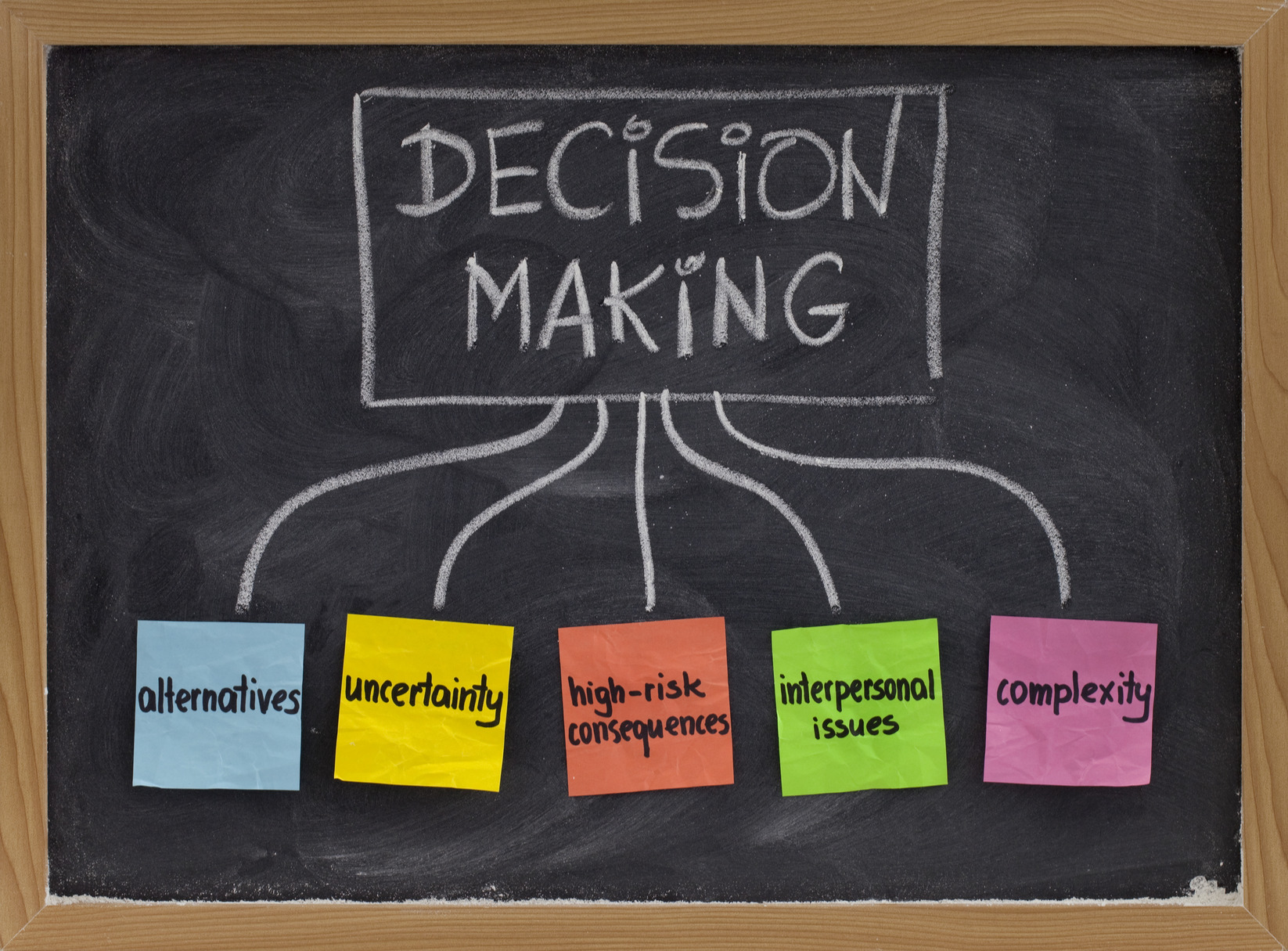
Decision Making Types


decision making concept on blackboardDecision Making types. Which one are you?

You know you need great ideas, a critical mass of talent, and a decent amount of luck to build a successful business. But there’s something even more fundamental to putting together a smart organization.

Before everything else, you, the founder, need an honest understanding of your strengths and weaknesses. Without it, you won’t know how to build a great supporting team. One place to start is to look at how you make decisions.

A new survey of about 5,000 McKinsey Quarterly and Harvard Business Review readers might offer some insight. After in-depth work on 1,021 of the responses, study authors Dan Lovallo and Olivier Sibony identified five decision-making styles. They are: Visionary, Guardian, Motivator, Flexible, and Catalyst.

Each style is a combination of preferences from a set of six pairs of opposing characteristics:


  • prefers ad hoc or process
  • prefers action or caution
  • gathers information narrowly or widely
  • believes corporate interests or personal interests prevail
  • likes continuity or change
  • prefers storytelling or facts

Although the authors stress that the research is still in an early stage, here is a summary of what they have learned so far.

Decision makers all have particular ways they like to work and there are actions each should take to keep their tendencies from undermining their intent.

Visionary

The visionary decision maker is “a champion of radical change with a natural gift for leading people through turbulent times.” Such people like change, gather information relatively narrowly, and are strongly biased toward action but “may be too quick to rush in the wrong direction.”

If you are a visionary leader, you should seek the opinions and views of a broad group and “encourage dissenters to voice their concerns.” Only that way can you get a wider set of views and information that can be critical to success.

Guardian

A guardian is a “model of fairness who preserves the health, balance, and values of the organization.” Such people have sound decision-making processes, try for fact-based choices, and plan carefully. They like continuity, are moderately cautious, and gather information relatively widely.

Those are fine characteristics for normal times. But the guardian can be too cautious and slow moving during a crisis, when there is “desperate need for change.” That is why a guardian should talk to people outside the organization and have them “challenge deeply held beliefs about the company and its industry.” Task forces are then in order to “explore major changes in the environment.”

Motivator

Motivators are good choices for change. They are charismatic, can convince people of the need for action, and build alignment among parts of the company. But like all good storytellers, they risk believing the story in the face of countervailing facts. They gather information relatively narrowly, and strongly believe that self-interest prevails over corporate interest.

Rather than looking simply for outside counsel, motivators need to explore the existing facts and see if there are other ways to interpret them–ways that do not necessarily play into the narrative they have created. Formal processes are a help. Motivators can use surveys to get a realistic sense of the rest of the company.

Flexible

Flexible leaders are, as you might expect from the name, more versatile than other types of leaders: “comfortable with uncertainty, open minded in adapting to circumstances, and willing to involve a variety of people in the decision making.” They mildly lean to ad hoc approaches rather than formal processes and are fairly cautious.

The problem with flexible leaders is that they can become too open-minded. Looking at all the potential issues, solutions, and outcomes can paralyze the decision-making process. They should set deadlines for decisions before the paralytic debate can commence. It can also make sense to create a framework for ordinary repetitive decisions, making them the subject of a set of rules so as not to waste time on reconsidering.

Catalyst

The catalyst is an excellent person to lead the work of groups, whether making decisions or implementing them. They are balanced, being in the middle on four out of the six characteristics, although they slightly prefer action to caution and are slightly biased toward broadly, rather than narrowly, gathering information. The more extreme the necessary decision, the more they can naturally resist inherent biases.

That said, being middle of the road can yield only average results. To avoid that, a catalyst should watch for circumstances that require high-stakes decisions and realize that they may need a different type of decision process, like having a team look at the situation and suggest potential approaches.

How does this research square with your assumptions and decision-making tendencies?

[button color=”blue” size=”small” link=” http://www.inc.com/erik-sherman/which-of-the-5-kinds-of-decision-maker-are-you.html#ixzz32zDppSN8″ target=”blank” ]Read More[/button]

 

5 Team Building Exercises

Teamwork: team working together.

Five main categories of team building exercises exist. They consist of activities that build communication, promote problem solving and decision making, encourage adaptability and the ability to plan, work to build trust, and develop a cooperative spirit. The team building exercises that promote these various skills are meant to be enjoyable and instructional.

Depending on what you want to improve on your team, you can try some of the following activities:

1. Build communication. Activities that develop open lines of communication and listening increase communication. Try games like telephone, where you sit in a circle and one person whispers a scenario into the ear of the next person, such as how an important report was not delivered to the president in time. The “telephone” chain continues until the last person, who announces what he or she heard. Generally, by the end of the chain the story has been altered substantially. This gives employees a chance to discuss how the story changed along the way and methods they could use in the future to improve communication.

2. Promote problem solving and decision making. Used often in science fairs, the egg drop is a particularly effective activity for promoting problem solving. Split the employees into two groups and have them rig up a package that ensures a raw egg doesn’t break when dropped from a distance. Make it more challenging by timing them and limiting the types of materials they can use to protect the egg.

3. Encourage adaptability and planning. Survival scenarios work well to encourage planning and adaptability. Announce a survival situation, such as the fact that everyone will be deserted on an island indefinitely. Instruct the group to come up with a list of 15 items they must bring with them in order to ensure their survival. The process of choosing will require that they adapt and plan for the unexpected.

4. Build trust. One of the most efficient ways to test the trust between two individuals is to have them protect one another physically. This can be done by having one person close his or her eyes and fall backward into the arms of another. Or, you could have employees stand facing each other in pairs; with their elbows bent, they place their palms together, leaning toward each other and moving their feet back further and further until they’re supporting each other. Such exercises quickly highlight trust issues and help everyone learn to believe in one another.

5. Nurture a cooperative spirit. Assigning employee teams to volunteer with charitable causes is the best way to encourage cooperation. When people work on a cause that the team cares about, they will bond. The opportunity to give back to those less fortunate often creates a charitable, cooperative attitude among everyone involved.

Armed with these ideas for team building exercises, you can create the best working culture for your business.

6 Business Skills Every Entrepreneur Should Have

entrepreneur

When starting out in business, you may be able to fumble your way to short-term success if you have a good product and a measure of business savvy.

If you want to experience long-term success, however, there are some core disciplines you learn and execute.

At some point (sooner is better than later), you will need to become skilled in the following six areas:

1. Conducting market research

Doing market research will provide you with key information about the industry in which you operate. It will also help you develop your business plan and adapt it over time. Adequate market research includes, at a minimum, the following areas:

2. Testing your ideas

Starting a new business or launching a new product can be intimidating, but it’s also very exciting. Sometimes the excitement causes entrepreneurs to over-commit time and resources on untested or unproven ideas. This is a recipe for failure.

Find ways to test every idea before rolling it out. With the Internet, testing an idea does not have to be difficult or expensive. Search engines and social networks provide some incredible tools that can be used to effectively test and perfect business ideas.

3. Developing business plans

Another important discipline involves proper planning. Creating a business plan in the beginning will raise your likelihood of future success because it forces you to think about and plan for critical issues you will face down the road. Furthermore, by devoting time to planning each year, you will be better equipped to adapt to changing market conditions.

There are several mobile and desktop applications that make creating business plans much simpler than it used to be.

4. Saving vs. spending

It’s easy to spend money on a new venture, and many entrepreneurs overspend in the beginning. Because it can take awhile to get established and begin generating revenue on a consistent basis, it is wise to maintain a cushion at all times. A new business owner should have at least six months of operating costs socked away before going into business.

5. The art of negotiating

Knowing how to negotiate is one of the most powerful skills an entrepreneur can acquire. When opportunities arise, you must know how to negotiate for lower prices when buying and higher prices when selling. If negotiating is not one of your strengths, study the art of negotiating and practice doing it whenever you get the chance.


6. Mental toughness

If you’re not resilient, you won’t be able to bounce back from the setbacks that you will face. Every entrepreneur inevitably faces setbacks and failures. Some will be small, and some will be so big that they will seem overwhelming. You must cultivate mental toughness and the determination to press on despite obstacles if you’re going to survive in the business world.

You have the ability to build a successful business. Thousands of people have done it who have no more ability than you do. To succeed, they simply learned the necessary behaviors to make their dreams a reality, and consistently took action to reach their goals. You can do the same.

Read more at: http://startupcollective.com/6-business-skills-every-entrepreneur-should-have/?utm_source=rss&utm_medium=rss&utm_campaign=6-business-skills-every-entrepreneur-should-have#ixzz30AKXV0yv