Tag Archives: March 2015

Ten Amazing Literary Facts You Should Know

1. Most expensive book ever purchased:

Everyone’s favorite billionaire Bill Gates bought ‘Codex Leicester’, one of Leonardo Di Vinci’s scientific journals for $30.8 million.

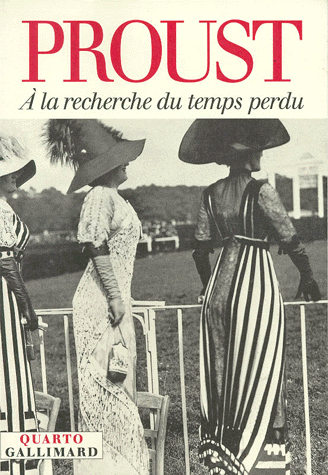
2. Longest book in the world:

‘A la recherche du temps perdu’ by Marcel Proust is the longest book in the world at 9,609,000 characters. Translated into Remembers of Things Past, the book tells the story of the narrator’s experiences growing up.

Via tumblr

3. Roald Dahl’s interesting life experiences:

Dahl served in the Royal Air Force during World War II and also tested chocolates for Cadbury’s while he was at school. (I guess we know where his inspiration for Charlie and the Chocolate Factory came from).

Via Telegraph

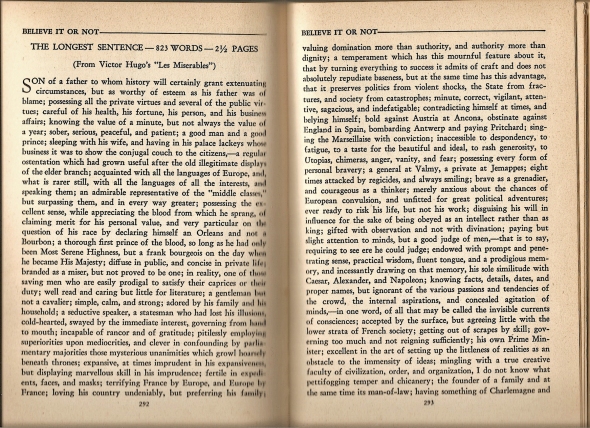
5. Victor Hugo’s 823 word long sentence:

In Victor Hugo’s novel, Les Miserables, you can find a sentence that is 823 words long. However, there may be other sentences that surpasses this length. But this one is worth knowing.

Via yankeeskeptic.com

6. J.K. Rowling is not actually her name:

Our favorite author who goes by initials, actually doesn’t have a middle name. After a suggestion from her publisher, she chose her grandmother’s name, Kathleen.

Via The Times

7. Charles Dickens’ superstitious behaviour:

Dickens believed that sleeping facing North, would improve his writing. He also carried a compass when travelling to make sure he was facing the right direction and he always touched things 3 times for luck.

VIa Telegraph

8. Tolstoy owes War and Peace to his wife’s efforts:

The 1400 page novel was copied around 7 times by Leo Tolstoy’s wife, Sophia, by hand – that’s love.

Via phlmetropolis.com

9. The words F. Scott Fitzgerald created that you use everyday:

Oxford English Dictionary notes the earliest use of the word ‘wicked’ to mean good/cool to be from Fitzgerald’s novel ‘This Side of Paradise’. He is also thought to have used the word T-shirt for the first time.

Via Penguin

10. The children’s story that China banned:

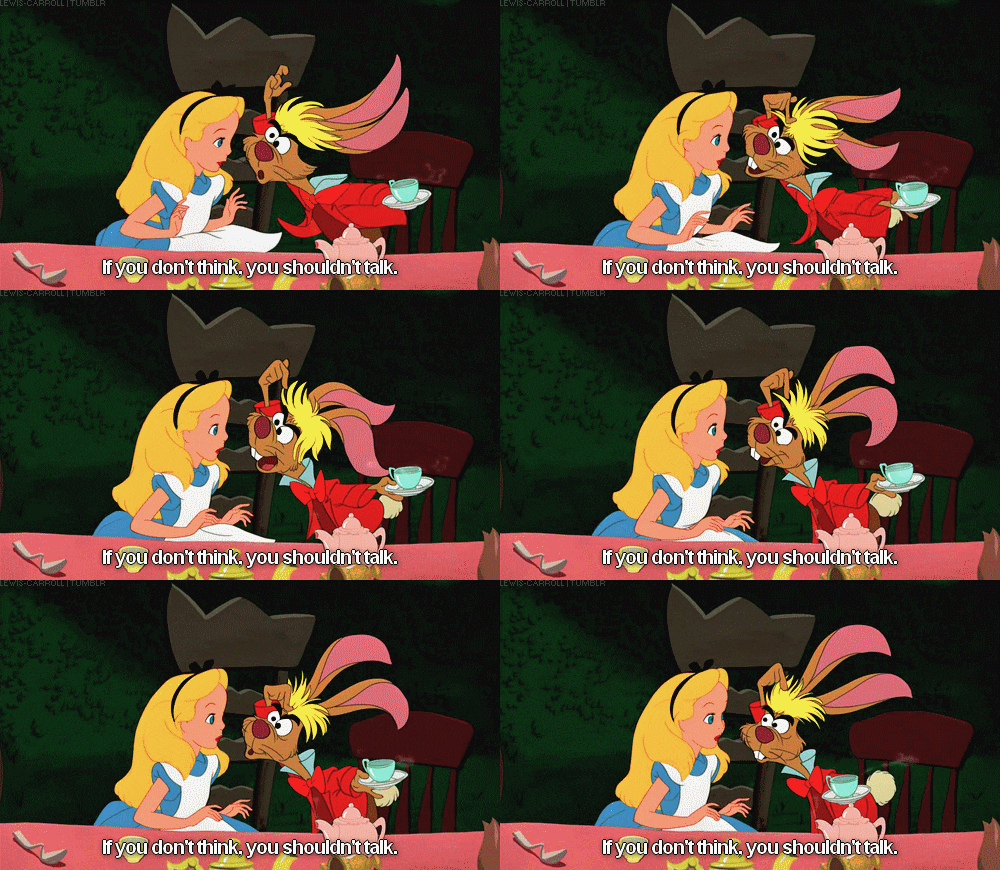
The Governor of Hunan Province in China banned Lewis Carroll’s Alice in Wonderland because he believed that animals should not be given the power to use the language of humans and to put animals and humans on the same level would be ‘disastrous’.


7 Life Rules That Will Position You for Greater Success

Your standards of work, ethics, personal development and responsibility set your course in life and business. Follow the seven tips below and remember to think as big as you can, expect nothing less than the best, have courage and most importantly, be kind.

1. Collaborate with others.

At its core, success is about relationships. Involve customers and colleagues in the creation and direction of your business pursuits. With them, set standards for the work that needs to be accomplished in each person’s area of responsibility. Make these standards challenging but achievable. The result will be the high-level productivity and service you aim to perform.

You can only go so far in business alone. You need others for your own success, empowerment and completeness. In business, choose your aims and equip your team to get your business where it needs to go, rewarding the team members along the way.

2. Never neglect.

Personal power and complacency cannot co-exist in the pursuit of success. Dedicate time and energy wherever necessary to ensure that no important areas of focus, personal or professional, are neglected.

Complete tasks and assignments and work hard to overcome obstacles, focusing on what you can gain, learn and improve upon to make life and business flow more effortlessly. Make lists of things which need to be done with expectations for performance and dates of completion. Focus your efforts on what is most important for the bigger picture, not on what is urgent. Urgency creates an irrational mind. Let those elements settle while you focus on what you can control.

3. Choose possibilities, not problems.

With personal power you possess the deep belief there are available solutions for problems. When you approach challenges from a solutions-focused perspective it engages the creative process of examining and architecting alternate routes in lieu of staying stuck in false beliefs of why things cannot be done.

If you cannot find a solution, open your thoughts to others, seek their ideas and suggestions. Solution-focused minds reward and inspire each other. When solutions are the focus you learn to fail and adapt, moving away from the fixing and failing approach.

4. Self-check.

To grow in personal power use the motivational mindset of consistently monitoring, evaluating and adjusting your own work, attitude and beliefs to stay clear of complacency so you may continue meeting your higher standards.

One of the best ways to keep yourself motivated in reaching your higher standards is to write things down and define your direction. Describe what superior performance would be in light of your chosen aims, and then describe what complacent performance would be and actions steps to stay away from lower level habits.

Personal power means you set performance standards somewhere between complacency and superiority.

5. Manage your time.

The power of now. To uphold your personal power examine where you spend most of your time. Do you get the most important tasks out of the way first or do you typically get through the small, tedious things which seem more urgent? Getting caught in the small, urgent tasks pull you from the more important aims requiring your attention. Focus on what is most important and work from there.

When it comes to relationships, be on time or early to all events, business and professional, as this gives your commitments the feeling of importance. When you can make another feel significant, this is power. How you are with time says much about your commitment and character as a person and leader.

When you respect your time and that of others, you and everyone around you, will work to much higher standards.

6. Accept responsibility.

Whatever happens in your life or career the best path to the development of your personal power is to accept responsibility for the outcomes, both positive and negative, which are the result of your efforts. If you make a mistake, see it as a self-created learning experience and figure out what needs to shift for you and your efforts to be more effective. Taking responsibility allows you to be flexible and change your approach.

Power is understanding mistakes gift you with more than they take. It is from mistakes all new directions arise.

Powerful leadership is not about ego. It is about humility and a willingness to learn. Inspire in others the willingness to accept personal responsibility for the outcomes of their work. To instill this you must first demonstrate these behaviors publicly, powerfully and consistently yourself.

Elevating another person to live at a higher level of existence is the gift your personal power inspires.

7. Be kind.

There is no greater a value to offer as a human being than the simple power of kindness. Kindness does not mean you are a “yes” person or a pushover. Kindness which is success generated is the kindness that can deliver good and bad news with grace. Kindness that is geared toward higher standards is the kindness which gives feedback rather than criticism. Kindness that inspires hard work is the kindness that sees possibilities not problems.

Be kind. Be good to yourself and the people you work with and for. Create the emotional environment around you to be infectious, contagious and advantageous to all who are blessed to be a part of it. Kindness will take you further in success than any other human attribute.

To have and to lead from personal power means you embrace your inalienable right to think for yourself, to speak your mind, to pursue happiness, success and financial gain, to seek inner awareness and a sense of peace, and to do so without having to conform to anyone else’s small standards including your own. Empower yourself by being yourself. Take advantage of what it means to have opportunity, to organize your pursuits, to be kind in your leadership and to strive for that beautiful and attainable sense of personal freedom.

In your freedom lies your power.

საინტერესო სიტყვები და გამონათქვამები – Birds of a feather flock together

“Birds of a feather flock together.”

What does it mean?

People like to spend time with others who are similar to them.

Where does it come from?

This proverb has been in use since at least the mid 16th century. In 1545, William Turner used a version of it in his papist satire The Rescuing of Romish Fox:

“Byrdes of on kynde and color flok and flye allwayes together.”

Which Book Would You Read?

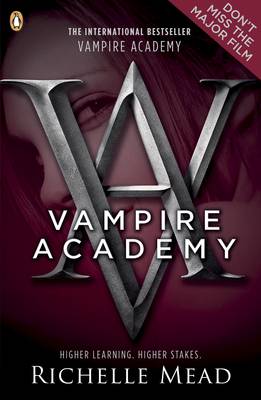
vampVampire Academy: Vampire Academy Series 1

ISBN: 9780141328522

Author: Richelle Mead

The story that kicked off the international #1 bestselling Vampire Academy series is NOW A MAJOR MOTION PICTURE!

St. Vladimir’s Academy isn’t just any boarding school—it’s a hidden place where vampires are educated in the ways of magic and half-human teens train to protect them. Rose Hathaway is a Dhampir, a bodyguard for her best friend Lissa, a Moroi Vampire Princess. They’ve been on the run, but now they’re being dragged back to St. Vladimir’s—the very place where they’re most in danger…

Rose and Lissa become enmeshed in forbidden romance, the Academy’s ruthless social scene, and unspeakable nighttime rituals. But they must be careful lest the Strigoi—the world’s fiercest and most dangerous vampires—make Lissa one of them forever.

Price: 24.9 ლ

[button color=”blue” size=”small” link=”http://onlinebookshop.ge/product/vampire-academy-vampire-academy-series-1/” target=”blank” ]Buy the Book[/button]


dracDracula

ISBN: 9780141199337

Author: Bram Stoker

Dracula has inspired countless movies, books, and plays. But few, if any, have been fully faithful to Bram Stoker’s original, best-selling novel of mystery and horror, love and death, sin and redemption.

Dracula chronicles the vampire’s journey from Transylvania to the nighttime streets of London. There, he searches for the blood of strong men and beautiful women while his enemies plot to rid the world of his frightful power.

Today’s critics see Dracula as a virtual textbook on Victorian repression of the erotic and fear of female sexuality. In it, Stoker created a new word for terror, a new myth to feed our nightmares, and a character who will outlive us all.

Price: 15.0 ლ

[button color=”blue” size=”small” link=”http://onlinebookshop.ge/product/dracula/” target=”blank” ]Buy the Book[/button]

Theme of the Week: Celebrating Authors of March

This week we celebrate authors of the past and present who had birthdays in the month of March. Check them out below.

Scott Hutchins                  

(March 4, 1974 – Present)

Hutchins is an American novelist and short-story writer. His work has appeared in The New York Times, San Francisco Magazine and Esquire Magazine. His debut novel A Working Theory of Love has been called both “revelatory and exciting” and “ambitious and accomplished.”

Mar 5 - hutchins


[button color=”blue” size=”small” link=”http://onlinebookshop.ge/product/working-theory-of-love-by-scott-hutchins/” target=”blank” ]Buy the Book[/button]

Kenneth Grahame         

(March 8, 1859 – July 6, 1932)

Grahame was a Scottish writer, most famous for The Wind in the Willows (1908), one of the classics of children’s literature. It was later adapted into a Disney film.

windwillows


[button color=”blue” size=”small” link=”http://onlinebookshop.ge/product/wind-in-the-willows/” target=”blank” ]Buy the Book[/button]

John Updike

(March 18, 1932 – January 27, 2009)

Updike was an American novelist, poet, short story writer, art critic, and literary critic. His most famous work is his “Rabbit” series, which chronicles the life of the middle-class everyman Harry “Rabbit” Angstrom over the course of several decades, from young adulthood to death.

03.03-updike


[button color=”blue” size=”small” link=”http://onlinebookshop.ge/vendor/john-updike/” target=”blank” ]Buy the Book[/button]

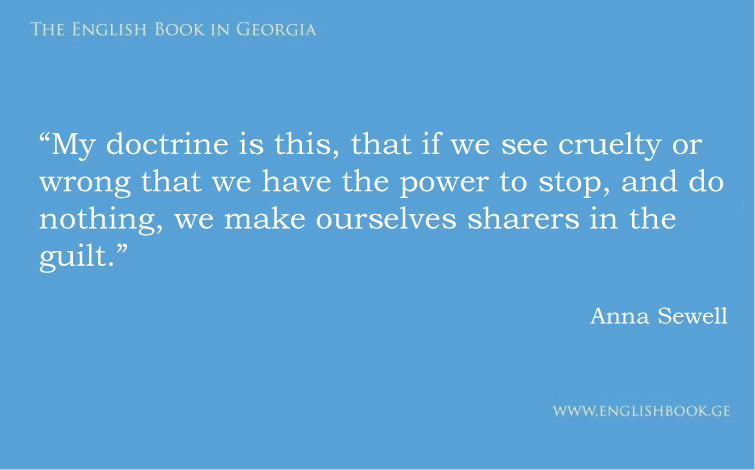
Anna Sewell

(March 30, 1820 – April 25, 1878)

Sewell was an English novelist, best known as the author of the classic novel Black Beauty.

black


[button color=”blue” size=”small” link=”http://onlinebookshop.ge/product/black-beauty/” target=”blank” ]Buy the Book[/button]

John Fowles

(March 31, 1926 – November 5, 2005)

Fowles was an English novelist of international stature, critically positioned between modernism and postmodernism.

ebony


[button color=”blue” size=”small” link=”http://onlinebookshop.ge/product/the-ebony-tower/” target=”blank” ]Buy the Book[/button]


Inspirational Quotes


Deprecated: preg_match_all(): Passing null to parameter #2 ($subject) of type string is deprecated in /home2/englita2/public_html/blogebg/wp-includes/media.php on line 1893

Deprecated: str_contains(): Passing null to parameter #1 ($haystack) of type string is deprecated in /home2/englita2/public_html/blogebg/wp-includes/shortcodes.php on line 150

Deprecated: preg_split(): Passing null to parameter #2 ($subject) of type string is deprecated in /home2/englita2/public_html/blogebg/wp-includes/formatting.php on line 3492

Managing a Large Class Size


Do you have more students this year? Education budget cuts across the country are one cause of class-size increase in public schools. If you’ve found yourself with larger class sizes, or you’re a new teacher still grasping the often overwhelming experience of one of you and many of them, here’s some helpful tips:

Tip #1: Don’t Give Up on Collaborative Grouping

Students need opportunities to check in with each other around their learning, ask questions, guide each other and reflect together. And this is even more crucial with a large class. If a tight classroom space won’t allow for quick triads or quad grouping, use “elbow partners” — two students in close proximity. Do this often. As we know, with large class sizes, quiet students tend to get even less airtime. With less one-on-one time with small groups and individual students, teachers need to keep that large number of kids talking and being listened to. You can do a “turn and talk” even for just 27 seconds. Much can be discovered, wondered about, and solidified in that half a minute.

Tip #2: Accept That Things Take Longer

Accept that presenting and discussing a unit’s learning objectives may have taken 20 minutes with that smaller class in the past, and probably takes twice as long with this larger group. Also, you might be lamenting over the days when you could whip around the room and spend a few quality moments with each student or group, or when you could offer immediate and thorough support. Unfortunately, if you did that now with 35 or more in the room, you’d find yourself out of time before coming close to accomplishing the daily learning objective.

One remedy, especially when it comes to checking for understanding? Strategies like thumbs up/thumbs down, or having students hold 1 to 3 fingers on their chest to let you know how well they understand (3 means “I’ve got it!) Other quick formative assessments, such as sentence starters, can help beat that Time Thief in the room. You can also use exit slips to see if they “got it,” asking one strategic question about the day’s learning.

Tip #3: Find New Ways to Know Students

Unfortunately, the larger the class size, the more the relationships with students suffer. Consider creating surveys once or twice a week where students can answer questions on a likert scale and also ask questions of you. Invite students to write a letter to you about their learning, their accomplishments, challenges, and interests.

You can also rotate your focus every few days to 5 or 6 different students. That way, no one will slip through the cracks. Often with large class sizes, the squeaky wheels, so to speak, are the one’s that receive much of the teacher’s time. Make sure you check in regularly with your “proficient” students, and continue to create differentiated assignments for those gifted kids in the room.

Tip #4: Be Okay With Loud and Letting Go

Start repeating this mantra immediately, “Just because it’s loud doesn’t mean they aren’t learning, just because it’s loud . . .” Somewhere along road, we began to attribute silence to deep thought and high-level learning. It’s more often just a sign of kids being compliant. So go ahead, take those 37 kids and put them in groups! Give them a challenging task and some supplies. Let it be loud! Roam from group to group and if your door suddenly swings open to visitors from the district, let them get an eye full of engaged, enthusiastic learners!

As for the letting go, if you are still passing out papers, collecting supplies, stamping homework all on your own, stop. Assign students “jobs” immediately. By giving up these managerial tasks, you will have more time free to check in with a child who has been absent a lot, add a step to an assignment for that advanced student, crack a joke with the quiet one who avoids others, or pose a strategic inquiry question to the whole class.

Inspirational Quotes


Deprecated: preg_match_all(): Passing null to parameter #2 ($subject) of type string is deprecated in /home2/englita2/public_html/blogebg/wp-includes/media.php on line 1893

Deprecated: str_contains(): Passing null to parameter #1 ($haystack) of type string is deprecated in /home2/englita2/public_html/blogebg/wp-includes/shortcodes.php on line 150

Deprecated: preg_split(): Passing null to parameter #2 ($subject) of type string is deprecated in /home2/englita2/public_html/blogebg/wp-includes/formatting.php on line 3492

საინტერესო სიტყვები და გამონათქვამები – Juxtapose

What does Juxtapose mean?

It is a verb that means to put side-by-side.

How do you pronounce it?

/dʒʌkstəˈpəʊz/

OR

juhk-stuh-pohz

Where does it come from?

From the French word juxtaposer which is based from the Latin word juxta meaning: ‘next’ + the French word poser meaning: ‘to place’.

How do you use it?

When comparing two paintings, it’s often helpful to juxtapose them so that you can distinguish the differences and similarities.

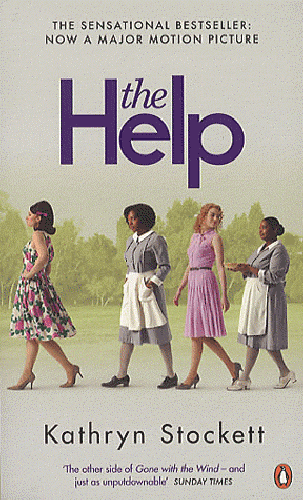
Book of the Week: The Help by Kathryn Stockett

Mar 18-the-help

Three ordinary women are about to take one extraordinary step.

Twenty-two-year-old Skeeter has just returned home after graduating from Ole Miss. She may have a degree, but it is 1962, Mississippi, and her mother will not be happy till Skeeter has a ring on her finger. Skeeter would normally find solace with her beloved maid Constantine, the woman who raised her, but Constantine has disappeared and no one will tell Skeeter where she has gone.

Aibileen is a black maid, a wise, regal woman raising her seventeenth white child. Something has shifted inside her after the loss of her own son, who died while his bosses looked the other way. She is devoted to the little girl she looks after, though she knows both their hearts may be broken.

Minny, Aibileen’s best friend, is short, fat, and perhaps the sassiest woman in Mississippi. She can cook like nobody’s business, but she can’’t mind her tongue, so she’s lost yet another job. Minny finally finds a position working for someone too new to town to know her reputation. But her new boss has secrets of her own.

Seemingly as different from one another as can be, these women will nonetheless come together for a clandestine project that will put them all at risk. And why? Because they are suffocating within the lines that define their town and their times. And sometimes lines are made to be crossed.

In pitch-perfect voices, Kathryn Stockett creates three extraordinary women whose determination to start a movement of their own forever changes a town, and the way women, —mothers, daughters, caregivers, and friends— view one another.

A deeply moving novel filled with poignancy, humor, and hope, The Help is a timeless and universal story about the lines we abide by, and the ones we don’’t.

[button color=”blue” size=”small” link=”http://onlinebookshop.ge/product/the-help-film-tie-in/” target=”blank” ]Buy the Book[/button]