Tag Archives: For Teachers

Educator’s Methodology: Part 3: 5 Quick Classroom-Management Tips for Novice Teachers

classroom-management

When it comes to managing a classroom, most of what new teachers learn is trial by fire. It’s also smart to heed the advice of those who have walked — and stumbled — before you. If you are struggling with discipline, here are five tips that you can start using right away:

1.            Use a normal, natural voice

Are you teaching in your normal voice? Every teacher can remember this from the first year in the classroom: spending those first months talking at an above-normal range until one day, you lose your voice.

Raising our voice to get students’ attention is not the best approach, and the stress it causes and the vibe it puts in the room just isn’t worth it. The students will mirror your voice level, so avoid using that semi-shouting voice. If we want kids to talk at a normal, pleasant volume, we must do the same.

You want to also differentiate your tone. If you are asking students to put away their notebooks and get into their groups, be sure to use a declarative, matter-of-fact tone. If you are asking a question about a character in a short story, or about contributions made by the Roman Empire, use an inviting, conversational tone.


2.            Speak only when students are quiet and ready

A 20-year teaching veteran advises that you should just wait and then wait some more until all students were quiet.

So try it! Fight the temptation to talk. Sometimes you may have wait much longer than you think could hold out for. Slowly but surely, the students would cue each other: “Sshh, she’s trying to tell us something,” “Come on, stop talking,” and “Hey guys, be quiet.” (They’ll do all the work for you!)

Your patience will pay off. And you’ll get to keep your voice.


3.            Use hand signals and other non-verbal communication

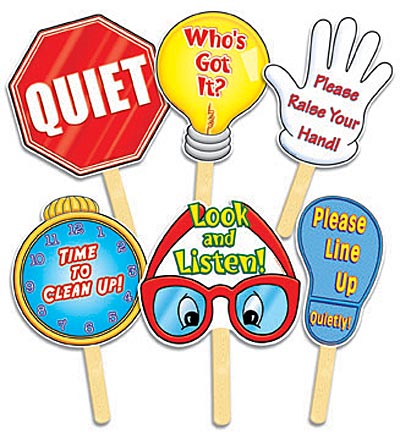
Holding one hand in the air and making eye contact with students is a great way to quiet the class and get their attention on you. It takes awhile for students to get used to this as a routine, but it works wonderfully. Have them raise their hand along with you until all are up. Then lower yours and talk.

Flicking the lights off and on once to get the attention is an oldie but goodie. It could also be something you do routinely to let them know they have three minutes to finish an assignment or clean up, etc.

With younger students, try clapping your hands three times and teaching the children to quickly clap back twice. This is a fun and active way to get their attention and all eyes on you.


4.            Address behavior issues quickly and wisely

Be sure to address an issue between you and a student or between two students as quickly as possible. Bad feelings — on your part or the students — can so quickly grow from molehills into mountains.

Now, for handling those conflicts wisely, you and the student should step away from the other students, just in the doorway of the classroom perhaps. Wait until after instruction if possible, avoiding interruption of the lesson. Ask naive questions such as, “How might I help you?” Don’t accuse the child of anything. Act as if you do care, even if you have the opposite feeling at that moment. The student will usually become disarmed because she might be expecting you to be angry and confrontational.

And, if you must address bad behavior during your instruction, always take a positive approach. Say, “It looks like you have a question” rather than, “Why are you off task and talking?”

When students have conflicts with each other, arrange for the students to meet with you at lunch, after or before school. Use neutral language as you act as a mediator, helping them resolve the problem peacefully or at least reach an agreeable truce.


5.            Always have a well-designed, engaging lesson

This tip is most important of all. Perhaps you’ve heard the saying, if you don’t have a plan for them, they’ll have one for you. Always over plan. It’s better to run out of time than to run short on a lesson.

Bored students equal trouble! If the lesson is poorly planned, there is often way too much talking and telling from the teacher and not enough hands-on learning and discovery by the students. We all know engaging lessons take both serious mind and time to plan. And they are certainly worth it — for many reasons.

Share with us your classroom management experiences: What specific challenges are you having? What strategies have worked well for you and your students? Please share in the comment section.

[button color=”blue” size=”small” link=”http://www.edutopia.org/blog/classroom-management-tips-novice-teachers-rebecca-alber” target=”blank” ]Source[/button]

 

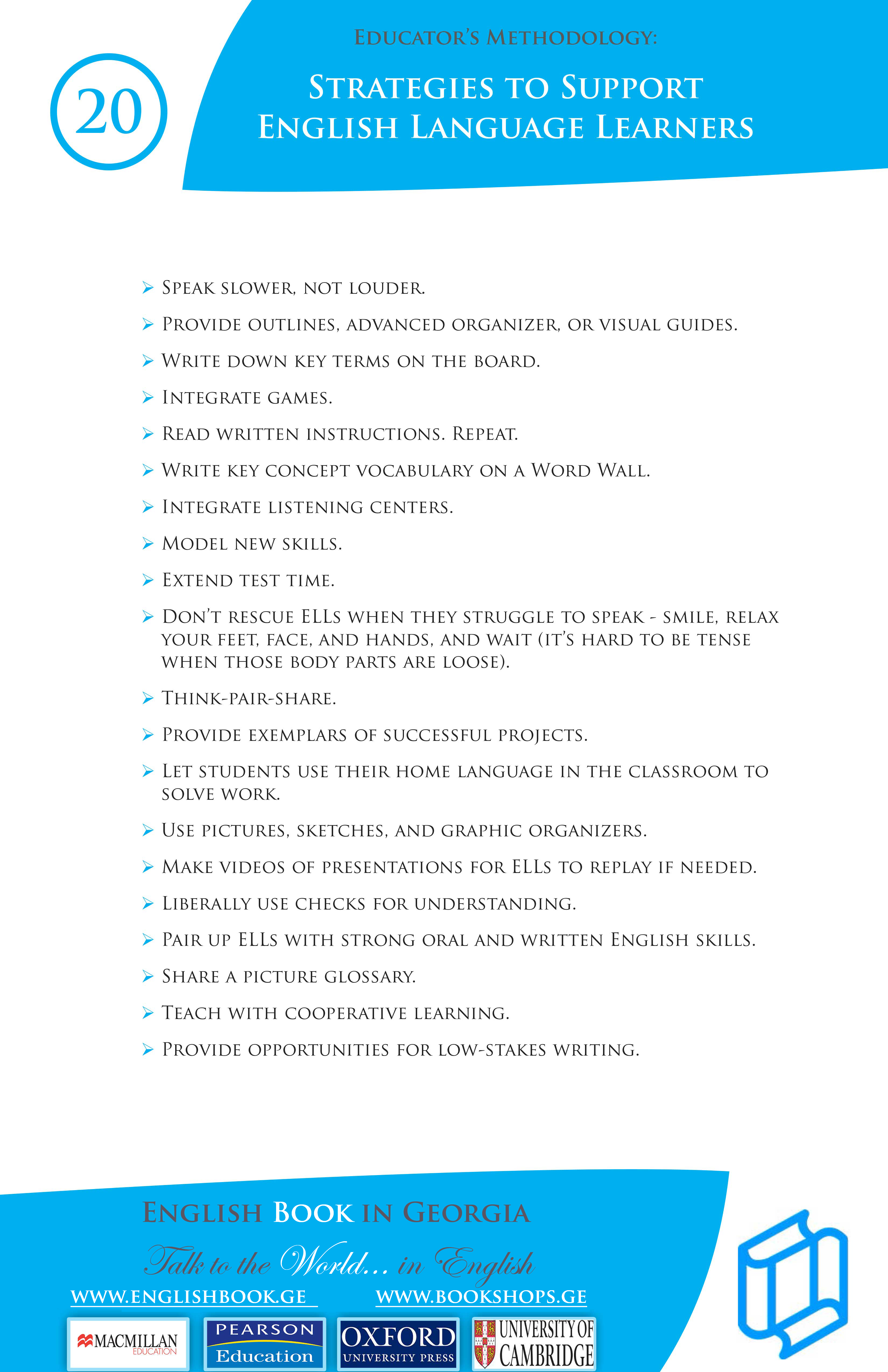
Educator’s Methodology: Part 2: 20 Strategies to Support English Language Learners

Continuing our 3 part series, Educator’s Methodology, to inform and educate people working in the education field. Last week we discussed developing students trust. This week we discuss support. We hope you enjoy this series and look forward to hearing your comments. Stay tuned and check out part 3 next week!

The below graphic is  free and can be printed for your personal use. Enjoy!

Educator's Method. - 20 Strat Poster


Educator’s Methodology: Part 1: Developing Students’ Trust: The Key to a Learning Partnership

We’d like to introduce you to a 3 part series we call Educator’s Methodology. It serves to inform and educate people working in the education field. We hope you enjoy this series and look forward to hearing your comments. Stay tuned and check out part 2 next week!

Educator’s Methodology

Part 1: Developing Students’ Trust: The Key to a Learning Partnership

Trust

By Ben Johnson (Administrator, author and educator)

I am a pragmatist, and I believe in simple, systemic solutions. I firmly believe that the true art/skill/magic/science of teaching is to perfectly match your style with the individual student’s needs. Conceptually, many teachers know this is the right way to teach. However, it flies in the face of what most teaching professionals practice. In many classrooms still, students must either adapt to the teacher’s way of teaching or fail.

I often reflect on what we call “teaching” and have come to the brilliant conclusion that it is less about what the teacher does and all about what students learn. How you approach teaching all comes down to what you believe about students and what methods you believe are the best ways to get them to learn. Here is one example of what I believe:

A shaggy but beautiful stray dog came to our house in the country one day. Our hearts went out to it, and we decided to help it. My wife and I put out some food, which it ate, but it refused to let us approach. Every time we tried, it would shy away and stay out of reach. The bottom line is that, for one reason or another, it did not trust us. Who knows what its history was? It trusted us enough to eat our food, but that was as far as it went.

I am sure that, given a few weeks, we could have built a relationship of trust with that dog — but, unfortunately, it moved on and we haven’t seen it since.

Students who come to our classrooms are much like that dog: Unless they trust us, they are unapproachable.

We earn our students’ trust by showing them respect in the form of meaningful, challenging, and rewarding learning activities that are worthy of their time and best efforts.

Students in their early years of school are naturally trusting, and — please don’t take this the wrong way — we abuse that trust in the name of socialization and classroom management. In essence, we teach them to obey rather than to build confidence to explore. As students get older, they often trust less and start behaving much like our shaggy and suspicious visitor. Most students will take what we offer but will not allow a learning partnership because they do not trust us.

Trust works the other way, too. As teachers, we have learned to distrust our students. All it takes is one disruptive young person to ruin it for the rest of the students that follow. We don’t want to get burned again, so we tighten the rules and narrow the focus. We develop an attitude that we can’t trust our students to learn independently. Especially in the early grades, we feel it is our responsibility to control every aspect of their learning activities so things don’t get out of hand, or so they don’t make a mess.

We could call this way of thinking the color-between-the-lines syndrome: We like everything neat and orderly. So, by the time the students get to high school, some know how to color between the lines, while others drop out because they don’t want to.

There is a solution to this: student-directed learning. As the name suggests, student independence and choice is a central part of it. Teaching is just as much about taking risks as learning is. A teacher has to take a chance on students and trust them enough to be independent learners. That can’t happen if the teacher is uncomfortable about tailoring the curriculum to multiple levels of student performance. (Does this sound familiar?) This lofty goal of differentiated instruction is achievable on many levels, but it is much easier to reach when teachers work together to help individual students.

Unfortunately, many teachers have tried cooperative groups, inquiry, project (process/product/performance)-based learning and had a terrible experience. Perhaps the students did not behave appropriately, or they did not learn, or it was a waste of time. Too often teachers with this first experience are hesitant to try again. Instead, they fall back on what they know works — students in straight rows, individual worksheets, slide show lectures, and direct instruction. If this applies to you, I would urge you to try again (trust again). I guarantee that each time you try again, it will get better. Students will learn what to do, they will behave better, and they will appreciate your trust.

As I said earlier, teaching flows from what an educator believes is the best way to teach a student. That belief is not demonstrated in mission statements and platitudes, but it is clearly visible in the way teachers set up and run their classrooms and in how they treat their students. Once a teacher understands the mechanics of the teaching (learning) cycle, discipline and classroom management take a secondary role and the teacher can begin to focus on what he or she can do to help each individual student to learn best — whatever it takes. We have to get beyond socialization and control, and teach students how to trust themselves to learn in the early grades. Otherwise, we will continue to be frustrated as we end up trying to teach a bunch of skittish stray dogs for students.

How do you feel about this approach? Please share your thoughts.

4 Big Things Transformational Teachers Do

ask questions

Transformational teachers don’t react, instead, they anticipate and prepare. Expert teachers should be able to have cognitive understanding of how students learn, emotional preparation to relate to many students whose needs aren’t always noticeable, content knowledge so that you can have different ways to introduce an idea; and, lastly, the ability to act on your teaching decisions quickly.

So how can you do that? Check out how below.

1. Transformational Teachers Create Constructivist Experiences

Instructors tend to use one of two instructional orientations:

  1. Transmission: Where “the teacher’s role is to prepare and transmit information to learners” and “the learners’ role is to receive, store, and act upon this information.”
  2. Transformational: Where students’ active engagement in developing knowledge and skills, critical thinking, higher order skills, and communication are facilitated by the instructor.

It is difficult to accomplish transformational teaching without understanding and implementing constructivist pedagogy — facilitating hands-on experiences — where students construct meaning through active learning. However, the checklist below suggests some tactics:

What Does Transformational Teaching Look Like?

1. Have students ask questions and solve real-world problems.

2. Questions should require students to:

  • Analyze
  • Synthesize
  • Create
  • Empathize
  • Interpret
  • Reference background knowledge
  • Defend alternative perspectives
  • Determine what they know and don’t know

3. Organize students into learning groups.

4. Make learning segments manageable through modeling and mastery.

5. Guide, facilitate, challenge, and support.

6. Let learning transform you.

2. Transformational Instructors Teach Like Scientists, Artists, and Essayists

Transformational teachers know that artful teaching without science lacks efficacy, and scientific teaching without aesthetics lacks vision. Says child psychologist Dr. David Elkind, “The art comes from the teacher’s personality, experience, and talents. The science comes from knowledge of child development and the structure of the curriculum.” The art and science of teaching work in harmony. Writes Richard Bankert, an eighth grade science teacher, “The best teachers are artists who know the science of teaching.”

In contrast to immature teachers who fill a 90-minute class with activities (and ignore targeted objectives), a transformational teacher treats those 90 minutes like a carefully crafted persuasive essay — with a clear purpose and unique sense of style, a memorable beginning and end, a logical sequence, important content, nimble transitions, and contagious passion. These characteristics persuade students to believe that learning the content and skills really matters.

3. Transformational Teachers Model Symphonic Thinking

To be effective in advancing human potential, teachers need to manifest what Daniel Pink calls “symphonic thinking” — critically appraising and synthesizing new ideas. Someone with symphony thinking skills is able to do the following:

  • Understand the logical connections between ideas.
  • Identify, construct, and evaluate arguments.
  • Detect inconsistencies and common mistakes in reasoning.
  • Combine different ideas to form a new concept.
  • Identify the relevance and importance of ideas.
  • Reflect on the justification of one’s own beliefs and values.

Such thinking is necessary in order for students to thrive in the new economy, according to Pink. It’s also necessary for teachers to model.

4. Transformational Teachers Facilitate Productive Struggle

It’s hard not to rescue kids when they beg for help. But that altruistic instinct can get in the way of learning. In a Wired Magazine piece, “Telling You the Answer Isn’t the Answer,” Rhett Allain explains why letting students engage in productive struggle is the unpopular and necessary approach to instruction:

What if a person was having trouble doing a pull up for exercise? Instead of giving them some other exercise, I could help them by doing the pull up for that person. Right? No, that wouldn’t actually be useful. However, if I push on the person’s feet a little bit, they can still struggle and still exercise.

Warning: allowing productive struggle to occur will consume more class time. However, when the learning process is frictionless, retention is less likely. Struggle actually saves re-teaching time in the long run and is the best way for new dendrites to grow.

Allowing productive struggle to occur, using artistic and scientific instruction, modeling symphonic thinking, and encouraging students to lean into constructivist problem solving can lead to the holy grail of transformational teaching: epiphany. We hope you’ll tell us about your transformational teaching in the comment area below.


[button color=”blue” size=”small” link=”http://www.edutopia.org/blog/big-things-transformational-teachers-do-todd-finley” target=”blank” ]Source[/button]

5 Ways to Help Your Students Become Better Questioners

berger-students-better-questioners

Asking questions are important tools in our lives. It helps us learn, adapt and explore. Questions are the most valuable aspects of our lives in a world that’s ever-changing. But many of us don’t seem to utilize or value asking questions as much as we should. We live in a world where the answers are the greatest reward but the question-the key to getting us to the answer-is almost intolerable.

Working in a system that only wants the answer and not the query is difficult especially when our culture might see questions as weakness. So teachers, you must strive to create a productive environment towards queries. Here are some suggestions from teachers, schools and organizations that work and promote a question based environment.

[tabs type=”vertical”][tabs_head][tab_title]Make It Safe[/tab_title][tab_title]Make It “Cool”[/tab_title][tab_title]Make It Fun[/tab_title][tab_title]Make It Rewarding[/tab_title][tab_title]Make It Stick[/tab_title][/tabs_head][tab]Asking a question can be a scary step into the void. It’s also an admission to the world (and more terrifyingly, to classmates) that one doesn’t know the answer. So teachers must somehow “flip the script” by creating an environment where questioning becomes a strength; where it is welcomed and desired. The Right Question Institute, a nonprofit group that teaches inquiry skills in low-income schools, encourages teachers to run group exercises dedicated entirely to formulating questions (no answers allowed!) — with clear rules and guidelines to ensure that students’ questions aren’t judged or edited, and that all questions are written down and respected. There are many variations on this type of exercise. The second-grade teacher Julie Grimm uses a “10 by 10” exercise, in which kids are encouraged to come up with 10 great questions about a topic during a 10-minute span. But the bottom line is, designate some kind of safe haven in the classroom where all students can freely exercise the “questioning muscle.”[/tab][tab]This is a tough one. Among many kids, it’s cool to already know — or to not care. But what if we could help students understand that the people who ask questions happen to be some of the coolest people on the planet? As I discovered in the research for my book on inquiry, questioners thought of many of those whiz-bang gadgets we now love. They’re the ones breaking new ground in music, movies, the arts. They’re the explorers, the mavericks, the rebels, making the world a more interesting place — and having a heck of a time themselves. How cool is that? [/tab][tab]Part of the appeal of “questions-only” exercises is that there’s an element of play involved, as in: Can you turn that answer/statement into a question? Can you open your closed questions, and close your open ones? There are countless ways to inject a “game” element into questioning, but here’s an example borrowed from the business world: Some companies use a practice called “the 5 whys,” which involves formulating a series of “why” questions to try to get to the root of a problem. Kids were practically born asking “why” questions, so why not allow them to use that innate talent within a structured challenge? Or, show them how to use the “Why/What if/How” sequence of questioning as a fun way to tackle just about any problem. Whatever the approach, let kids tap into their imaginations and innate question-asking skills in ways that make inquiry an engaging part of a larger challenge.[/tab][tab]Obviously, we must praise and celebrate the questions that are asked — and not only the on-target, penetrating ones, but also the more expansive, sometimes-offbeat ones (I found that seemingly “crazy questions” sometimes result in the biggest breakthroughs). Help create a path for students to get from a question to a meaningful result. A great question can be the basis of an ongoing project, a report, an original creation of some kind. The point is to show that if one is willing to spend time on a question — to not just Google it but grapple with it, share it with others, and build on it — that question can ultimately lead to something rewarding and worthwhile.[/tab][tab]If the long-term goal is to create lifelong questioners, then the challenge is to make questioning a habit — a part of the way one thinks. RQI’s Dan Rothstein says it’s important to include a metacognitive stage in question-training exercises wherein kids can reflect on how they’ve used questioning and articulate what they’ve learned about it, so they can “pave a new neural pathway” for lifelong inquiry. As for the behavioral habits associated with good questioning, here are a few: Questioners train themselves to observe everyday surroundings with “vuja de” eyes that see the familiar in fresh ways; they’re always on the lookout for assumptions (including their own) that should be questioned; and they’re willing to ask questions that might be considered “naïve” by others.[/tab][/tabs]

[button color=”blue” size=”small” link=”http://www.edutopia.org/blog/help-students-become-better-questioners-warren-berger” target=”blank” ]Source[/button]

Using Songs with Young Learners

Why to use songs with young children:

  • They are memorable, and so make students remember the language
  • They can be great fun
  • They cover the same topics as they kids are covering in the English lessons and other classes: animals (Old Macdonald), body parts (Teddy Bear Teddy Bear) etc.
  • They are the best way of marking different stages of the lesson
  • Students can listen to the songs at home and revise the language
  • They provide an easy way of changing the pace, e.g. settling down restless students with a lullaby-like calming song (Incy Wincy Spider etc.) or wearing them out with a manic, lively song (YMCA etc.)
  • They provide an achievable challenge for all levels of learner in mixed ability classes, by letting some students just show their understanding by doing the actions while others can sing along or even improvise their own words
  • They allow for lots of repetition of the language without kids getting bored (as long as you add variations), vital for learning in small children. Variations to keep it interesting include doing the song louder and quieter, slower and faster etc.

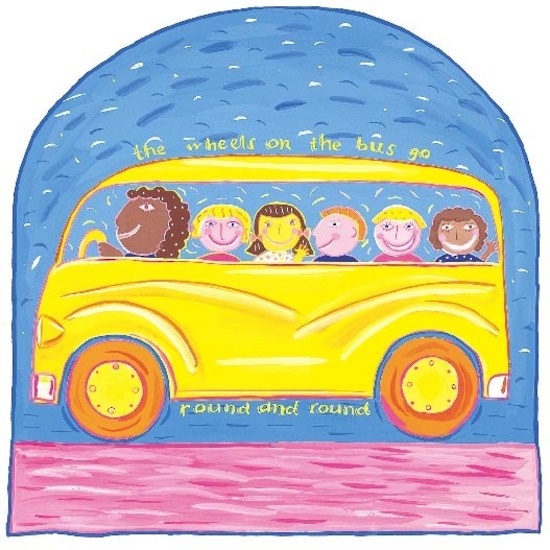
The Wheels on the Bus

Next question is how songs should be used. Here are some general principles for making a song ‘work’. First of all, what does ‘work’ mean? What are we aiming for when we use a song in class? Here are some of the things we might want to achieve by using a song:

  1. Students have fun and are therefore motivated for the rest of the lesson and future lessons
  2. Students learn quicker than with other methods
  3. Students remember longer than with other methods
  4. Students lose some of their inhibitions about speaking out, using rhythm and intonation when speaking, moving around and using gestures etc.
  5. Using the song reinforces other things you are working on in the classroom such as discipline, teaching kids to work together, rewarding good behaviour, fostering learner independence etc.

To make sure we achieve those things we will need to make sure that:

  1. The meaning of the song’s words can be made clear in a quick and easy way
  2. Whether the students understand the meaning of the song or not is easy to gauge
  3. The meanings and the song are easy to remember
  4. The song is suitable for the students in terms of age, speed, content, embarrassment factor
  5. The language in the song is similar to language they will be able to use in other parts of the class and/ or outside the class

Source

How to Activate and Use Macmillan Starter Pack

2014 წელს, კომპანიის „ინგლისური წიგნი საქართველოში“ შუამდგომლობით და რეკომენდაციით, გამომცემლობამ Macmillan Education ქართველ მასწავლებლებს შესთავაზა უფასო რესურსები დაწყებითი კლასებისთვის. ყველა მასწავლებელს დაურიგდა ინდივიდუალური საიდენტიფიკაციო კოდი.

ჩვენს YouTube გვერდზე ავტვირთეთ Macmillan Starter Pack-ის აქტივაციისა და გამოყენების ვიდეო ინსტრუქცია. ეს ინსტრუქცია, ქართულ ენაზე შედგენილ დოკუმენტთან ერთად (გადმოსაწერად დააჭირეთ აქ) დაგეხმარებათ გამოიყენოთ თქვენთვის უფასოდ განთავსებული რესურსები.

დამატებითი ინფორმაციისთვის შეგიძლიათ დაუკავშირდეთ კომპანიას “ინგლისური წიგნი საქართველოში”, გისურვებთ წარმატებას!

Classroom Resources: Fun Practice for Comparative Adjectives

The topic of comparatives like “bigger”, “further” and “more fun” is covered in the majority of lower level textbooks. However, as it is one of the grammar topics that students have most difficulty converting from textbook knowledge into fluent and accurate speech, more controlled spoken practice is always welcome – and by simply introducing connected adverbs like “far…” and “a bit…” it can also be useful in higher level classes.

Describing with comparatives guessing games
One of the simplest games for this grammar point is for one person to describe an object using comparatives until someone guesses what it is, e.g. “It is the biggest thing here, but it is shorter than a giraffe. It isn’t as heavy as a whale” for “elephant”. Wrong guesses should be replied to with another clue comparing the real object with that wrong guess, e.g. “No, this thing isn’t a snake. It isn’t as scary as a snake.”
The objects described can be ones in the room, on a worksheet or on the board – or students can think of their own ideas. Instead of shouting out the name of the thing to guess, students could slap the relevant flashcard, run and touch the relevant classroom object, etc.

Guess the comparison
This game is in New English File 1 photocopiable materials. A student reads out a comparison with the adjective missing and the other students must try to guess the missing bit, e.g. “more informal” from “(Mobile phone) texts are usually __________ than emails”. You could allow one point for other adjectives that are true, but to win or get the maximum number of points students must guess exactly the adjective that is in the original sentence. As with this example, this game can be used as a way of showing the differences between easily confused words. It can also be used to present cultural differences. After the examples on the worksheets, students can make their own gapped sentences to test other groups.

Guess the comparison hint by hint
This is a slight variation on the game above. Students give more and more example sentences with the same missing comparative until someone who is listening works out what the missing word is. Each hint should be linked to the last one. For example, they could start with “The projector is probably the most lalala thing in this room”, then “A car is even more hmmmhmmmm than the projector” etc until their partner guesses that the missing words are “expensive”. The game then continues with different adjectives.

Perfect picture dictation
A Picture Dictation is a task in which one student describes something that the other student can’t see (e.g. something on their worksheet) for the person listening to draw. In one variation, the person speaking is allowed to see what the other student is drawing or has drawn and to tell them what changes are needed with language like “The nose should be longer” and “The glasses should be more rounded”.

Warmer/ cooler numbers
Students are asked to guess a number, e.g. the population of a country or the height of something in the classroom, and are given hints like “No, it’s much shorter” and “Nearly, but it’s a little heavier” until they get exactly the right number. As the comparatives are in the hints rather than the guesses, students should then ask similar questions (from their own knowledge, their research or a worksheet) to test each other in the same way.

Comparative forms race
The teacher or a student shouts out one adjective and students race to shout out the correct comparative form, getting one point for a correct answer but minus five for a wrong guess. This works best with regular comparative adjectives they haven’t seen the comparative forms of before, plus maybe a few ones that don’t match the most common rules such as “more fun”. You could also let them use their dictionaries (racing to be first to find the correct answer) if none of them are confident enough to use their own knowledge or guess.

More activities can be found here

Getting Ready for the Conference

Dear all,

We are happy to inform you that the preparations for the conference are almost finalized!

Starting from tomorrow, the conference will gather hundreds of Georgian English language teachers in four different cities: Batumi (25 June), Kutaisi (26 June), Telavi (27 June) and Tbilisi (28 June).

The event is organized by English Book in Georgia with the great support of Macmillan and we are honored to have Jim Scivener (a freelance writer, consultant, teacher, trainer and conference speaker), Maura O’Brien (teacher trainer), Philip Kerr (lecturer, teacher trainer and materials writer), Teresa Doğuelli (teacher trainer) and Nick Goode(Regional Manager, Central Europe for Macmillan Education) as the guest-speakers of the conference.

მოგესალმებით,

კონფერენციის მზადება თითქმის დასრულებულია! ხვალიდან საქართველოს ოთხ ქალაქში: ბათუმი(25 ივნისი), ქუთაისი(26 ივნისი), თელავი(27 ივნისი), თბილისი(28 ივნისი) ინგლისური ენის პედაგოგებისთვის ჩატარდება კონფერენცია, რომელიც გაიმართება „ინგლისური წიგნი საქართველოში“-ს ინიციატივითა და Macmillan-ის მხარდაჭერით.

კონფერენციის მომხსენებლები არიან Jim Scivener (a freelance writer, consultant, teacher, trainer and conference speaker), Maura O’Brien (teacher trainer), Philip Kerr (lecturer, teacher trainer and materials writer), Teresa Doğuelli (teacher trainer), Nick Goode(Regional Manager, Central Europe for Macmillan Education), რომლებიც Macmillan-ის და English Book in Georgia-ს მოწვევით ესტუმრებიან საქართველოს.