Tag Archives: educator’s methodology

Educator’s Methodology: Part 3: 5 Quick Classroom-Management Tips for Novice Teachers

classroom-management

When it comes to managing a classroom, most of what new teachers learn is trial by fire. It’s also smart to heed the advice of those who have walked — and stumbled — before you. If you are struggling with discipline, here are five tips that you can start using right away:

1.            Use a normal, natural voice

Are you teaching in your normal voice? Every teacher can remember this from the first year in the classroom: spending those first months talking at an above-normal range until one day, you lose your voice.

Raising our voice to get students’ attention is not the best approach, and the stress it causes and the vibe it puts in the room just isn’t worth it. The students will mirror your voice level, so avoid using that semi-shouting voice. If we want kids to talk at a normal, pleasant volume, we must do the same.

You want to also differentiate your tone. If you are asking students to put away their notebooks and get into their groups, be sure to use a declarative, matter-of-fact tone. If you are asking a question about a character in a short story, or about contributions made by the Roman Empire, use an inviting, conversational tone.


2.            Speak only when students are quiet and ready

A 20-year teaching veteran advises that you should just wait and then wait some more until all students were quiet.

So try it! Fight the temptation to talk. Sometimes you may have wait much longer than you think could hold out for. Slowly but surely, the students would cue each other: “Sshh, she’s trying to tell us something,” “Come on, stop talking,” and “Hey guys, be quiet.” (They’ll do all the work for you!)

Your patience will pay off. And you’ll get to keep your voice.


3.            Use hand signals and other non-verbal communication

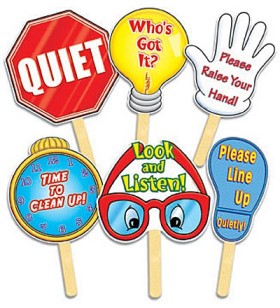
Holding one hand in the air and making eye contact with students is a great way to quiet the class and get their attention on you. It takes awhile for students to get used to this as a routine, but it works wonderfully. Have them raise their hand along with you until all are up. Then lower yours and talk.

Flicking the lights off and on once to get the attention is an oldie but goodie. It could also be something you do routinely to let them know they have three minutes to finish an assignment or clean up, etc.

With younger students, try clapping your hands three times and teaching the children to quickly clap back twice. This is a fun and active way to get their attention and all eyes on you.


4.            Address behavior issues quickly and wisely

Be sure to address an issue between you and a student or between two students as quickly as possible. Bad feelings — on your part or the students — can so quickly grow from molehills into mountains.

Now, for handling those conflicts wisely, you and the student should step away from the other students, just in the doorway of the classroom perhaps. Wait until after instruction if possible, avoiding interruption of the lesson. Ask naive questions such as, “How might I help you?” Don’t accuse the child of anything. Act as if you do care, even if you have the opposite feeling at that moment. The student will usually become disarmed because she might be expecting you to be angry and confrontational.

And, if you must address bad behavior during your instruction, always take a positive approach. Say, “It looks like you have a question” rather than, “Why are you off task and talking?”

When students have conflicts with each other, arrange for the students to meet with you at lunch, after or before school. Use neutral language as you act as a mediator, helping them resolve the problem peacefully or at least reach an agreeable truce.


5.            Always have a well-designed, engaging lesson

This tip is most important of all. Perhaps you’ve heard the saying, if you don’t have a plan for them, they’ll have one for you. Always over plan. It’s better to run out of time than to run short on a lesson.

Bored students equal trouble! If the lesson is poorly planned, there is often way too much talking and telling from the teacher and not enough hands-on learning and discovery by the students. We all know engaging lessons take both serious mind and time to plan. And they are certainly worth it — for many reasons.

Share with us your classroom management experiences: What specific challenges are you having? What strategies have worked well for you and your students? Please share in the comment section.

[button color=”blue” size=”small” link=”http://www.edutopia.org/blog/classroom-management-tips-novice-teachers-rebecca-alber” target=”blank” ]Source[/button]


Educator’s Methodology: Part 2: 20 Strategies to Support English Language Learners

Continuing our 3 part series, Educator’s Methodology, to inform and educate people working in the education field. Last week we discussed developing students trust. This week we discuss support. We hope you enjoy this series and look forward to hearing your comments. Stay tuned and check out part 3 next week!

The below graphic is  free and can be printed for your personal use. Enjoy!

Educator's Method. - 20 Strat Poster


Educator’s Methodology: Part 1: Developing Students’ Trust: The Key to a Learning Partnership

We’d like to introduce you to a 3 part series we call Educator’s Methodology. It serves to inform and educate people working in the education field. We hope you enjoy this series and look forward to hearing your comments. Stay tuned and check out part 2 next week!

Educator’s Methodology

Part 1: Developing Students’ Trust: The Key to a Learning Partnership

Trust

By Ben Johnson (Administrator, author and educator)

I am a pragmatist, and I believe in simple, systemic solutions. I firmly believe that the true art/skill/magic/science of teaching is to perfectly match your style with the individual student’s needs. Conceptually, many teachers know this is the right way to teach. However, it flies in the face of what most teaching professionals practice. In many classrooms still, students must either adapt to the teacher’s way of teaching or fail.

I often reflect on what we call “teaching” and have come to the brilliant conclusion that it is less about what the teacher does and all about what students learn. How you approach teaching all comes down to what you believe about students and what methods you believe are the best ways to get them to learn. Here is one example of what I believe:

A shaggy but beautiful stray dog came to our house in the country one day. Our hearts went out to it, and we decided to help it. My wife and I put out some food, which it ate, but it refused to let us approach. Every time we tried, it would shy away and stay out of reach. The bottom line is that, for one reason or another, it did not trust us. Who knows what its history was? It trusted us enough to eat our food, but that was as far as it went.

I am sure that, given a few weeks, we could have built a relationship of trust with that dog — but, unfortunately, it moved on and we haven’t seen it since.

Students who come to our classrooms are much like that dog: Unless they trust us, they are unapproachable.

We earn our students’ trust by showing them respect in the form of meaningful, challenging, and rewarding learning activities that are worthy of their time and best efforts.

Students in their early years of school are naturally trusting, and — please don’t take this the wrong way — we abuse that trust in the name of socialization and classroom management. In essence, we teach them to obey rather than to build confidence to explore. As students get older, they often trust less and start behaving much like our shaggy and suspicious visitor. Most students will take what we offer but will not allow a learning partnership because they do not trust us.

Trust works the other way, too. As teachers, we have learned to distrust our students. All it takes is one disruptive young person to ruin it for the rest of the students that follow. We don’t want to get burned again, so we tighten the rules and narrow the focus. We develop an attitude that we can’t trust our students to learn independently. Especially in the early grades, we feel it is our responsibility to control every aspect of their learning activities so things don’t get out of hand, or so they don’t make a mess.

We could call this way of thinking the color-between-the-lines syndrome: We like everything neat and orderly. So, by the time the students get to high school, some know how to color between the lines, while others drop out because they don’t want to.

There is a solution to this: student-directed learning. As the name suggests, student independence and choice is a central part of it. Teaching is just as much about taking risks as learning is. A teacher has to take a chance on students and trust them enough to be independent learners. That can’t happen if the teacher is uncomfortable about tailoring the curriculum to multiple levels of student performance. (Does this sound familiar?) This lofty goal of differentiated instruction is achievable on many levels, but it is much easier to reach when teachers work together to help individual students.

Unfortunately, many teachers have tried cooperative groups, inquiry, project (process/product/performance)-based learning and had a terrible experience. Perhaps the students did not behave appropriately, or they did not learn, or it was a waste of time. Too often teachers with this first experience are hesitant to try again. Instead, they fall back on what they know works — students in straight rows, individual worksheets, slide show lectures, and direct instruction. If this applies to you, I would urge you to try again (trust again). I guarantee that each time you try again, it will get better. Students will learn what to do, they will behave better, and they will appreciate your trust.

As I said earlier, teaching flows from what an educator believes is the best way to teach a student. That belief is not demonstrated in mission statements and platitudes, but it is clearly visible in the way teachers set up and run their classrooms and in how they treat their students. Once a teacher understands the mechanics of the teaching (learning) cycle, discipline and classroom management take a secondary role and the teacher can begin to focus on what he or she can do to help each individual student to learn best — whatever it takes. We have to get beyond socialization and control, and teach students how to trust themselves to learn in the early grades. Otherwise, we will continue to be frustrated as we end up trying to teach a bunch of skittish stray dogs for students.

How do you feel about this approach? Please share your thoughts.