Category Archives: Teacher Resources

For Secondary teachers looking to develop the four key language skills in the 21st century classroom

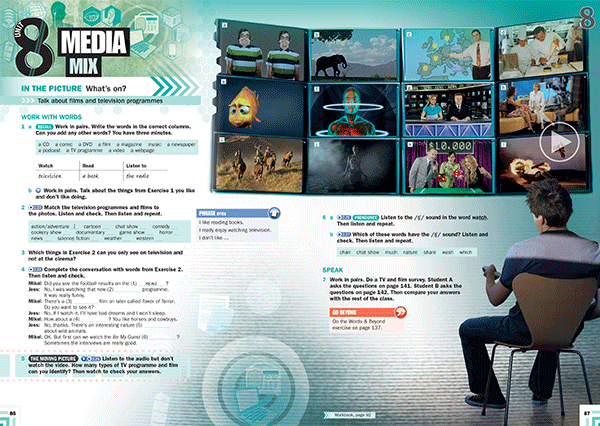
Beyond is a new six-level course for teenagers, from A1+ to B2. The course is based on detailed CEFR mapping and helps to prepare students for international exams.

The creative and dynamic approach to topics motivates students to engage with the material, making language learning more meaningful and successful. Two separate video strands (Speaking videos and Moving Picture videos), accompanied by a variety of task types, bring the pages to life and make the new language accessible and motivating for this age group.

Beyond-about-double-sml

Beyond focuses on developing strong linguistic skills, as well as teaching the wider skills and strategies students need to improve as language learners. Beyond develops a comprehensive and practical sub-skills syllabus, equipping students with invaluable skills they can transfer to other areas of their education.

Language-and-Beyond-216x300

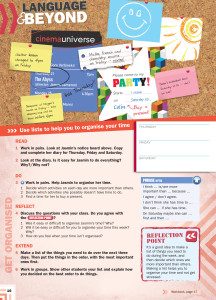
The inclusion of age-appropriate, 21st century life skills introduces a new dimension to language teaching. With their strong links to the unit topic and language, the life skills lessons ensure students not only develop academically, but also grow into self-aware, considerate and confident individuals with the ability to think for themselves. A life skills lesson in every unit promotes planning and organisation, critical thinking, problem-solving, social skills or cultural awareness.

The regular use of multimedia materials and class and homework activities on the Resource Centreensures that the students are learning from a variety of sources. The language practice environment for students is extended into an Online Workbook which provides a wide range of interactive and engaging activities accessible on computers or mobile devices.

BeyB1plusOWB_new3

Make your English classroom a wonderful place to be with these resources on the environment.

environment

The environment we are in affects our moods, ability to form relationships, effectiveness in work or play—even our health. In addition, the early childhood group environment has a very crucial role in children’s learning and development for two important reasons.

First, young children are in the process of rapid brain development. In the early years, the brain develops more synapses or connections than it can possibly use. Those that are used by the child form strong connections, while the synapses that are not used are pruned away. Children’s experiences help to make this determination. The National Scientific Council of the Developing Child compares the development of the brain to constructing a house stating, “Just as a lack of the right materials can result in blueprints that change, the lack of appropriate experiences can lead to alterations in genetic plans.” They further state, “Building more advanced cognitive, social, and emotional skills on a weak initial foundation of brain architecture is far more difficult and less effective than getting things right from the beginning” (2007, p. 1). Because children’s experiences are limited by their surroundings, the environment we provide for them has a crucial impact on the way the child’s brain develops.

The second reason that the early childhood group environment has such a strong role in children’s development is because of the amount of time children spend in these environments. Many children spend a large portion of their wakeful hours in early childhood group settings. For example, a baby beginning child care will spend up to 12,000 hours in the program. This is more time than he will spend in both elementary and secondary school (Greenman, 2005a, p. 1). Children will typically spend another 4,000 hours in kindergarten through third grade classrooms.

[gview file=”http://englishbookgeorgia.com/blogebg/wp-content/uploads/2018/03/USRHN10000012_Environment_ws.pdf”]

[gview file=”http://englishbookgeorgia.com/blogebg/wp-content/uploads/2018/03/USRHN10000013_Environment_search_pz.pdf”]

[gview file=”http://englishbookgeorgia.com/blogebg/wp-content/uploads/2018/03/USRHN10000014_Environment_search_pz_ak.pdf”]

[gview file=”http://englishbookgeorgia.com/blogebg/wp-content/uploads/2018/03/USRHN10000015_Environment_gm.pdf”]

[gview file=”http://englishbookgeorgia.com/blogebg/wp-content/uploads/2018/03/USRHN10000016_environment_wu.pdf”]

[gview file=”http://englishbookgeorgia.com/blogebg/wp-content/uploads/2018/03/USRHN10000017_Environment_fi.pdf”]

[gview file=”http://englishbookgeorgia.com/blogebg/wp-content/uploads/2018/03/USRHN10000018_Environment_fl.pdf”]

[gview file=”http://englishbookgeorgia.com/blogebg/wp-content/uploads/2018/03/USRHN10000019_Environment_Chant_ac.pdf”]

[gview file=”http://englishbookgeorgia.com/blogebg/wp-content/uploads/2018/03/USRHN10000020_environment_lp.pdf”]

how children learn at different stages of development

outsourcing-product-development

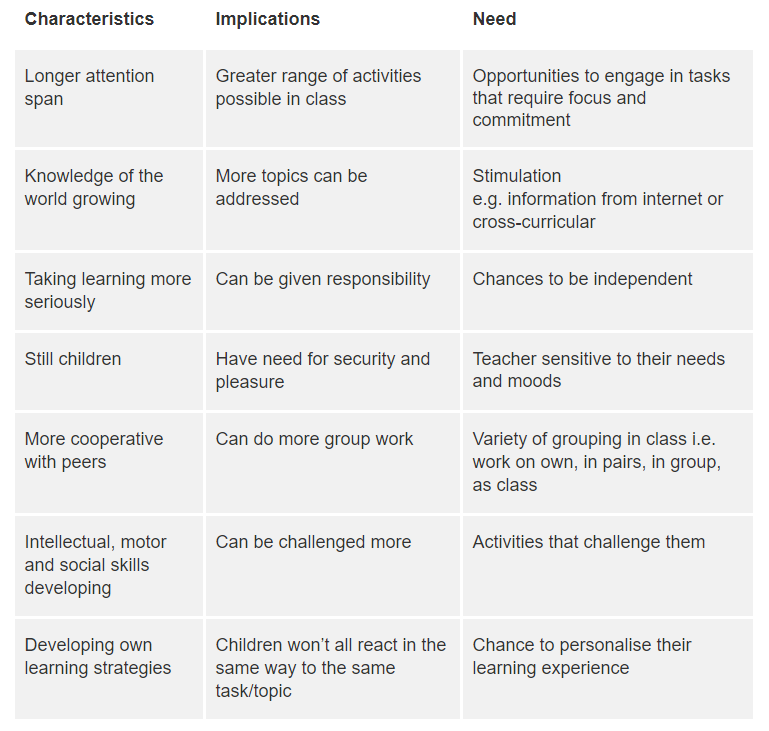
This section looks at how children learn at different stages of development and how activities in the classroom need to address their cognitive, motor, language and social development.

Children between four and twelve years old are very different as language learners, so here we take a look at how children learn at different stages of development and how activities in the classroom need to address their cognitive, motor, language and social development.

Obviously children do not all fit neatly into categories and their development will depend on their personality, maturity and previous learning experiences. You will no doubt recognise how your own students fit the descriptions. The age groups will be grouped as: 4-6, 7-9 and 10-12 year old

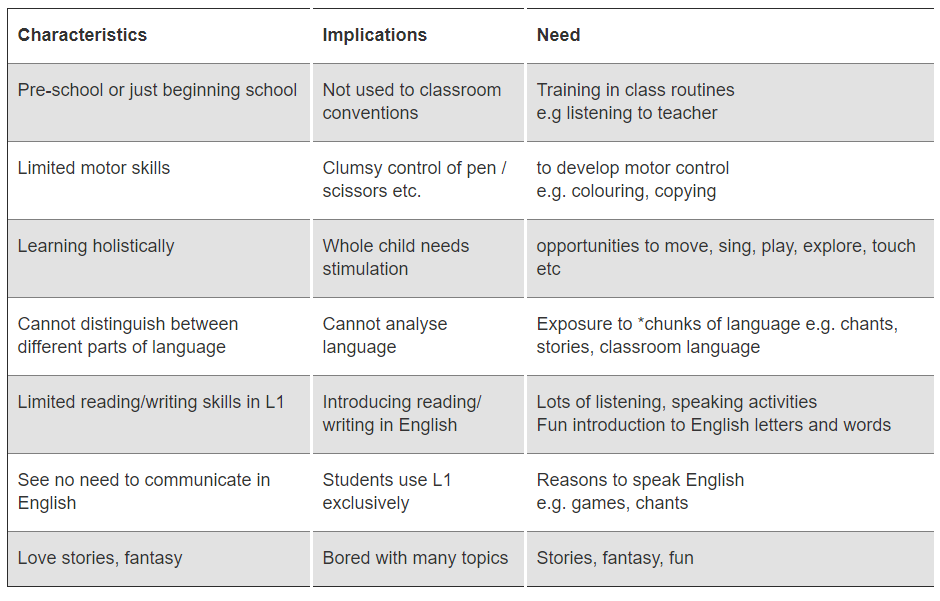
Children: 4-6 year-olds

4-6

Chants

Chants are great as children

  • learn to work together
  • pick up chunks
  • get to listen to lots of meaningful language
  • have a reason to use English
  • find them funny
  • move their body
  • enjoy repeating them

Chants are easy to make up. I made this one up for my 5-6 year olds. They had already begun learning animals. We chanted it together and did actions for the different animals. (pretended to splash water etc)

  • My name’s Fred and I’m a frog – jump, jump, jump
  • My name’s Kate and I’m a cat – miaow, miaow, miaow
  • My name’s Fergie and I’m a fish – splash, splash, splash
  • My name’s Micky and I’m a mouse – squeak, squeak, squeak
  • My name’s Benny and I’m a bird – flap, flap, flap

This is a lovely chant with a rhythm that children enjoy. They can stretch their arms out to show ‘big’ and bring their hands close together to show ‘little’. It also helps to develop:

Motor skills – children will enjoy colouring in the pictures that come with the chant. Colouring demands concentration, eye/hand coordination and hand control – all important pre-writing skills

Word recognition – when beginning word recognition they can draw a line between the animal words – cat, mouse etc and the and the pictures

 Songs

Classic songs like Old MacDonald had a farm (see related pages below)are very popular with young children. This is a version of the song that encourages students to produce long vowel sounds. It also practises the numbers one to four.  Farms are pretty universal. Young students enjoy making the animal noises and farm animals are a nice lexical set.

To create a nice wall display, get children to draw their favourite farm animal and the teacher (or a child who draws quickly and finishes their animal) can draw a big farm to paste the animals onto. More animals can be added later as well as a farmer etc. Once they begin writing, students can label the different animals.

Stories

There are many story books based on animals. Children love listening to stories about animals especially If there are colourful, child-friendly visuals to help them follow the story. You can also use cuddly animal toys while story-telling to get and hold the children’s attention.

Games

Children all love games. 4 – 6 year olds have still to develop cooperative skills, so introducing games that involve turn-taking helps to develop these skills. Do not despair if they get impatient or want to take each other’s turns – they are still learning to be less egocentric and need lots of opportunities to allow these skills to develop (see related pages The animal game below).

The first version of the game is appropriate for 4 – 6 year olds as they simply have to count out the steps of the game according to what their dice lands on and then name the animal on the spot.

Cutting and colouring

See related pages How things work below. The students get to create a herd of elephants by cutting out an elephant and naming him/her. They can also colour it in. They can practise the ‘What’s your elephant called?’  & ‘He’s / She’s called….’


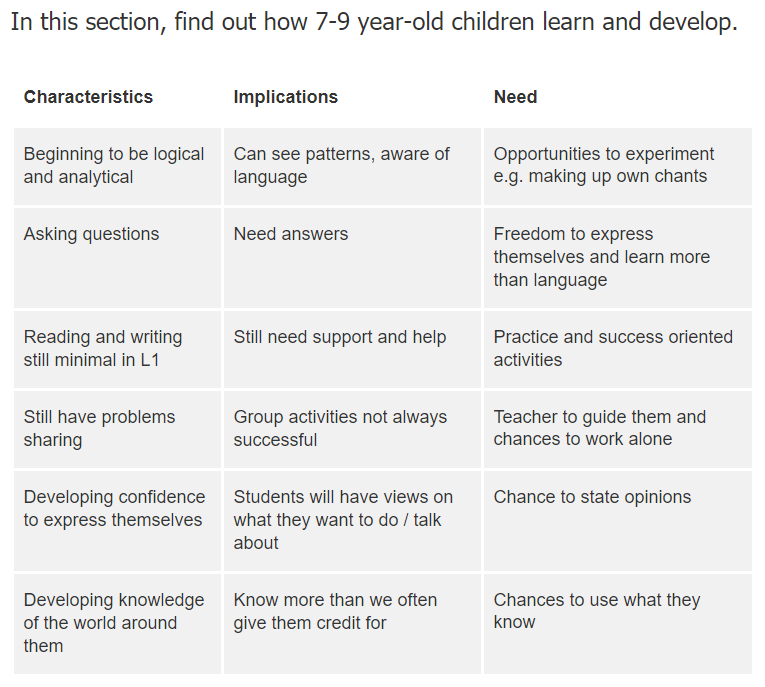
Children: 7-9 year-olds

7-9

Chants

Children at this age group still love chants, but can add their own verses too. This stimulates their creative skills and gives them a sense of achievement when they can produce their own (see Five little speckled frogs song in related pages below).

World knowledge

The quiz at the bottom of the page requires not just linguistic knowledge, but also knowledge about animals.

Wall displays

By now many children are developing their writing skills and becoming proficient drawers. They also get a great sense of achievement from seeing what they have created.

A mini-project on animals is easy to set up. Each child chooses an animal they like. They draw a picture of the animal and write sentences based on a model* provided by the teacher. The pictures are neatly mounted on the classroom walls. Invite parents in too to see these lovely displays.

model:

  • …………… is a big/small animal
  • …………… lives in the jungle / on a farm / in my house
  • ………….. eats leaves / other animals/ …………..
  • ………….. can fly / run / swim etc etc


Children: 10-12 year-olds

10-12

Projects

By now it is clear that students have very different approaches to learning and have distinct preferences and interests. A project on animals can ensure all are satisfied.

Students can choose to work independently or with a partner(s)

Get students to choose an animal, or the creative ones can create a new one!

Students choose whether to create a wall display, a book or a presentation on their animal

Their work can include illustrations, their own or ones they find

Their project can be a factual description about the animal including information found in books, the internet etc or it can be a story about the animal. It could also be a poster calling for conservation of a particular species

Give a time limit – say 2 or 3 lessons for them to prepare their work and then it can either be displayed, shared or presented

This is especially good in a mixed ability class. Students who are not so keen on writing can create something more visual and very enthusiastic students have more scope for their imagination and language skills

Printable young learner worksheets

levinson-169hero-playintesting-shutterstock

A selection of worksheets and lesson plans from Macmillan resources.

We offer a broad range of worksheets on this site. We are proud to say our worksheets cover every area in teaching ESL/EFL Young learners and beginners. We have handwriting worksheets, crossword puzzles, word searches, grammar sheets, coloring (colouring) exercises, reading text mazes, word scrambles and lots more. The worksheets have been carefully classified according to sets.


[gview file=”http://englishbookgeorgia.com/blogebg/wp-content/uploads/2018/02/Classroom-cubes.pdf”]

[gview file=”http://englishbookgeorgia.com/blogebg/wp-content/uploads/2018/02/Racing-past.pdf”]

Welcome to Next Move

NM_logo1-toucan_2

Macmillan Next Move is a fun and engaging seven-level British English course which takes students on a journey through different countries and cultures as they explore the English language.

With fresh and dynamic Pupil’s Books and Workbooks and new digital materials, both teachers and students will always be on the move with Macmillan Next Move.      MNM-Three-covers

Key features:

-A reading comprehension programme with fiction and non-fiction texts.

– A variety of activities to develop competencies and story-based lessons to develop values.

-New digital components with resources for teachers and students including videos and animated phonics.

Find out all about the Macmillan Next Move course and browse sample print and digital resources to discover how our rich content can support you and your learners inside and outside the classroom.
If you are already a Macmillan Next Move teacher, register or log-in to access our Teacher Resources including printable tests and a variety of printable templates to enhance your lessons.
[gview file=”http://englishbookgeorgia.com/blogebg/wp-content/uploads/2018/02/mnm1_scope.pdf”]
[gview file=”http://englishbookgeorgia.com/blogebg/wp-content/uploads/2018/02/mnm1_pb01.pdf”]
[gview file=”http://englishbookgeorgia.com/blogebg/wp-content/uploads/2018/02/mnm1_tb01.pdf”]

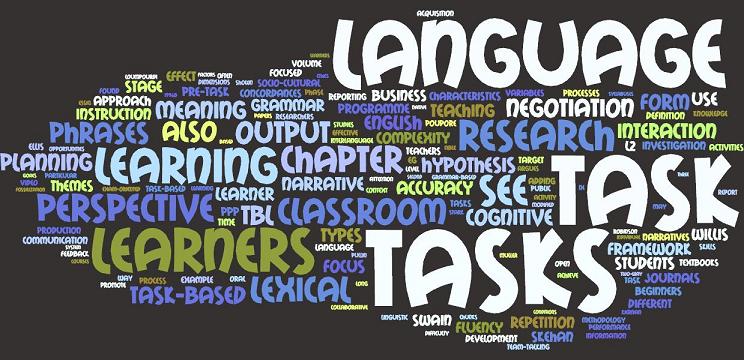
Task-based grammar teaching

WordleTask60

Introduction

One approach to teaching language that has attracted a lot of attention over the past twenty-five years is a task based approach to learning and teaching. In task-based approaches, the focus of classroom activities is on the task, and ultimately on meaning (for more on Task Based Teaching and Learning, see the Methodology section). In Jane Willis’ flexible model for task-based learning, learners begin by carrying out a communicative task, without specific focus on form. After they have done the task, they report and discuss how they accomplished this, perhaps listening to a fluent speaker doing the same task. Only at the end is there a specific focus on features of language form.

The advantage of the task-based approach, according to its advocates, is that during the task the learners are allowed to use whatever language they want, freeing them to focus entirely on the meaning of their message. This makes it closer to a real-life communicative situation.

One danger of task-based approaches is that focus on meaning could come at the expense of focus on form. Learners become quite fluent, but their utterances are not often accurate. In addition, they develop strategies to complete the tasks quite quickly, cutting corners in their language use and form.

Nevertheless, the task-based model is an attractive and liberating one, especially if you and your learners have been accustomed to a Presentation – Practice – Production model. The attached lesson plan follows Jane Willis’ flexible task-based learning framework* to teach the grammar point used to.

Aim:
Students discuss how they were different 10 years ago.

Level:
Pre-intermediate
Preparation

  1. For this class you need a photograph of yourself when you were 10 years younger (or thereabouts). This works best if you look considerably different in the photo than you do now.
  2. You also need to prepare a short text about how your life was different then to what it is now. In this text include at least two examples of things you used to do and two examples of things you didn’t use to do. You can either record this text onto a cassette to play for the students, or practise reading it out loud until you are able to “speak” it comfortably in front of the class.
  3. Prepare a written version of this text that you can distribute to the class.

Pre-task warmer

Aim: To prepare students for the task, to engage their attention.

Tell the students that you are going to show them a photo of you from 10 years ago. Ask them what they think will be different, but don’t correct them at this stage (i.e. respond to the meaning of what they say, not the form). Allow time for three or four suggestions. Then take out the photo of yourself and walk around the class, showing it to the students. Ask them what was different about you then. Put the picture up on the board and ask “What else was different about my life, do you think?” Allow more comments and suggestions from the class, but don’t tell them if they are right or wrong in their guesses. Explain that they will find this out later.

Task

Aim: For students to discuss how their life was different ten years ago.

Ask students to work in groups of three. Tell them to talk about their life ten years ago. Put the following questions on the board:

  • What did you look like?
  • What was different about your life?
  • Did you have different likes and dislikes? Different hobbies?
  • Are you very different now?

Explain that the questions are to help them start talking. Give them a time limit of three to five minutes to discuss this. Circulate and listen to the students doing the task, but do not correct any language at this moment.

Planning

Aim: For students to prepare an oral report of their task.

Stop the task. Tell the students that they must work together to prepare a summary of their discussion to report to the whole class. They must write notes for this summary and be prepared to report this orally to the rest of the class. Set a time limit of five minutes for them to do this.

Report

Aim: For students to present their reports and find out who was most different ten years ago.

When the students are ready, ask a spokesperson from each group to report the group’s summary. Tell the class that they must listen to each group’s report and decide at the end of all the reports which students have changed the most in the past ten years.After all the reports, ask students who they think has changed the most. You could ask the students who have changed the most to bring in a photo of themselves at that time.
Post-task listening

Aim: For students to hear a fluent English speaker doing the same task.

Draw the student’s attention back to the photo of you on the board and explain that you are going to ask them to listen to you doing the same task that they did.Read or play the recording that you made. Ask the students some quick comprehension questions about what they heard (e.g. What did I say about my hair? What did I say about my job?) If the students find it difficult to understand, repeat the text again.

Language focus

Aim: To raise students’ awareness about the target language.
Choose two or three sentences from your text which include the grammar “used to” and write them on the board. For example:

a) I used to go to heavy metal concerts.
b) I used to have long black hair.
c) I used to wear tight leather trousers.
d) I didn’t use to do my homework.

Check that students understand the meaning of the sentences. This is best done by concept check questions. For example a) above, the concept check questions would be:

  • Did I go to heavy metal concerts in the past? (Yes)
  • Was it a regular occurrence? (Yes)
  • Do I go to heavy metal concerts now? (No).

Explain the rules of form for used to:

  • used to + infinitiveand
  • didn’t use to + infinitive

At this point you could distribute the script of your story and ask students to find other examples of how you used used to. Point out that in English we use used to to talk about states and habits that continued for a period of time in the past.

Language practice

Aim: To give the students some restricted written practice in the target language.

If you feel that your class needs some restricted practice in the grammar, ask them to write down three things that they used to do and three things that they didn’t use to do when they were children. Circulate and monitor. Ask students to check their sentences with each other and elicit some examples to put on the board.

Optional follow-up

Aim: To give the students a chance to repeat (and hopefully improve) the task.

Ask students to work with a partner that they haven’t worked with yet during this class. Tell them to repeat the same task as they did at the beginning of the class, but that they should try to include the target structure used to into their speaking.

Once students have practised together, ask a couple to report back to the class what they talked about with their partner. Use this time to focus on accuracy, i.e. correct what they say if they make mistakes using the target language.

Using games for win-win learning

Dice-e1516866978505

Using games for win-win learning

Like many people around the world, I recently took time off at the end of December and the New Year to relax at home. A common feature of any holiday season, alongside eating large meals and seeing family and old friends, is playing games. For example, my son was playing with a new video game console and within a short time I was addicted and striving to reach the ‘next level’. Then, after finishing off yet another large meal, someone suggested playing a board game that hadn’t been opened since last year. Initially, there was typical resistance to starting a game which had a long set of rules and which could take up the whole evening. And yet, 15 minutes later, everyone was thoroughly engrossed and participating fully.

This was a demonstration of just how engaging games can be! And it doesn’t stop at board games, there are action or guessing games, treasure hunts, trivia or memory games, games with props, online games, or even game shows on TV (which we invest our time in with no hope of winning an actual prize). Games incorporate fun, incite collaboration and competition, which in combination is incredibly motivating.

One theory for the motivational power of games (both physical and online) is that players reach a mental state where they are completely focused on the task. This is sometimes referred to as ‘flow’ (1); in other words, the difficulty of the game is not too hard or too easy, equally matched to the player’s skill level.

It is at this level that games have the most potential as valuable classroom tools. As teachers, we are always looking for classroom activities which take students to that place in their language learning when they feel fully engaged and motivated to continue to the end. Of course, we normally think of games as involving winning and losing, but when we use games in the classroom I prefer to think of them as achieving a win-win outcome.

Yes, you can try to win the game, but you also win by taking advantage of playing a well-designed language practice game. Because when games work well, students often forget that they are doing an exercise, as they start to use English in their state of flow.

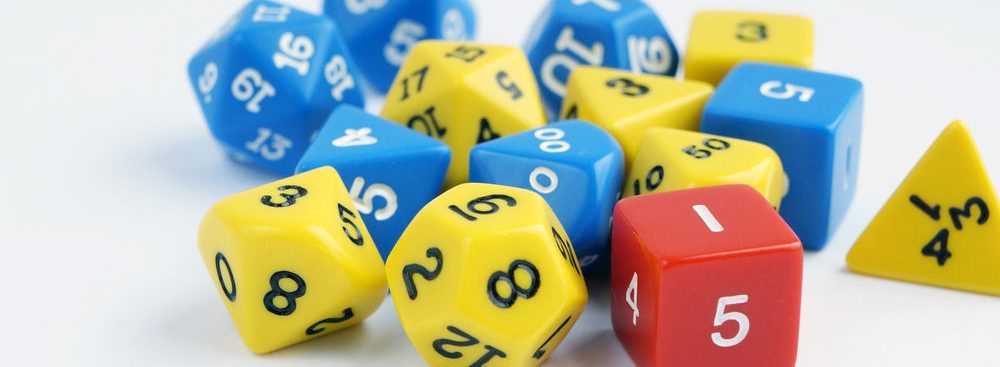
As for the type of language that games can practise, I have yet to find a language point that a game isn’t good for! Take, for example, the board game format where everyone starts on one square, rolls a dice and moves round the board landing on different squares. For vocabulary, you can write different words on squares and students have to say a sentence with the word or ask another player a question using the word. For functional language, write speaking tasks on the squares such as ‘Ask the player on your right out for dinner this evening.’ Or even have students make their own board game and write the rules for other teams to play.

Finally, when choosing or creating a game to use in the classroom with your students, try to make sure that it contains these five components which all begin with the letter ‘C’:

  • Games benefit from having an element of chance which can be created by the throwing of a dice or picking up of a card at random. Chance adds tension to a game, and for language practice it encourages students to use language in response to changing situations.
  • Challenge. Players like to feel a sense of achievement in a game and this is only reached by including the right level of difficulty and including factors where students must succeed against adversity in some way.
  • Competition. Although you don’t want a classroom entirely based on winning and losing, a little bit of competition is often an effective way to change the pace of a lesson.
  • Collaboration. Games which involve students working together in teams or pairs are the perfect way to create a collaborative environment in which students support each other’s learning.
  • Communication. This is probably the most important C. Games for provide students with an authentic reason to communicate, allowing them to start using the targeted language.

When using Macmillan English, Benefits for parents

MacmillanEnglish-hompage_2b

Macmillan English is the first International English coursebook to be informed by English lessons in native-speaker classrooms. It is designed for second-language learners of English but uses many of the approaches to reading, writing and speaking that underpin the teaching of English to first-language children.

Designed for students who have a high number of contact hours in English, this six-level course recognizes that proficiency in English is an essential part of modern life, and that early exposure to rich and genuine language allows young learners to move confidently towards native-speaker fluency in both oral and written English.

In the early levels, the course does not assume a first-language child’s experience of spoken English or culture. Language structures are introduced and practised to give a firm grounding in grammar, but from the start, the exposure to new language is more extensive than in traditional second-language courses.

As children move up through the course, they experience more first-language teaching methods. At the upper levels children cover the same aspects of English as do first-language learners, though the needs of second-language learners are always taken into account.

Each level of Macmillan English is delivered through eighteen units. Each unit has six lessons requiring a minimum of seven teaching sessions.

Useful advice on practicing English at home. Short activities to revise and recycle what your child is learning in class. Some activities are suitable for parents who do not know English.

[gview file=”http://englishbookgeorgia.com/blogebg/wp-content/uploads/2018/02/Web_Parent_Help_L1.pdf”]

[gview file=”http://englishbookgeorgia.com/blogebg/wp-content/uploads/2018/02/Web_Parent_help_L2.pdf”]

How to make your own question loop activites: Teacher’s note

IMG1

Your pupils will love these easy, fun and effective speaking activities that consolidate knowledge of popular CLIL topics such as animals, the human body and plants.

How do they work? Each pupil receives a strip of paper containing a question or a definition and an answer to a separate question. One pupil begins by reading out their question to the rest of the class. The rest of the class looks at their slips of paper to see if they have the answer. When one pupil spots that they have the answer, they shout it out, then read out their own question. The process continues until the questions loop back to the beginning. Very easy, fun, and effective!

Each set of question loops is accompanied by procedural guidance on exactly how to conduct the activity in class.

These notes explain how to create your  very own questions loops

[gview file=”http://englishbookgeorgia.com/blogebg/wp-content/uploads/2018/02/How-to-make-your-own-question-loops.pdf”]