[gview file=”http://englishbookgeorgia.com/blogebg/wp-content/uploads/2017/10/Animal_World_Map_Activities.pdf”]
content-views-query-and-display-post-page domain was triggered too early. This is usually an indicator for some code in the plugin or theme running too early. Translations should be loaded at the init action or later. Please see Debugging in WordPress for more information. (This message was added in version 6.7.0.) in /home2/englita2/public_html/blogebg/wp-includes/functions.php on line 6170js_composer domain was triggered too early. This is usually an indicator for some code in the plugin or theme running too early. Translations should be loaded at the init action or later. Please see Debugging in WordPress for more information. (This message was added in version 6.7.0.) in /home2/englita2/public_html/blogebg/wp-includes/functions.php on line 6170gravity-forms-pdf-extended domain was triggered too early. This is usually an indicator for some code in the plugin or theme running too early. Translations should be loaded at the init action or later. Please see Debugging in WordPress for more information. (This message was added in version 6.7.0.) in /home2/englita2/public_html/blogebg/wp-includes/functions.php on line 6170
[gview file=”http://englishbookgeorgia.com/blogebg/wp-content/uploads/2017/10/Animal_World_Map_Activities.pdf”]
| Big English
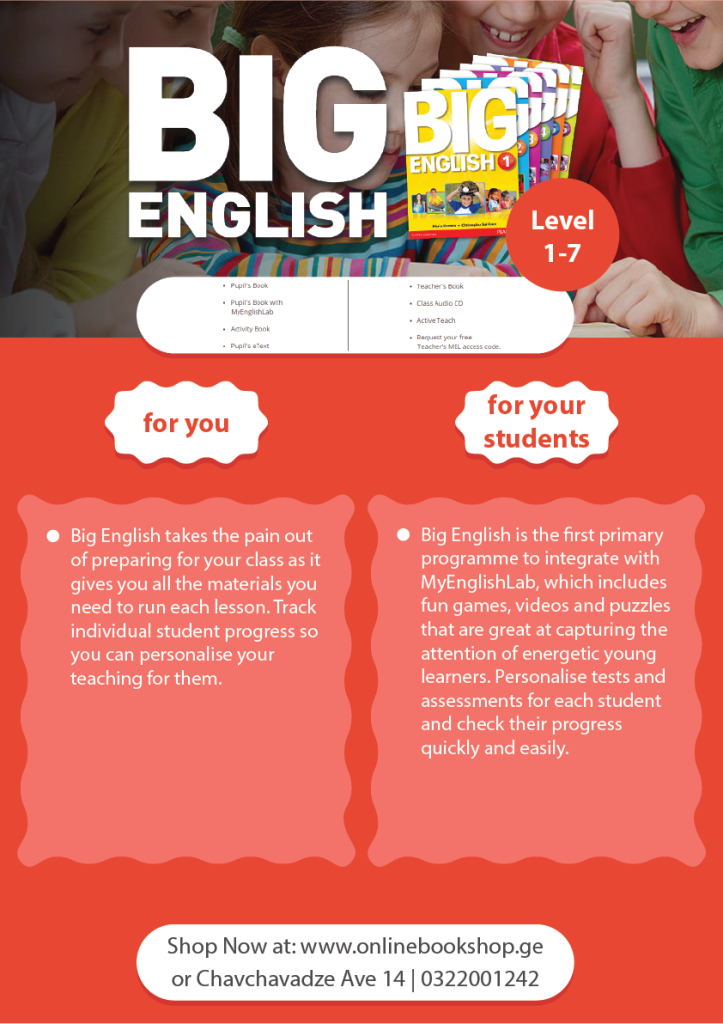
What is Big English? Big English gives you the most complete English course combined with the very best of technology. It gives you everything you need for your lessons so that you have time to focus on what you do best – teach.
|
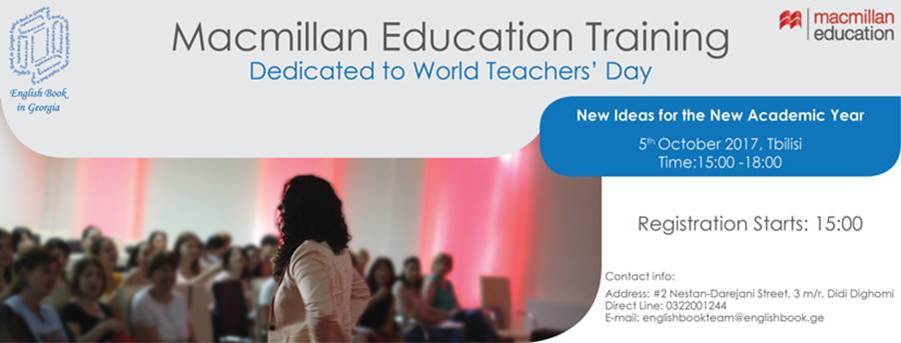

For detailed information please download the Agenda
[gview file=”http://englishbookgeorgia.com/blogebg/wp-content/uploads/2017/09/5-October-Training-Agenda.pdf”]

Some think that just because technology plays a key role in ‘blended’ classrooms, teachers are no longer central to the model. This isn’t true. Blended learning does not imply a silent classroom full of students all working individually on their computers while their teacher addresses technical issues. The model combines the best of both worlds, which means that teachers are just as important as computers.
The technology provides access to the online materials, sure, but it’s the teacher who chooses what to do. The technology also marks closed practice activities, but teachers facilitate open activities and assess students’ language use. Teachers also recognize and praise their effort.
In short, teachers shouldn’t feel threatened by technology, but rather see an opportunity to improve their work.
“Blended Learning myths: busted!”, Graham Skerritt. Cambridge University Press, 5 April, 2017, P10

A fun experiment for teachers to do with their students involves accents. An accent is a particular way of speaking that tells you a lot about the speaker (their geographic and social background). The experiment starts out with splitting into groups of three. Then, each person has to speak for 60-90 seconds about a topic of interest while the other two listeners make notes on the speaker’s pronunciation. Then, in order, the groups discuss their findings.
This can be extremely beneficial to both students and teachers, as they’ll be more aware of their accents and be able to better grade language and understand differences between accents and the range of variation. Though there are broad types of accents, each person has his or her own ways of pronouncing things. Being aware of such differences is crucial for teachers.
Source: Ozog, Chris “’I don’t have an accent!’ Said Alison from Sussex” Cambridge University Press, 4 April, 2017, P3

Tiger Time is a vibrant, six-level primary course based around different settings and characters which grow and change with the students, reflecting their evolving interests and needs.
Units contain humorous stories told through different genres, which use everyday language as well as catchy songs, chants and raps at the lower levels. Within each unit lessons are carefully structured focusing first on vocabulary, grammar and skills, and building to CLIL, culture and projects, allowing children to practise and consolidate their learning throughout the unit. Each unit ends with a review, encouraging active communication.
Written with classroom management in mind, activities are practical and well-staged. The accompanying Presentation Kit and Teacher’s Resource Centre help teachers create dynamic lessons, which cater to diverse classroom situations. The Student’s Resource Centre provides a home-school connection offering extra activities and support.
Components for students:
Components for teachers:
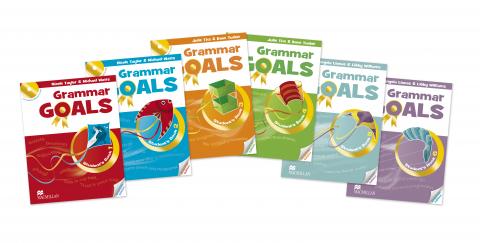
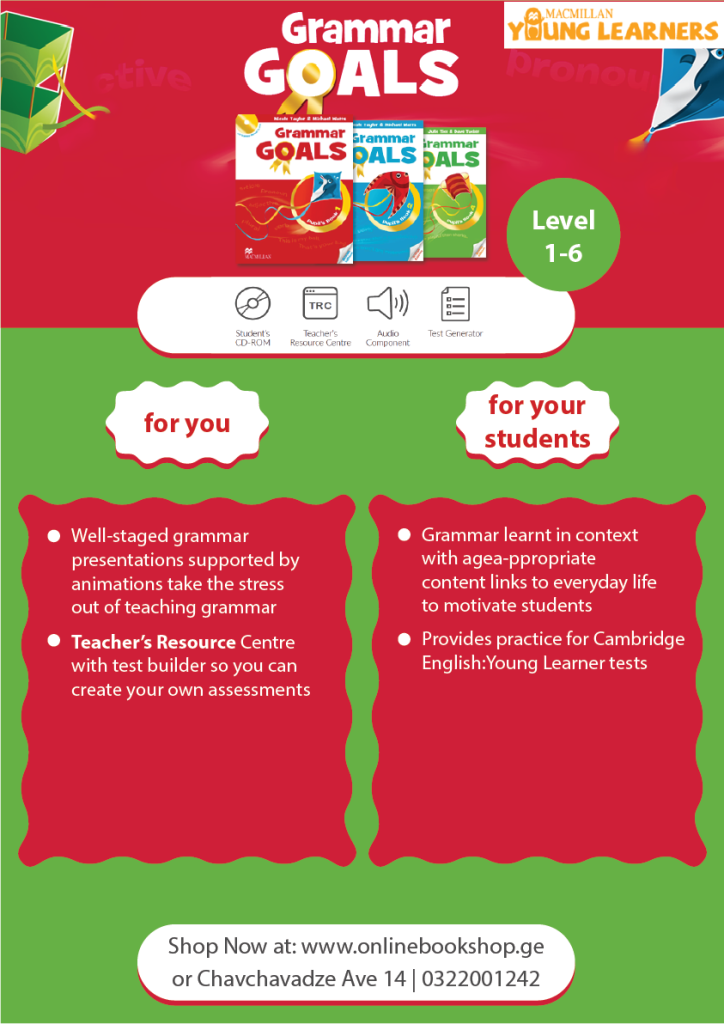
Grammar Goals is a new six-level grammar series for children aged 6-12 years. It presents and practises grammar in lively and meaningful age-appropriate contexts that reflect pupils’ real lives and interests. Linked to the Cambridge and Trinity external exam syllabuses, Grammar Goals offers regular exam-style practice tasks in the Pupil’s Books.
The visually appealing nature of the course ensures that grammar is presented in a child-friendly format that keeps pupils actively involved in learning the language form, function and meaning. The careful staging of the units provides three levels of challenge and success – bronze, silver and gold – helping students reflect on their progress and aim for higher goals.
Key features:
Authors:
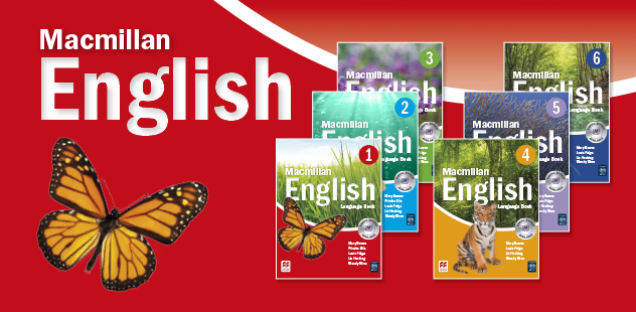
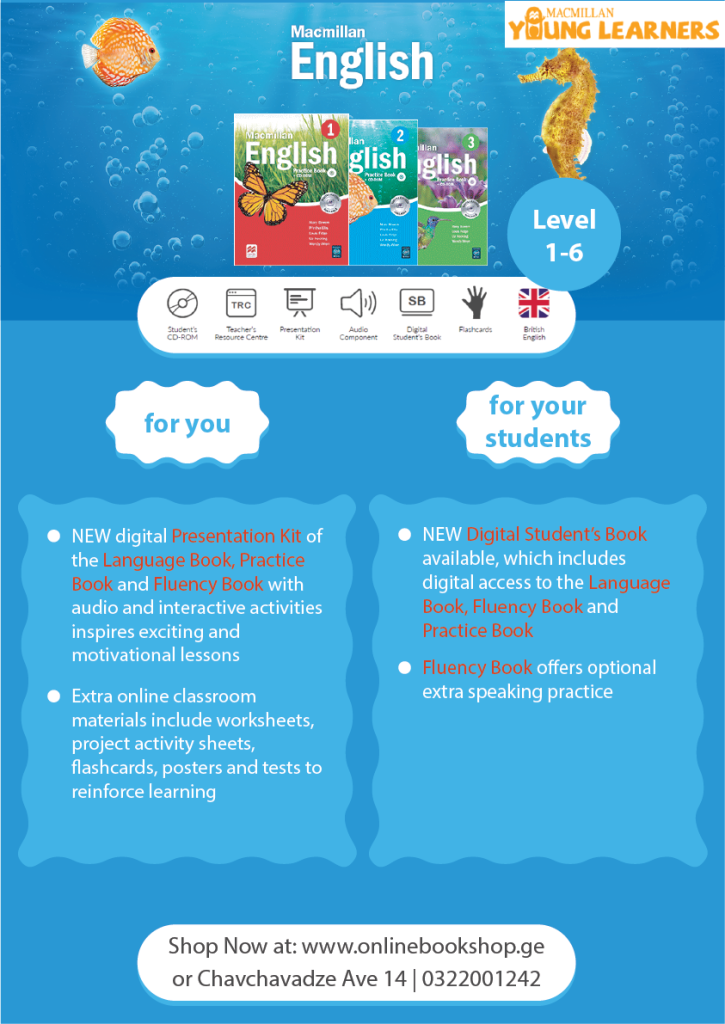
Macmillan English is the first International English coursebook to be informed by English lessons in native-speaker classrooms. It is designed for second-language learners of English but uses many of the approaches to reading, writing and speaking that underpin the teaching of English to first-language children.
Designed for students who have a high number of contact hours in English, this six-level course recognizes that proficiency in English is an essential part of modern life, and that early exposure to rich and genuine language allows young learners to move confidently towards native-speaker fluency in both oral and written English.
In the early levels, the course does not assume a first-language child’s experience of spoken English or culture. Language structures are introduced and practised to give a firm grounding in grammar, but from the start, the exposure to new language is more extensive than in traditional second-language courses.
As children move up through the course, they experience more first-language teaching methods. At the upper levels children cover the same aspects of English as do first-language learners, though the needs of second-language learners are always taken into account.
Each level of Macmillan English is delivered through eighteen units. Each unit has six lessons requiring a minimum of seven teaching sessions.
Components
For parents