Tag Archives: For Teachers

Methodology – Minimal Resources: Skills

role-playing


Minimal resources: Role-plays and discussion

ELT legend Scott Thornbury gives us some imaginative tips and ideas for using role-plays in lessons.

In the last instalment I looked at ways that dialogues could be set up in the classroom using minimal materials. An extension of dialogue-type interaction is the role play, in which the interactants get speaking practice by stepping outside their own character, job, and so on, in order to experience a wider range of situations than the classroom normally offers, and to explore other registers and domains of language use. Further along the line from controlled to free, discussions and debates provide learners opportunities to interact freely and spontaneously, to cope with unpredictability, and to voice opinions using language that is both complex and fluent.

Teachers are sometimes discouraged from setting up either role plays or discussions, because they think that they will need to provide elaborate resources, such as role cards, or preparatory reading texts, in advance. However, many of the most successful fluency activities require no materials at all. They simply draw on the learners’ own experience, knowledge, and imagination.

Here are a few materials-light ideas for role plays and discussions:

1. Choose a holiday

The idea is to set up a situation whereby students in pairs shop around for a package holiday, visiting different “travel agencies” (also pairs of students) in turn, and then making their decision. Divide the class into two – one half will be “shoppers”, the other half “agents”. Divide these groups again, into pairs. The agent pairs should be distributed around the room, and separated as much as possible from the shoppers. Tell the agents each to put together an attractive ten-day holiday package, including destination, itinerary, excursions, accommodation, and so on. (It is important, by the way, that all the holidays cost the same – fix a price in advance – so that the agents don’t simply undercut one another). Meanwhile, the pairs of shoppers decide what it is that they, personally, want out of their holiday, e.g. relaxation, adventure sports, shopping opportunities, etc. The shoppers then “visit” each agency in turn – seating should be arranged so that the shoppers can sit down when visiting the agencies. After sufficient time has elapsed for the an exchange of information, the shoppers all move round one, and the process starts again, until all the shoppers have visited all the agencies. Each pair of shoppers can then decide which holiday they will choose.

The format for this role play works for a number of different situations that involve shopping around. I have used it successively for a “choosing a school” scenario: each “school” puts together a policy on such things as discipline, homework, uniform, compulsory subjects, extra-curricular activities, even a school motto! Meanwhile, each pair of “parents” decide what kind of school they are looking for, for their “special needs” child. They then interview – and are interviewed by – the school’s representatives.

Other situations that lend themselves to this idea are: choosing a flatmate, choosing a wedding function, choosing a retirement village, and so on.

The beauty of this role play format – apart from the lack of materials – is that there is in-built repetition, as each pair of shoppers repeats its interaction with a new agent. Task repetition is an important factor in the development of fluency.

2. Alibis

This is an old favourite which, like the previous activity, is inherently repetitive. It also has an added game element, in that the participants have to try and outwit each other. The basic format starts with two students being “accused” of having committed some crime, such as a robbery in the institution where the class takes place, in a fixed period, say, between the hours of 10 and 11 in the morning on the preceding day. The two “accused” then have to establish an alibi, and they go out of the room to do this. The alibi needs to account for their actions only during the time period in question (anything before or after is irrelevant), and it is important to establish that they were together for all that time. While the accused contrive their alibi, the rest of the class can prepare generic questions, with the teacher prompting, if necessary, of the type: What were you doing…What did you do next? Did you meet anyone? What did you say? How much did it cost? Who paid? etc. The accused are then led in, one at a time, and have to answer the questions put to them. (It helps to establish the rule that they are not allowed to claim that they don’t remember). Any significant discrepancy in their answers means that they are, of course, guilty.

With large classes, Alibis can be played in groups, each group playing their own version of the game. Alternatively, (and so long as they are out of earshot) the two accused can be interviewed simultaneously by two different groups, and then exchange places.

A variant is Green Card, in which immigration officers interview, separately, two candidates who claim to be members of the same family (in which case, they have to answer questions about the other members of their immediate family – their names, age, and appearance), or who claim to be partners (in which case, they have to answer questions about their daily routine). Another variant of Alibis is UFO, in which two people are interviewed separately by The Institute of Paranormal Research about an encounter with aliens that they claim to have experienced.

3. Pyramid (or consensus) debate

The principle of this format is that at first individuals work in pairs to achieve consensus on an issue, and then these pairs try to convince other pairs, before forming groups of four, and so on, until the whole class comes to an agreement. For example, the teacher might set the class the task of devising some “class rules” with regard to such things as classroom etiquette, discipline, duties, homework, etc. First individuals draft a list of a maximum of, say, eight rules. They then compare in pairs, and draft a new list of eight rules, but one that they are both agreed on. This will normally involve some discussion and negotiation. Once they have their list they join forces with another pair, and the process begins again. Finally, the two halves of the class come together to agree on the definitive version.

Other ideas that work well in this format are ranking tasks – e.g. the five most important people in history; the ten best pop songs of all time; the eight things I would take to a desert island; the six school subjects that should be compulsory, and so on. Or students take a bare statement and qualify it in such a way as to make it acceptable. For example:

– Children should be beaten.
– Smoking should be banned.
– Anyone should be allowed to adopt children.
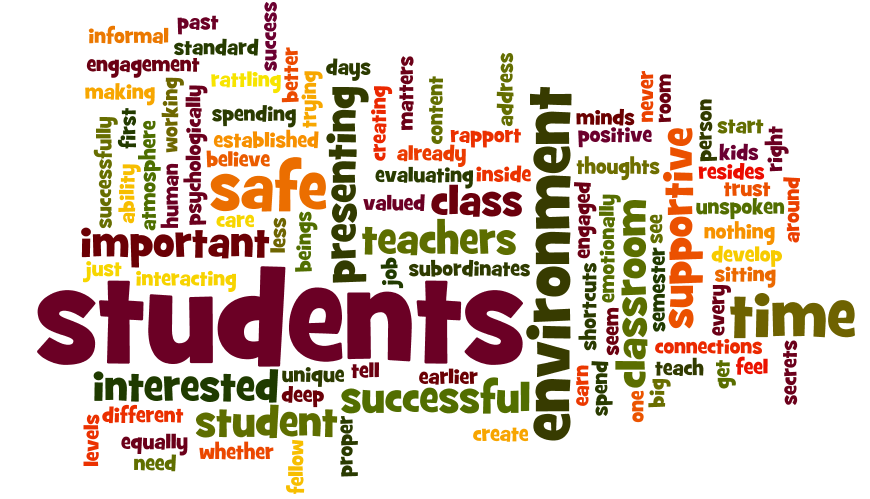
 

A Positive Learning Experience

positive-classroom-environment

A positive learning experience

Teaching methods often change, but it’s always the students who can decide if they had a good learning experience. English teacher and writer Paul Bress recommends a few “dos and don’ts” for teachers.

Dos

  • The lessons should always be connected to the students’ interests. If a lot of them like movies for instance, teachers should try to talk about movies in class. This will make the learning process positive for the students.
  • Teachers should always allow their students to be creative. Of course, repeating exercises is very important, but it’s equally important to make the children practice their English in real world scenarios.
  • Teachers should always make sure that the tasks in class aren’t too difficult for their students.
  • Teachers should always make sure that their syllabus is clear to the students. Otherwise, the students may become confused and uninterested during the year.

Don’ts

  • Teachers should never get angry at their students. It’s important to try to understand students’ problems instead of yelling at them.
  • Teachers should never have favorite students. Though some students may seem smarter than others, that doesn’t mean that teachers should always have them respond to questions. Otherwise, the rest of the class will begin to dislike that student.


Bress, Paul. “A Positive Learning Experience” English Teaching Professional, March 2016, 36.

კვირის წიგნი: I Am Malala: The Girl Who Stood Up for Education and Was Shot by the Taliban by Malala Yousafzai & Christina Lamb

9781780226583

*Winner of the 2014 Nobel Peace Prize*

In 2009 Malala Yousafzai began writing a blog on BBC Urdu about life in the Swat Valley as the Taliban gained control, at times banning girls from attending school. When her identity was discovered, Malala began to appear in both Pakistani and international media, advocating the freedom to pursue education for all.

In October 2012, gunmen boarded Malala’s school bus and shot her in the face, a bullet passing through her head and into her shoulder. Remarkably, Malala survived the shooting. At a very young age, Malala Yousafzai has become a worldwide symbol of courage and hope. Her shooting has sparked a wave of solidarity across Pakistan, not to mention globally, for the right to education, freedom from terror and female emancipation.

[button color=”blue” size=”small” link=”http://onlinebookshop.ge/shop/biography/i-am-malala-the-girl-who-stood-up-for-education-and-was-shot-by-the-taliban/” target=”blank” ]იყიდება წიგნი[/button]

საინტერესო სიტყვები და გამონათქვამები – Good things come to those who wait

What does it mean?

Be patient. Eventually something good will happen to you.

Where does it come from?

The related phrase all things come to those who wait was used by Violet Fane in 1892.


4 Ideas to Kickstart Your Summer Learning

kickstart-summer-learning-01

To keep our students sharp over the summer, we often assign subject-specific reading, math drills, and projects. However, as educators, we also need to hone our own skills, develop new ideas, and reflect on our practice. Here are five ways to kickstart your summer learning.


1. Construct Your Learning Archive

When planning curriculum or attending professional development, we collect resources — both physical and digital. However, we need an efficient way to organize what we find valuable. In the past, this has resulted in the accumulation of binders or folders, but now we also have files scattered across devices.

Take time this summer to create a learning archive. A great digital system supports the individual learner and can be saved, searched, or shared. Whether you choose EvernoteOneNote, or Google Drive, think about how you can start organizing all of your learning and making it accessible from any device and at any time. If you prefer handwritten notes on paper, make sure to pick a tool that allows you to easily take pictures of those notes, add them to your archive, and search them later.

In addition to collecting notes, think about how you might archive online resources. You could add links and notes to a Google Doc or an Evernote note, or build a shareable library using Diigo or Pinterest.

Not only is summer a great time to get organized for the coming school year, but it’s also a fantastic time to explore.


2. Read for Inspiration

Though many schools assign summer reading books to their faculties, we would recommend adding one of these titles to your list:

500 Activities for the Primary Classroom by Carol Read

Children Learning English by Jayne Moon

Learning Teaching: A Guidebook for English Language Teachers by Jim Scrivener

Teaching Practice by Roger Gower, Diane Phillips and Steve Walters

Teaching English Grammar by Jim Scrivener

3. Design Your Digital Space

If you already have or want to set up a class website or blog, an email newsletter for parents, or a learning management system take time over the summer to design and test your digital space.


4. Redesign Your Physical Space

Your current students have become comfortable in your classroom, office, or lab. They understand your expectations and routine. Fast-forward to fall. What do you want your students to think when they enter your space? Is this a class where they’ll engage in group work and discussion? Do they have choice in how they demonstrate their learning? What do you have on the walls? Where is your desk? All of these considerations help set the tone for your students.

კვირის წიგნი: Girl Online by Zoe Sugg

9780141357270

This is the incredible debut novel from YouTube phenomenon Zoe Sugg, aka Zoella. I have this dream that, secretly, all teenage girls feel exactly like me. And maybe one day, when we realize that we all feel the same, we can all stop pretending we’re something we’re not…But until that day, I’m going to keep it real on this blog and keep it unreal in real life. Penny has a secret. Under the alias Girl Online, Penny blogs her hidden feelings about friendship, boys, high school drama, her crazy family, and the panic attacks that have begun to take over her life. When things go from bad to worse, her family whisks her away to New York, where she meets Noah, a gorgeous, guitar-strumming American. Suddenly Penny is falling in love – and capturing every moment of it on her blog. But Noah has a secret, too, one that threatens to ruin Penny’s cover – and her closest friendship – forever.

[button color=”blue” size=”small” link=”http://onlinebookshop.ge/shop/books/girl-online/” target=”blank” ]იყიდება წიგნი[/button]

საინტერესო სიტყვები და გამონათქვამები – One man’s trash is another man’s treasure

What does it mean?

Different people have different ideas about what’s valuable.

Where does it come from?

The earliest example I found in Google Books is in Hector Urquhart’s introduction to 1860s Popular Tales of the West Highlands:

Practical men may despise the tales, earnest men condemn them as lies, some even consider them wicked ; one refused to write any more for a whole estate ; my best friend says they are all ‘ blethers.’ But one man’s rubbish may be another’s treasure, and what is the standard of value in such a pursuit as this?”


Sometimes Misbehavior Is Not What It Seems

curwin-misbehavior-is-not-whta-it-seems-01

By Dr. Richard Curwin, Director, Graduate program in behavior disorder, David Yellin College

When Sigmund Freud reportedly said, “Sometimes a cigar is just a cigar,” the key word was “sometimes,” because sometimes a cigar is more than a cigar. So it is with understanding misbehavior. Sometimes the reason for misbehavior is very different than the obvious and requires a totally different intervention than the usual consequences. It is never easy to determine why children do the things they do.

The following are examples of seeing misbehavior from a new perspective. In each of these cases, diagnosis is very difficult — as are the remedies. For chronic misbehaving students, pay close attention to their home situations, the type of misbehavior, when it occurs, and whether they behave differently with other adults. Be advised that the best responses to these situations sound easier than they are to put into practice.

1. Sometimes students misbehave because they like you too much.

Some students have experienced so much pain that they build a wall between themselves and everyone else. For those familiar with the Simon and Garfunkel song, it’s the “I Am A Rock” syndrome:

And a rock feels no pain
And an island never cries.

The closer to you get to children like this, the greater their fear of getting hurt. As this fear intensifies, the more they try to push you away. The more the child pushes you away, the more you think that he either dislikes or disrespects you. When feeling disrespected or disliked, many teachers try to develop a closer relationship. While this strategy works for most students, it only frightens students like these into more dramatic methods of pushing you away.

2. Sometimes students want you to prove yourself.

Some students have been promised that things would be better only to have things get worse. Children shuffled through the foster care system are likely to feel this way. The same is true for students who have had teachers that overly encouraged success and rewarded them for minor behavioral achievements, only to give up on them later. Sometimes children of divorced parents feel cheated and abandoned by one parent or the other. Before they can trust you, they continue pushing you, harder and harder, to see if you will give up on them, too.

The best approach for both of these two situations is the same. No matter what they do, believe in them, even if their behavior is serious or severe. Say things like, “What you just did is unacceptable in our classroom, but no matter what you do, I’m still on your side. I will never give up or stop believing in you.” There are two big dangers in this approach:

  1. You must really mean it. As Neil Postman once said, “Kids have built-in crap detectors.” You can’t fake believing in them. You really must feel that way.
  2. If you do give up, you will be added to their list of adults who abandoned them. That will make it even harder for someone else to reach them. If you make a commitment, you must keep it. Do not give up.

3. Sometimes students are physically attracted to you.

Many teachers, especially those who look to be about the same age as their students, have trouble when students develop crushes on them. When students are attracted to their teacher, their goal becomes interaction. Obviously, they can’t engage on a more romantic level (although some occasionally try), so they connect through the only other way that’s open to them.

Younger children are sometimes attracted to their teachers in a different way, although with the same result. They see their teachers as mommies or daddies. I guess many of you who teach very young children have been called “Mommy” by mistake.

The solution, which many younger teachers have told me they object to, is to dress as professionally and unprovocatively as possible — no jeans or anything that makes them seem as equals to students. Use a modest amount of makeup. Men do better with students who develop crushes by wearing a tie or at least a sport coat. Be friendly, but not as friends. Draw strong professional limits. Do not feed their fantasies.

4. Sometimes students need to be noticed.

Rollo May, in Love and Will, made a simple but profound statement when he said that attention for something bad is better than no attention at all. This theory explains, at least partially, some of the school violence by students in recent years. No one wants to feel anonymous or unseen. For these students, misbehavior is like raising a flag that says, “Notice me, I matter.” Students like these often feel unnoticed at home, among other students, and by most of their teachers.

These students can be helped by greeting them at the door before class, calling on them more frequently, asking them to help perform academic tasks, like solving a problem on the whiteboard, or generally making sure they feel appreciated. Learn their names, say hello in the corridors, and occasionally seek them out on the playground or in the lunchroom for a brief conversation.

In all four of the situations above, certain sensitivities can be very helpful. Whether you’re making positive or negative comments about behavior and academic performance, make those comments in private. Never publicly draw attention with comments such as, “I like the way that Allen is sitting.” Never write their names on the whiteboard for any reason. Never discuss their situations with any other students or other parents. When talking with these students’ parents, never blame either the children or parents. Be more stubborn than these chronically misbehaving students and never give up on them.


კვირის წიგნი: Big Game by Dan Smith

13-year-old Oskari is sent into the cold wilderness on an ancient test of manhood. He must survive armed only with a bow and arrow. But instead, he stumbles upon an escape pod from a burning airliner: Air Force One. Terrorists have shot down the President of the United States. The boy hunter and the world’s most powerful man are suddenly the hunted, in a race against a deadly enemy.

[button color=”blue” size=”small” link=”http://onlinebookshop.ge/shop/film-tie-in/big-game-film-tie-in/” target=”blank” ]იყიდება წიგნი[/button]