Tag Archives: ELT

Managing a Large Class Size


Do you have more students this year? Education budget cuts across the country are one cause of class-size increase in public schools. If you’ve found yourself with larger class sizes, or you’re a new teacher still grasping the often overwhelming experience of one of you and many of them, here’s some helpful tips:

Tip #1: Don’t Give Up on Collaborative Grouping

Students need opportunities to check in with each other around their learning, ask questions, guide each other and reflect together. And this is even more crucial with a large class. If a tight classroom space won’t allow for quick triads or quad grouping, use “elbow partners” — two students in close proximity. Do this often. As we know, with large class sizes, quiet students tend to get even less airtime. With less one-on-one time with small groups and individual students, teachers need to keep that large number of kids talking and being listened to. You can do a “turn and talk” even for just 27 seconds. Much can be discovered, wondered about, and solidified in that half a minute.

Tip #2: Accept That Things Take Longer

Accept that presenting and discussing a unit’s learning objectives may have taken 20 minutes with that smaller class in the past, and probably takes twice as long with this larger group. Also, you might be lamenting over the days when you could whip around the room and spend a few quality moments with each student or group, or when you could offer immediate and thorough support. Unfortunately, if you did that now with 35 or more in the room, you’d find yourself out of time before coming close to accomplishing the daily learning objective.

One remedy, especially when it comes to checking for understanding? Strategies like thumbs up/thumbs down, or having students hold 1 to 3 fingers on their chest to let you know how well they understand (3 means “I’ve got it!) Other quick formative assessments, such as sentence starters, can help beat that Time Thief in the room. You can also use exit slips to see if they “got it,” asking one strategic question about the day’s learning.

Tip #3: Find New Ways to Know Students

Unfortunately, the larger the class size, the more the relationships with students suffer. Consider creating surveys once or twice a week where students can answer questions on a likert scale and also ask questions of you. Invite students to write a letter to you about their learning, their accomplishments, challenges, and interests.

You can also rotate your focus every few days to 5 or 6 different students. That way, no one will slip through the cracks. Often with large class sizes, the squeaky wheels, so to speak, are the one’s that receive much of the teacher’s time. Make sure you check in regularly with your “proficient” students, and continue to create differentiated assignments for those gifted kids in the room.

Tip #4: Be Okay With Loud and Letting Go

Start repeating this mantra immediately, “Just because it’s loud doesn’t mean they aren’t learning, just because it’s loud . . .” Somewhere along road, we began to attribute silence to deep thought and high-level learning. It’s more often just a sign of kids being compliant. So go ahead, take those 37 kids and put them in groups! Give them a challenging task and some supplies. Let it be loud! Roam from group to group and if your door suddenly swings open to visitors from the district, let them get an eye full of engaged, enthusiastic learners!

As for the letting go, if you are still passing out papers, collecting supplies, stamping homework all on your own, stop. Assign students “jobs” immediately. By giving up these managerial tasks, you will have more time free to check in with a child who has been absent a lot, add a step to an assignment for that advanced student, crack a joke with the quiet one who avoids others, or pose a strategic inquiry question to the whole class.

8 Tips for Reaching Out to Parents

1. Avoid Doing Battle

Always log and take notes on parent phone calls, a good practice in case you need to recall the details of a conversation (or if one took place). When parents get overly angry, emotional or offensive (which rarely happens), end the conversation quickly but diplomatically: “I hear you’re upset, but I no longer feel comfortable speaking with you on the phone. We should meet face to face, but with an administrator also present.” Then, report it to your department chair. Sometimes, five percent of parents will consume 95 percent of your time.

2. Keep Email Timely and Brief

When you receive e-mail from parents, reply the very same day. By not responding in a timely fashion, you make your school and yourself look lazy and unprofessional. If the e-mail is anything beyond a simple request, like reminding Dato to meet for extra help after school, it’s always wise to avoid a detailed exchange and request a face-to-face meeting instead. It’s remarkably easy to misconstrue tone and meaning via e-mail, which heightens fears and emotions.

3. Post Assignments Online

Post at least two weeks’ worth of lessons and assignments online, and they are easily accessible to students and parents alike. Few things hurt a teacher’s reputation more than being perceived as unprepared and disorganized. Besides, parents should know what their child is studying, and students should have a clear idea of what they will be learning. On many occasions, this planning will also allow you to meet with parents and students in advance about how to prepare for more challenging assignments. Moreover, when students miss days of school, neither they nor their parents need to e-mail or call you about missed work.

4. Involve Parents in Their Children’s Education

Great teachers welcome parent support and curiosity. In conversations with parents, express how impressed you are with something in particular that Levani or Salome did or said, letting the parents see that you really know and care about their child. Sometimes, parents ask what they can do to help their child succeed — and it’s crucial that you lay out an approach involving their direct action. Enlist their help as another coach, not as a surrogate.

5. Prepare for a Successful Back-to-School Night

Early on, the best way to earn parent support is to run a successful back-to-school night — which, in many cases, can be a lot of fun. When speaking to parents, do your best to bring the same vigor and eagerness you bring to your students in the classroom. Love what you teach, and make that known not only by what you say, but also by how you say it. Be animated, talk excitedly about your classes. All the while, be careful not to monopolize the short time you have together. You want to hear from the parents. You want to learn their hopes and fears for their student, and how you can support them in your collective mission to help all kids meet their greatest potential.

6. Call Home to Report Good News

Parents rarely receive a positive call home. Twice a semester, make a point to call and tell them how impressed you are with something their student did or said. It’ll surprise you when parents nervously answer the phone, as if a student did something wrong. They are all the more relieved and proud when you have just good news to report. These calls let parents know that you care as much about recognizing success and improvement as you do about spotting struggle and weakness. These calls also reassure parents that you’re not out to make life more difficult for their child, that you’re fair in your assessments and feedback, and that you genuinely want to see students succeed.

7. Look Professional

Nothing spells “unprofessional” more than a messy-looking teacher, especially when meeting with parents. Since you never know when you might run into a parent, it’s a good idea to come to school looking neat and professional. This is an even wiser move for younger teachers looking to earn authority in the classroom.

8. Participate in After-School Activities

This could be anything from coaching to attending as a spectator. You will enjoy interacting with parents on a daily basis. You’ll not only speak about how their child is doing athletically, but emotionally and academically as well. This rapport may help you realize how to communicate more effectively with teens, both on the field and inside the classroom.

5 Highly Effective Teaching Practices

by Rebecca Alber

I remember how, as a new teacher, I would attend a professional development and feel inundated with new strategies. (I wanted to get back to the classroom and try them all!) After the magic of that day wore off, I reflected on the many strategies and would often think, “Lots of great stuff, but I’m not sure it’s worth the time it would take to implement it all.”

We teachers are always looking to innovate, so, yes, it’s essential that we try new things to add to our pedagogical bag of tricks. But it’s important to focus on purpose and intentionality — and not on quantity. So what really matters more than “always trying something new” is the reason behind why we do what we do.

What Research Says

This leads me to educational researcher John Hattie, who wrote Visible Learning for Teachers: Maximizing Impact on Learning. Through his research, one of his goals is to aid teachers in seeing and better understanding learning through the eyes of their students.

Hattie has spent more than 15 years researching the influences on achievement of K-12 children. His findings linked student outcomes to several highly effective classroom practices. Here I’d like to highlight five of those practices:

1. Teacher Clarity

When a teacher begins a new unit of study or project with students, she clarifies the purpose and learning goals, and provides explicit criteria on how students can be successful. It’s ideal to also present models or examples to students so they can see what the end product looks like.

2. Classroom Discussion

Teachers need to frequently step offstage and facilitate entire class discussion. This allows students to learn from each other. It’s also a great opportunity for teachers to formatively assess (through observation) how well students are grasping new content and concepts.

3. Feedback

How do learners know they are moving forward without steady, consistent feedback? They often won’t. Along with individual feedback (written or verbal), teachers need to provide whole-group feedback on patterns they see in the collective class’ growth and areas of need. Students also need to be given opportunities to provide feedback to the teacher so that she can adjust the learning process, materials, and instruction accordingly.

4. Formative Assessments

In order to provide students with effective and accurate feedback, teachers need to assess frequently and routinely where students are in relation to the unit of study’s learning goals or end product (summative assessment). Hattie recommends that teachers spend the same amount of time on formative evaluation as they do on summative assessment.

5. Metacognitive Strategies

Students are given opportunities to plan and organize, monitor their own work, direct their own learning, and to self-reflect along the way. When we provide students with time and space to be aware of their own knowledge and their own thinking, student ownership increases. And research shows that metacognition can be taught.

 Collaborating with Colleagues

Great teachers are earnest learners. Spend some time with a colleague, or two or three, and talk about what each of these research-based, best classroom practices looks like in the classroom. Discuss each one in the context of your unique learning environment: who your students are, what they need, what they already know, etc.

Three Steps to Positive Classroom Leadership

The American Psychological Association cites classroom management as the most sought after subject for teacher professional development. This article, first of a three-part series, explores the fundamental pillars to creating a positive classroom environment and avoiding common discipline problems.

Teachers commonly aim to have a “toolkit” of discipline strategies to use in their classrooms. While it can be helpful to maintain a rich repertoire of strategies, in order to be a truly effective classroom leader, it is pertinent for the teacher to develop an effective belief system.

The Importance of Beliefs

You may be wondering why beliefs matter, if you have solid skills and strategies. Positive leadership in the classroom is built upon authentic, caring relationships between teachers and students. In order to cultivate that relationship, it is essential that the teacher maintain a positive outlook about teaching and about her students.

Longstanding research proves that when teachers believe in the capability of their students and expect results, students actually perform better. Recent studies point out the crucial role of a “growth mindset.” Rather than seeing students’ intelligence as static or fixed, the growth mindset focuses on the potential for development and change. On the same note, reframing “bad” behaviors can help teachers avoid discipline issues and promote achievement.

The first step in cultivating productive beliefs about students is taking a personal inventory of your current beliefs. Do you see your students as capable of achieving? Interested in learning or unmotivated? Attentive or unable to concentrate? Willing to follow directions, or purposely defiant? When you think about your students’ generation, do you see the value in their interests, or do you view their hobbies as sub-par?

Reframing the way we see students can literally transform our teaching. Negative thinking traps a teacher into thinking that students cannot succeed or cannot behave. This literally squelches motivation to think creatively, and a teacher can easily find several factors to blame for student failure including their home life, peer influences or lack of resources. Have you ever accepted student misbehavior or failure and simply placed blame upon circumstances out of your control? Looking for the positive opens up possibilities to recognize the good in our students and help them move forward.

Creating a positive classroom climate requires you to hold yourself and your students accountable for progress. Blaming and complaining stop here; rather than wasting time venting and being negative, your new outlook will allow you to use your time to seek out the positive progress that you see, acknowledge it and teach accordingly.

In articles two and three, we will explore specific bodies of knowledge and practice that are essential to your practice. Before that, let’s look at how to reframe three common student misbehaviors in order to view them more productively.

[box type=”shadow” align=”aligncenter” ]Common Behavior Issues and How to Reframe Them

Tardiness and absences: Teachers may believe that tardiness to class is the outcome of lazy, unmotivated or apathetic students and parents. In reality, there may be a host of factors contributing to your students’ tardiness or absences.

Some students are dealing with unstable situations at home and it is important that we begin to understand what obstacles our students face in making it to school each day. Rather than reacting with disciplinary measures, try opening up an honest and sensitive dialogue with your students to see what’s really going on and how you may be able to help.

Calling out of turn: It can be irritating to try to maintain order in the classroom when students are calling out of turn. Rather than viewing these behaviors as defiant, you can think about your students’ behavior as an extension of that in their home and social lives. When a student feels comfortable, he may feel that he is participating in a conversation.

Rather than punishing this behavior, try to promote more in-class opportunities for student participation and engagement. Instead of seeing the outbursts as disrespectful, realize that your students may be in need of some attention or may be enthusiastic to participate and join the conversation.

Homework non-compliance: Over the years, teachers continue to air their frustrations about students not coming to class prepared. Whether they are missing pencils, textbooks or assignments, these students may impress a serious degree of apathy upon their teachers.

Rather than accepting this behavior as a sign of apathy, consider what children may have going on outside of school, including family obligations and even long hours working for older students.[/box]

What other behaviors do you see in your classroom, and how can you reframe them in order to view your students in a positive light? Thinking outside of the box is essential, and can really open up the possibility for positive relationships and a caring climate in your classroom.

Which Book Would You Read?

Around the World in Eighty Days

Jules Verne, Pepita Subira, Maria Jose Lobo

ISBN: 9780230026742

‘To go around the world…in such a short time and with the means of transport currently available, was not only impossible, it was madness’

One ill-fated evening at the Reform Club, Phileas Fogg rashly bets his companions £20,000 that he can travel around the entire globe in just eighty days – and he is determined not to lose. Breaking the well-established routine of his daily life, the reserved Englishman immediately sets off for Dover, accompanied by his hot-blooded French manservant, Passepartout. Travelling by train, steamship, sailing boat, sledge and even elephant, they must overcome storms, kidnappings, natural disasters, Sioux attacks and the dogged Inspector Fix of Scotland Yard – who believes that Fogg has robbed the Bank of England – to win the extraordinary wager. Around the World in Eighty Days gripped audiences on its publication and remains hugely popular, combining exploration, adventure and a thrilling race against time.


Price: 5 GEL


[button color=”blue” size=”small” link=”http://englishbookgeorgia.com/catalogue/shop/books-fiction-nonfiction-publishers/around-the-world-in-eighty-days/” target=”blank” ]Buy the Book[/button]

The Mark of Zorro

Johnston McCulley, Anne Collins

ISBN: 9780230029217

Old California, in a bygone era of sprawling haciendas and haughty caballeros, suffers beneath the whip-lash of oppression. Missions are pillaged, native peasants are abused, and innocent men and women are persecuted by the corrupt governor and his army.

But a champion of freedom rides the highways. His identity hidden behind a mask, the laughing outlaw Zorro defies the tyrant’s might. A deadly marksman and a demon swordsman, his flashing blade leaves behind . . .

First published in 1919, The Mark of Zorro has inspired countless films and television adventures. Now read how the legend began . . .


Price: 6,5 GEL


[iphorm_popup id=”1″ name=”მოითხოვე სასურველი წიგნი”]Order the Book[/iphorm_popup]


The Heart of Teaching: What It Means to be a Great Teacher

What does it mean to be a great teacher? Of course credentials, knowledge, critical thinking, and all other faculties of intelligence are important. However, a great teacher should be much more than credentials, experience and intelligence.

What lies in the heart of a great teacher?

You are kind: a great teacher shows kindness to students, colleagues, parents and those around her/him. My favorite saying is “kindness makes the world go around”. It truly changes the environment in the classroom and school. Being a kind teacher helps students feel welcomed, cared for and loved.

You are compassionate: Teaching is a very humanistic profession, and compassion is the utmost feeling of understanding, and showing others you are concerned about them. A compassionate teacher models that characteristic to the students with her/his actions, and as a result students will be more open to understanding the world around them.

You are empathetic: Empathy is such an important trait to have and to try to develop in ourselves and our students. Being able to put yourself in someone’s shoes and see things from their perspective can have such a powerful impact on our decisions and actions.

You are positive: Being a positive person, is not an easy task. Being a positive teacher is even harder when we’re always met with problems with very limited solutions. However, staying positive when it’s tough can have such a tremendous positive impact on the students and everyone around us. Looking on the bright side always seems to help make things better.

You are a builder: A great teacher bridges gaps and builds relationships, friendships, and a community. Teachers always look to make things better and improve things in and outside of the classroom. Building a community is something a great teacher seeks to do in the classroom and extends that to the entire school and its community.

You inspire: Everyone looks at a great teacher and they want to be a better teacher, they want to be a better student, even better, they want to be a better person. A great teacher uncovers hidden treasures, possibilities and magic right before everyone’s eyes.

Professional Development: Collaborative Teaching in EFL/ ESL

By Lindsay Clandfield and Jo Budden

Level: Starter/beginner, Elementary, Pre-intermediate, Intermediate, Upper intermediate, Advanced


“I love my new job. I can be creative in my class preparation, I get along really well with my students and I really appreciate the responsibility. There’s nobody looking over my shoulder all the time when I’m at work. It’s me and my class.”

“I feel bored and a bit depressed with my job. I feel like I am doing the same thing over and over again. I have no new ideas and I hate my course book. I don’t know if I can do this for the rest of my life. One of the problems is that I feel so lonely, even with a class full of students. I think I’m becoming disconnected from it all.”

The first quote is from a new English teacher in their first few months of teaching (after the “fear” of the first classes has worn off) and the second is from an English teacher who has been working for some years. Do either of these sound familiar? Why does the second teacher feel that way? What has happened?

The second teacher may be close to suffering from teacher burnout. Burnout is a response to chronic, everyday stress, rather than to occasional crises. As Dr. Susan Barduhn, President of IATEFL, notes, “People who go into teaching (or nursing, social work, fire-fighting or any kind of helping profession) often have a high need for approval and high expectations of themselves. The burnout-prone individual is one who simply takes on too much.” One of the best ways to avoid burnout is to start supporting and cooperating with fellow teachers and professionals. According to many studies, burnout and teacher turnover is drastically reduced when successful peer support exists.

This article is about Collaborative Teaching. I take Collaborative Teaching to mean more than teaching or planning a class between more than one teacher (although it can take that form). For me, collaborative teaching is about developing different mechanisms of peer support. It is also about developing professionally, but not in isolation. What follows is a series of tips and activities for teachers to do to start collaborative teaching and stop burnout before it occurs.


Share ideas

One of the easiest and cheapest ways to start collaborative teaching is to swap ideas. Teachers often do this anyway. You can formalize this process at your school in two ways:

Organize a folder entitled Ideas and Tips. Divide it into sections (either by level, or by theme) and ask other teachers to contribute. For a project like this to work you really have to have someone in charge of keeping the folder or folders in order. Why not rotate that duty among teachers? You could also have a “Tip or Activity of the Week” that you can post on the staff room wall.

Offer to organize a meeting to exchange ideas at your work. All you need is a time and a place where teachers can meet. At a school where I worked we called it the Materials Circus Maximus(Gladiator had just come out in the theatres!) We all met on a Friday afternoon and shared activity ideas. This became even more popular when teachers would “teach” the others using their material. It made the activity more memorable when teachers actually played the part of learners.

Sharing ideas in your school can be beneficial for all involved. But why stop at your school when you can share tips and classes with English teachers all around the world! One way of doing this is through the onestopenglish Lesson Share competition. See section G below for other ideas.


Start a teacher discussion group

This aspect of collaborative teaching means going further than just swapping tips and materials. Get together with a group of other teachers (or even just one other teacher!) to exchange ideas and methods and reflect on your teaching. This could be to discuss problems you have had with a certain class or course book, to share good and bad moments in class or to reflect on a particular aspect of your teaching. It could be a formalized meeting with other teachers at the school, or a more informal meeting at a cafe.
Here are some directions that a teacher discussion group could take:

  • The group meets to discuss discipline problems in their classes and ways of dealing with them.
  • The group meets to offer advice and suggestions to one member who is having trouble motivating a class.
  • Each member of the group researches an aspect of methodology which they haven’t tried (examples include Total Physical Response, Using Literature in the Classroom, Task Based Learning) and then presents their findings at the meeting. A good starting point for research like this is the Methodology section of onestopenglish.
  • Each member of the group writes some reflections on two different classes – one which went well and one which didn’t go so well. Teachers come together and exchange reflections. They then discuss the classes.

Observe a colleague

Peer observation is a great way to get new ideas and see how others deal with everyday classroom occurrences. Have you ever wondered what was going on in the classroom next door? Why was it so quiet or why was there so much laughter? Here’s your chance to find out.

Choose a colleague who you respect and ask them if they would mind you observing them. With any luck they’ll jump at the chance of having an extra pair of eyes in the class. You could use the observation to steal some new ideas for your own classes. There are many forms available to use as a guide for the observation. Click in the box below for some samples from Jim Scrivener’s Learning Teaching. Alternatively, make a form yourself for your exact needs.


Ask a colleague to observe you

Choose a colleague you admire and trust and invite them to observe one of your classes. Choose a focus that you’d like them to concentrate on, such as your instructions, interaction with students or use of L1 in the class and ask for feedback on that specific point.

Always remember that giving feedback is a skill in itself and you should aim to be mainly positive, by giving constructive advice and ideas. Think about what you would like to tell the observee before you begin the feedback and consider how best to tell them.


Set up a mentor program

In English language teaching, the idea of having mentors in a school is relatively new. The mentor is an experienced teacher in the school who knows where things are and is familiar with school procedures. A new teacher is assigned a mentor when they start. The mentor is responsible for this new member of staff. The mentor has different “roles”:

  • that of model (to inspire the mentee)
  • that of acculturator (to show the mentee around and get them used to the school culture)
  • that of sponsor and support (to “open doors” for the mentee, to introduce mentee to the “right people”; to “be there” for the mentee)
  • that of educator (to listen and coach the mentee so that the mentee can achieve professional learning objectives)

A more informal mentor program could be a simple buddy system by which new teachers are assigned a “buddy” on the staff who they can turn to if they have any problems or questions.


Inter-class communicating and swaps

If you teach in a school at the same time as another English teacher with a similar level, there are many interesting possibilities for collaboration. Here are some ideas.

For oral tests, swap classes with the other teacher. This can be beneficial for getting an outside view of your learners’ oral competence. It will almost certainly mean that your learners will take the test a lot more seriously. For learners who are preparing for an external exam like the Cambridge First Certificate or Advanced, both of which have an interview component this could be a good practice run for them.

Run friendly competitions between classes. This could involve trivia quizzes for example. Post the results of each group in the classrooms.

Have learners write letters to each other. You can even set up written role plays. For example, have one class write a series of job adverts for the other class. The students in the other class decide on which job they would like to apply for and write letters of application, which go back to the first class. This could even be followed up by a face-to-face interview.

Have individual learners come and visit the other class from time to time. They could be interviewed by their new classmates, or make short presentations.


Collaborate locally

The above ideas all more or less take place inside one school. You can expand your horizons and link up with other English teachers in your area. For example:

Go to a conference, seminar or product presentation. Many countries have an English teaching association and run a yearly conference. Conferences are great places to meet other teachers, network and get new ideas. Sometimes a local school or organization will set up a seminar on an aspect of language teaching. Finally, publishers will often have special teacher development days or product presentations (these often include free books or a free breakfast!). Get in touch with the publisher’s local representative.

Start a teachers’ newsletter. You could start this in the school where you work, or organize it between two or three schools. Include lesson ideas and tips and news about teaching in your local area.


Collaborate world-wide

Do some of the above projects seem too difficult to set up in your school? Maybe you work in many different schools and therefore are not in a position to implement or participate in such programs. Does that mean you can’t do any collaborative teaching? Not at all! There is a whole community of English language teachers helping each other around the world.

[button color=”blue” size=”small” link=”http://www.onestopenglish.com/support/methodology/professional-development/professional-development-collaborative-teaching-in-efl/-esl/146471.article” target=”blank” ]Source[/button]

February Teacher’s Training

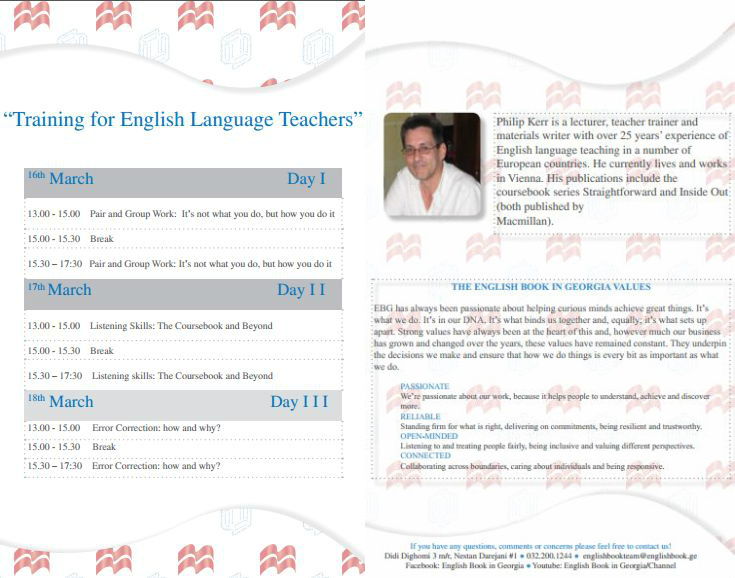
In conjunction with Macmillan Education, English Book in Georgia is pleased to offer a teacher training opportunity on the 3rd, 4th and 5th of February with Steve Taylore Knowles, author of Open Mind: The American English Mind series.

To register for this event, please email Lali Jokhadze: l.jokhadze@englishbook.ge OR call: 032 200 1244.

Training Newsletter

5 Powerful Questions Teachers Can Ask Students

Many would agree that for inquiry to be alive and well in a classroom that, amongst other things, the teacher needs to be expert at asking strategic questions, and not only asking well-designed ones, but ones that will also lead students to questions of their own.

[box type=”shadow” align=”aligncenter”]

Keeping It Simple

Asking straightforward, simply-worded questions can be just as effective as intricate ones. With that in mind, if you are a new teacher or perhaps not so new but know that question-asking is an area where you’d like to grow, start tomorrow with these five:


1. What do you think?

This question interrupts us from telling too much. There is a place for direct instruction where we give students information yet we need to always strive to balance this with plenty of opportunities for students to make sense of and apply that new information using their schemata and understanding.


2. Why do you think that?

After students share what they think, this follow-up question pushes them to provide reasoning for their thinking.


3. How do you know this?

When this question is asked, students can make connections to their ideas and thoughts with things they’ve experienced, read, and have seen.


4. Can you tell me more?

This question can inspire students to extend their thinking and share further evidence for their ideas.


5. What questions do you still have?

This allows students to offer up questions they have about the information, ideas or the evidence.[/box]

In addition to routinely and relentlessly asking your students questions, be sure to provide time for them to think. What’s best here, three seconds, five, or seven? Depending on their age, the depth of the material, and their comfort level, this think time will vary. Just push yourself to stay silent and wait for those hands to go up.

Also be sure to vary your tone so it genuinely sounds like a question and not a statement. When we say something in a declarative way, it is often with one tone and flat sounding. On the other hand, there is a lilt in our voice when we are inquiring and questioning.

To help student feel more comfortable and confident with answering questions and asking ones of their own, you can use this scaffold: Ask a question, pause, and then invite students to “turn and talk” with a neighbor first before sharing out with the whole group. This allows all to have their voices heard and also gives them a chance to practice their responses before sharing in front of the whole class.