Category Archives: Secondary Learners

Season’s Greetings | English Language Teachers

222

To help you prepare lessons for the holiday season, onestopenglish has put together a page of themed resources, some of which are free to download and use.

http://www.onestopenglish.com/…/themed…/christmas-resources/

If you would like to use the resources that are not downloadable without a subscription, remember you can also sign up for a 30-day free trial subscription on the onestopenglish website!

Halloween Resources for ELT

[gview file=”http://englishbookgeorgia.com/blogebg/wp-content/uploads/2017/10/GBLAD10000273-Scary-Consequences.pdf”]

[gview file=”http://englishbookgeorgia.com/blogebg/wp-content/uploads/2017/10/GBLAD10000274-Pumpkin-Pie-Dialogue.pdf”]

[gview file=”http://englishbookgeorgia.com/blogebg/wp-content/uploads/2017/10/GBLAD10000275-Apple-Bobbing.pdf”]

[gview file=”http://englishbookgeorgia.com/blogebg/wp-content/uploads/2017/10/GBLAD10000278-Halloween-Worksheet-2.pdf”]

[gview file=”http://englishbookgeorgia.com/blogebg/wp-content/uploads/2017/10/GBLAD10000280-Spooky-Statements.pdf”]

[gview file=”http://englishbookgeorgia.com/blogebg/wp-content/uploads/2017/10/GBWSE10000097-Halloween-Wordsearch.pdf”]

[gview file=”http://englishbookgeorgia.com/blogebg/wp-content/uploads/2017/10/GBWSE10000098-Halloween-Wordsearch-Answer-Key.pdf”]

for more please visit: http://www.macmillanenglish.com/resources/halloween/

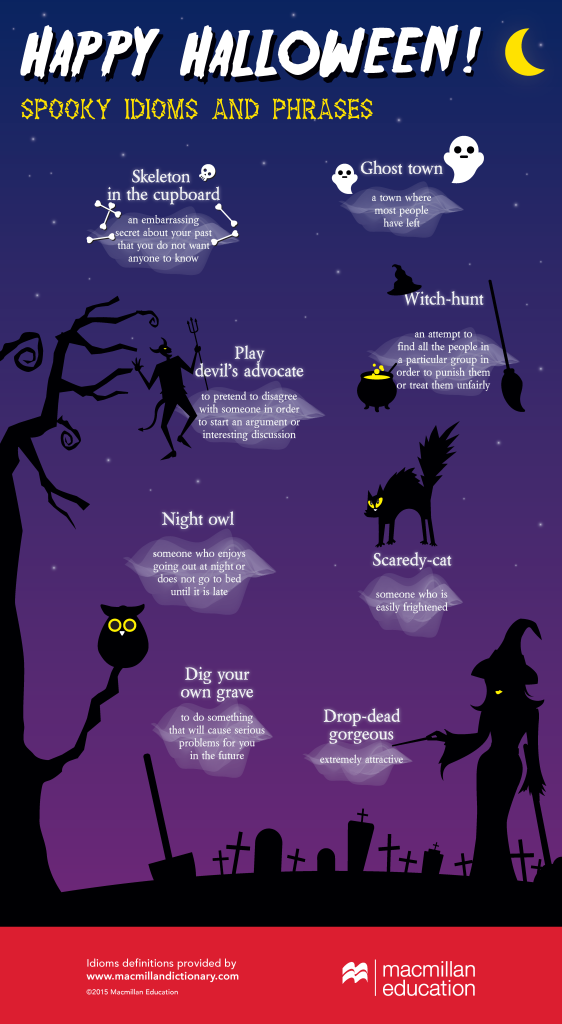
Spooky-halloween-idioms-infographic-image

Harry Potter and the English Language

hogwarts-castle-harry-potter-166431

Harry Potter turned 20 this year (the first in the series, Harry Potter and the Philosopher’s Stone, was published in 1997) and this has seen a whole raft of events to celebrate the anniversary, including the publication of 2 new companion books to coincide with the opening of Harry Potter: A History of Magic at the British Library. Harry Potter has contributed considerably to modern culture in the English speaking world but what about its impact on the English language? Resident language researcher Matt Norton takes a look using data from the Cambridge English Corpus and the Spoken British National Corpus.

Probably everybody has heard of Harry Potter. Most will also know some of the memorable words that feature in both the book and the film series. Certainly J.K. Rowling has contributed a number of new words to the English language as it is written and spoken today – there are hundreds of distinctively Potter-esque words that feature in the series. In order to investigate the impact this has had on modern English, we can use the Cambridge English Corpus (CEC) – a multi-billion word collection of contemporary spoken and written English and our most current collection of spoken British English (the Spoken British National Corpus). Both contain many Harry Potter words, some used quite frequent and some fairly rarely. In this article I use corpus linguistics to examine how the world of Harry Potter – or the ‘Potterverse’ – has influenced English with new words invented by Rowling (“coinings”); her reusing of rare or obscure words; and changes to existing word usage.

J.K Rowling’s use of language in the Harry Potter series

The Potter series shows a clear love of language. For example, we can see this by looking at the word-play involved in blend words – words made up from fusing two words together. Examples in Harry Potter include words like ‘animagus’, a blend of animal and magus (a kind of wizard, plural magi), and ‘merpeople’, blending from mer(maid) and people. Some of the words sound like parodies of English words, like ‘Hogwarts’, the name of Harry’s ‘School of Witchcraft and Wizardry‘, ‘Hufflepuff’ house or the game ‘Quidditch’. Although ‘Hogwarts’ sounds like a combination of hog and wart, there is also a plant called hogwort, which is a genuine English word, which may have also influenced this creation. So it seems that the English language may have already contained ‘otterisms before Potter, but they were obscure or “hidden”, a bit like how the magical world is hidden from humans in the Harry Potter series!

Rowling often uses imitation Latin, also known as dog Latin, especially in the spells or charms, such as ‘Expelliarmus’, the defense spell; ‘Expecto Patronum, to protect against dementors; and ‘Finite Incantatem’ (end the spell). The magical object ‘Horcrux’ has a dark, occult-like tone and appears to be a blend of horror (or similar Latin word) and Latin crux meaning cross.

Words invented by J.K. Rowling

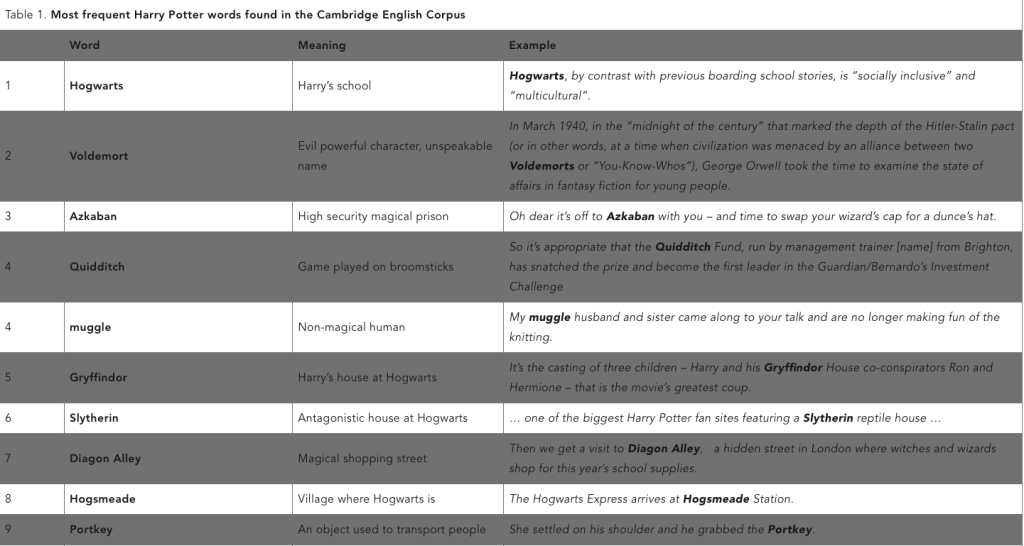
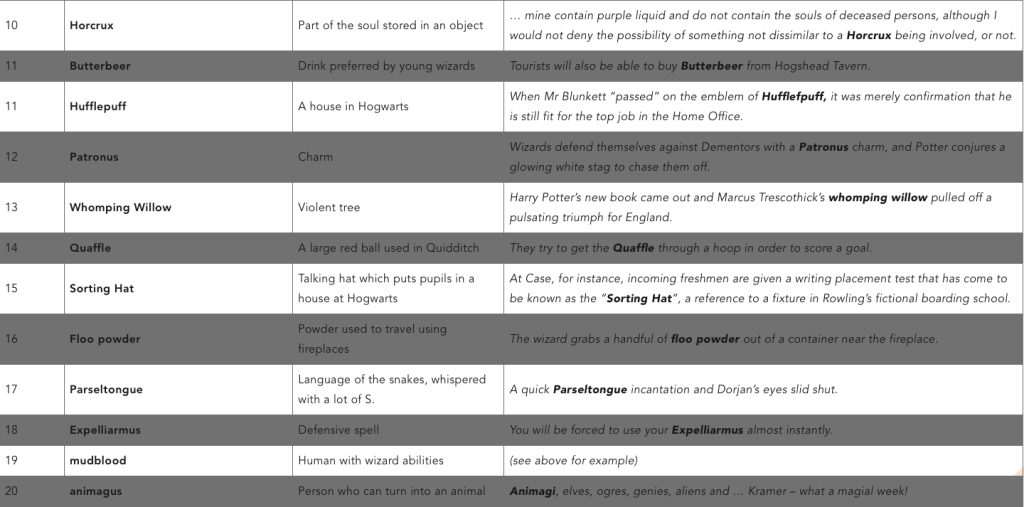
J.K. Rowling invented numerous words across the series – examples of the most frequent of these new Harry Potter words as found in the Cambridge English Corpus are shown in table below. What’s interesting to note here, is that often these words are used in context beyond talking about the Harry Potter books or films. In these cases the meaning of a word has been extended and applied to the real world. Lots of examples of this were found in the collection of spoken conversations (the Spoken BNC).
1

2

Hogwarts is the most popular newly-invented Harry Potter word in the data. It can be used to refer to large, old, dramatic buildings which have an appearance similar to Hogwarts, such as some of the older Cambridge University colleges. It can also be used to refer to university in general, e.g. in this example:

A: “It’s was so nice to be back at Uni again, you know?”
B: “Oh yeah I forgot, how are things going at Hogwarts?”

Aside from Hogwarts, Voldemort is the next most frequent coining in the Cambridge English Corpus. His name can represent a great evil power who may be so bad that his name cannot be uttered. In our data, we also see it used to refer to very bad people in general, e.g. dictators or warlords:

“…in the “midnight of the century” that marked the depth of the Hitler-Stalin pact (or in other words … an alliance between two Voldemorts or “You-Know-Whos)”

This new word also gives rise to Voldemortesque, Voldemortish and similar compounds. The name Voldemort seems to come from the French words “vol de mort” or “flight of death” or possibly “theft of death”.

Mudblood is a word often used by malevolent characters to refer to part-human part-magical people. In the example shown below, this term is used in non-Potter contexts to refer to a person of mixed geographical heritage:

A: “So what am I? Born in Essex but I‘ve got a Geordie mother and a Scottish dad, so what does that make me?”
B: “Oh it’s a, that’s a foreign country Essex.”
A: “Am I a mudblood?”

The word ‘muggle’ is used in the book to mean humans, i.e. people who don’t have magical powers. Because wizards see muggles as somewhat lacking in skill or knowledge, the term ‘muggle’ has now come to mean someone who is not very skilled at something, in a more general sense. In the Cambridge English Corpus we see examples such as this one referring to people who don’t have skills in a particular area:

“My muggle husband and sister came along to your talk and are no longer making fun of the knitting.”

Harry Potter has contributed considerably to modern culture in the English speaking world. For example, in the Spoken BNC there is reference to a Harry Potter themed club night, and to speakers wanting to do a university degree in the science of Harry Potter. The term Harry Potter has 18.9 instances per million in the new Spoken BNC, beating other seemingly common English words such as ‘marriage’ with 15.5 and ‘magic’ with 16.81. The English language now also contains words such as ‘Potterdom’ (the fandom or sphere of Harry Potter), ‘Potterfic’ (Harry Potter fiction), ‘Potterhead’/’Potterholic’/’Pottermaniac’ (a fan of Harry Potter), ‘Potterian’ (relating to Harry Potter), and ‘Potterverse’ (the world in the Harry Potter series).

Words reused or repopularized by the Harry Potter books

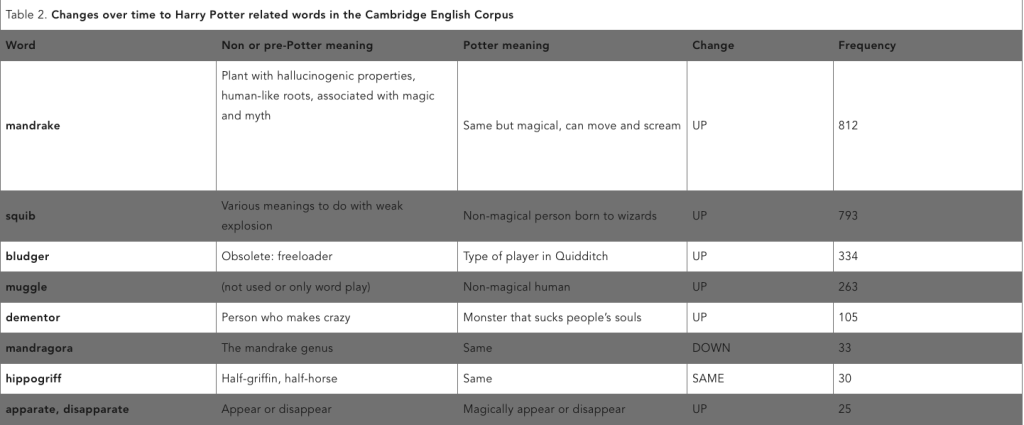
By looking at how frequent Potter-esque words were both before and after Harry Potter was published, we can see how language has changed. The results of this can be seen below.
3

‘Dementor’ is an old Latin word meaning ‘one who makes crazy or dements‘. It has been revived by Rowling (though with a specific sense of a kind of soul-sucking monster), and its use sharply increases in the nineties. Again, we frequently see this word used in the Cambridge English Corpus in a non-Harry Potter sense:

I called my kid a Dementor. Bad Mama! A gorgeous sweet friendly Dementor, who laughs at rolling soccer balls and squirty bath toys, but still.

Squib is a strange English word. Its origin is apparently an imitation of a not very impressive explosion e.g. made by a firework and we have the term damp squib, meaning disappointment. There are actually many senses of this word though not often used. In Harry Potter a squib is a wizard born without magical powers, something very rare, much less common than the opposite ‘mudblood’. Use of ‘squib’ declines over the 20th century but the CEC shows it increases after Potter. Apparate (and its opposite disapparate) are words reused by Rowling to mean make oneself appear or disappear – magically of course. Bludger occurs only once in the corpus before Potter (“He was the cheekiest little bludger you’ve ever seen in your life”). Although it seems to have some obscure senses, mainly Australian slang for freeloader, it has over 300 occurrences so this could be a big increase in use due to Potter.

It’s clear that the language used in Harry Potter has changed the English Language, with many Harry Potter terms now used more widely by many speakers. How could you use Harry Potter words in your lessons? Download our suggested magical Harry Potter themed wordlistsfor beginner, intermediate and advanced learners, and let us know how you use them!

Source: Cambridge.org (Published by: Matt Norton. 20 October 2017)

Who says grammar lessons have to be dull?

hogwarts-express-train-front2-c

Robert Dobie, owner of All Things Grammar, shares 8 lesson activities to liven up your class with just a little bit of magic.

How many Harry Potter books and films have been produced and written? If you know the answer to this (the answer, to date, is eight each), then it’s possible that you are a Harry Potter fan. Even if you’re not a fan, it’s likely that many of your learners are. Therefore, when it comes to teaching a book or film-based lesson, choosing something from the Harry Potter series is a ‘safe bet’ in terms of audience interest. However, it is the popularity of Harry Potter which may itself cause a bit of a problem.

There are so many Harry Potter books and films, and so there are also lots of Harry Potter lesson plans available. You might not have access to the particular title around which a lesson plan is based; it may not be available in your school library or as part of your home book or DVD collection. Some ELT lesson plans also try to get around this problem by focusing on either the production history of the series, or on the actors themselves. This then means there is little real reason to read or watch a Harry Potter book or film in the first place… So, what to do?

Not to worry! Below are 8 elementary and intermediate level grammar-based lesson ideas that can fit with any of the Harry Potter works produced.

Elementary

1. Comparative adjectives (for books or films)

Have your learners compare and contrast the characters’ personalities and physical appearances. You can ask them do this as a discussion to practice their speaking or as a writing task with group members reading aloud their sentences so that their partners can guess the characters they are describing.

For example:
Person A: This person is taller than Harry Potter and he is wiser.
Person B: Is it Dumbledore?
Person A: Yes, that’s correct!

Consider personalizing this activity by asking your learners to make comparisons between the film characters and themselves.

2. Present continuous (for films)

Play ‘True / False Tag’: classroom space permitting, have your learners stand in 2 equal lines facing each other. Label one line the ‘True’ team and the other the ‘False’ team. Show a section of the film and then pause the film intermediately. Immediately after pausing the movie, read aloud a previously prepared statement such as, “Lord Voldemort is chasing Harry.” If this statement is true, then the line designated as the ‘True’ team must touch the classroom wall nearest them – before the student opposite them in the ‘False’ team tags them. If the student opposite them catches up to them before they can touch the wall, they must “pay” that classmate (play money is good for this). If the statement is false, of course, learners in the “False” line must try to touch the wall closest to them.

3. Past continuous (for films)

Divide your class into 2 teams and then pause the film every 5 minutes or so. Each time you pause the film, ask one member from each team to come to the board at the front of the class. Then, ask the two students a question about the movie using past continuous; for example, “What was Harry holding a minute ago?” Seated team members are allowed to shout help and encouragement to those at the board as they try to be the first to write a complete sentence in answer to the question; for example, “He was holding a wand.” Award one point to the team for correct grammar usage (and perhaps spelling).

NOTE: Make sure to prepare a list of questions beforehand to ensure questions that are neither too easy, nor too difficult. Pay special attention to answers that might require any special vocabulary (such as ‘wand’, etc.).

4. ‘Should have’ with present perfect (for books or films)

As a short writing task, ask your students to imagine that they are Harry Potter and to write a personal memoir of the adventure portrayed in the story they have just seen or read – making sure they use ‘should have’ with present perfect. This can be done either as a short paragraph or as a set number of statements. For example, “I should have gone to the library with Hermione” or, “I shouldn’t have said that.” For more advanced learners, consider asking them to extend their sentences with ‘because’ (+ reason).

Intermediate

5. Any grammar focus (for films)

Watch short, selected scenes (in which there are 2 characters) without the audio. In pairs, ask your learners to use their imaginations to write the missing script. Then, of course, have your students stand up and perform for the class!

NOTE: Allow 5 to 10 minutes for ‘rehearsals’ as your students try to learn their lines. You can set a particular grammar for the students to use, or let them decide the grammar on their own. For larger classes, consider dividing the students into 2 or 3 audience groups (to avoid going overtime). Get ready for lots of fun!

6. Future with will – prediction (for books or films)

Stop the film at selected scenes (or stop reading at a particular page) and ask your learners (seated in groups) to make predictions about what they think will happen next. After predictions have been made, continue the film (or continue reading) to find out which group is correct (if any), and award them points for correct guesses. Insist on complete sentences with correct grammar usage. For example, “We think Ron will rescue Harry!”

7. Modal – should (for books or films)

Stop the film (or stop reading) at a point where it appears poor ol’ Harry could really use a bit of help. Your students then pretend that they are Harry Potter and write to an advice columnist for advice (They should first describe their problem, and then end with, “What should I do?”). Consider extending this activity by asking your learners to exchange papers and write advice (using ‘should’).

8. Past simple (for books or films)

This activity is an old classic – ask your learners to write a short summary of the story plot. Get more out of it by asking your writers to include 2 or 3 things that actually DIDN’T happen in the movie or book. Then, in small groups, have the authors read aloud their work so that their classmates can try to spot the errors.

Which of these 8 ideas would you like to try out the most? Let me know how it goes in the comments!

Source: Cambridge.org.

The Role Of a Teacher in a Blended Learning Classroom


Blended Learning

Some think that just because technology plays a key role in ‘blended’ classrooms, teachers are no longer central to the model. This isn’t true. Blended learning does not imply a silent classroom full of students all working individually on their computers while their teacher addresses technical issues. The model combines the best of both worlds, which means that teachers are just as important as computers.

The technology provides access to the online materials, sure, but it’s the teacher who chooses what to do. The technology also marks closed practice activities, but teachers facilitate open activities and assess students’ language use. Teachers also recognize and praise their effort.

In short, teachers shouldn’t feel threatened by technology, but rather see an opportunity to improve their work.

“Blended Learning myths: busted!”, Graham Skerritt. Cambridge University Press, 5 April, 2017, P10

A Teacher Centered Approach

15-classroom-management

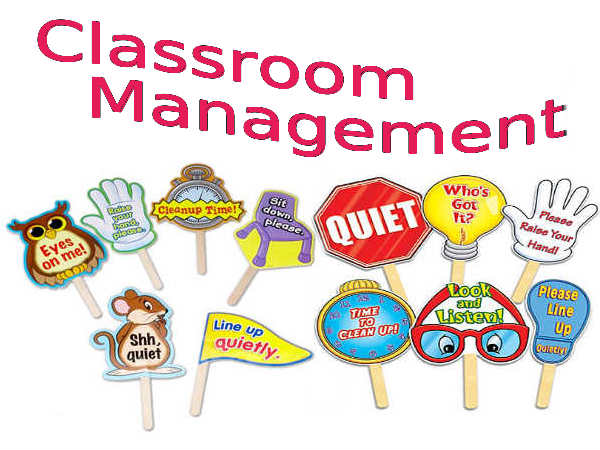
According to the classical model, it’s the teacher’s job to do the teaching and the student’s job to do the learning. But most modern experts agree that ideal classroom interaction involves a two-way process, where both the students and the teacher try to adapt to each other’s goals and procedures.

For instance, the teacher may first initiate an activity, but should then observe the students’ reactions. He should intervene and join those students who are having trouble. If this intervention doesn’t help the problem, then he would change the activity altogether. This negotiation sustains motivation in the classroom.

The student is “an active participant assuming partial responsibility for his own progress”. This means that the student must, first of all, make efforts to acquire the knowledge imparted by the teacher. But on an advanced level, the student seeks to share responsibility for his education with his teacher by keeping him informed about his progress through feedback.

Source: Peter Medgyes, “A ‘teacher-centered’ approach”, The Non-Native Teacher

Accents


pronunciation-am-vs-br

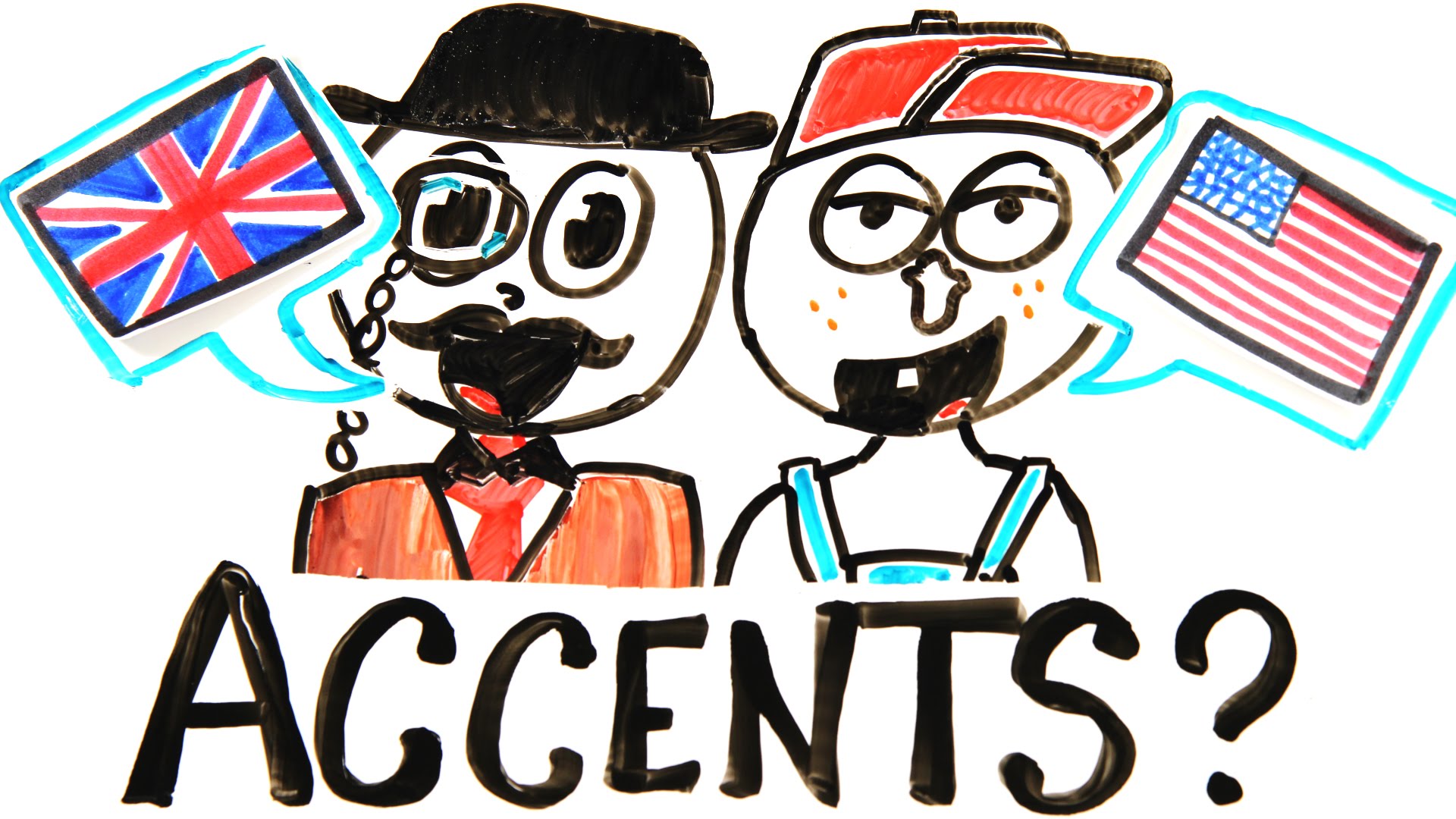
A fun experiment for teachers to do with their students involves accents. An accent is a particular way of speaking that tells you a lot about the speaker (their geographic and social background). The experiment starts out with splitting into groups of three. Then, each person has to speak for 60-90 seconds about a topic of interest while the other two listeners make notes on the speaker’s pronunciation. Then, in order, the groups discuss their findings.

This can be extremely beneficial to both students and teachers, as they’ll be more aware of their accents and be able to better grade language and understand differences between accents and the range of variation. Though there are broad types of accents, each person has his or her own ways of pronouncing things. Being aware of such differences is crucial for teachers.

Source: Ozog, Chris “’I don’t have an accent!’ Said Alison from Sussex” Cambridge University Press, 4 April, 2017, P3

Welcome to Gateway 2nd Edition

gateway-2nd-edition-1-638


About

Learning for life

If you don’t know Gateway already, this secondary course by teacher and author David Spencer is designed to lead teenage students to success in both international and school leaving exams. Each unit offers plenty of exam style activities and preparation tasks as well as Exam success tips.  The course is designed to prepare students for further study and future employment.

Gateway 2nd Edition retains many of the features that made Gateway so popular.
The approach to grammar and vocabulary and the development of the four skills is carefully staged and are both teacher- and student-friendly.

Gateway 2nd Edition also has several exciting new features!

The Flipped classroom videos bring grammar points from the Student’s Book to life and help teachers find more time in lessons and add variety to their teaching. The videos are short grammar presentations that are linked to one of each unit’s Grammar guides. Students can watch the presentation at home and complete tasks in the Online Workbook or printable worksheets on the Resource Centre. The videos are a flexible teaching tool and can also be used for revision, when students miss a class, or with the whole class in lesson-time, for variety.

At the heart of each unit there’s a special Life skills section preparing teenagers for varied aspects of life.  Each Life skills area has its own tailor-made video featuring British teenagers, demonstrating the topic and ends with students performing a Life Task; an activity that has direct relevance to the students’ lives outside the classroom.

Gateway 2nd Edition provides material which helps to develop other areas of knowledge, as well as English language skills. It offers brand-new, up-to-date texts to motivate teachers and their students. Reading texts include Critical thinking questions to get students reflecting on what they’ve just read and personalise the topic of the text.


Find out more

Source : www.macmillangateway2.com