Tag Archives: Sherlock Holmes

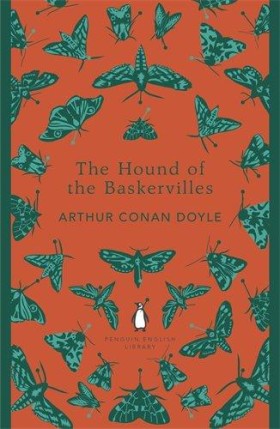
The Hound of the Baskervilles

‘The world is full of obvious things which nobody by any chance ever observes. Balance probabilities and choose the most likely’ – Holmes to Watson

The legend of the hound which has brought terror to the Baskerville family for generations brings Sherlock Holmes up against a formidable adversary and sends Dr Watson to a bleak and lonely moor where it is all too easy to believe that something not of this world is intent on driving his friend to a foul and hideous death…”As you value your life or your reason…

This adventure concerns the mysterious death of Sir Charles Baskerville, and the possibility that the heir to his fortune might be the object of murder. Before the novel begins, Sir Charles Baskerville had died suddenly, perhaps the victim of a ghostly hound believed to haunt his family because of an age-old curse. The Baskerville estate is located out in the remote moor of Devonshire.

Holmes and Watson are faced with their most terrifying case yet. The legend of the devil-beast that haunts the moors around the Baskerville family’s home warns the descendants of that ancient clan never to venture out in those dark hours when the power of evil is exalted. Now, the most recent Baskerville, Sir Charles, is dead and the footprints of a giant hound have been found near his body. Will the new heir meet the same fate?


7 Favorite Sherlock Holmes Stories

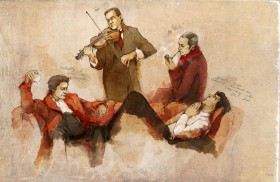
Sherlock Holmes is a cantankerous, brilliant man with an infectious laugh, reckless habits, and a great sense of compassion. One of the best things about Sherlock Holmes is that, like another strange genius most of us love, each generation has their own Holmes, with a new face and slightly different quirks. That’s what makes Holmes lasting and immortal, as he is reinvented by directors and actors, from Rathbone to Downey, Jr. to Cumberbatch. The same goes for his trustworthy partner, Dr. Watson, who has remained a steadfast and endearing companion through countless film and TV versions.

sh_develop_your_mind_by_mad_samurai-d4n8hxi


But in the end, where would we be if it wasn’t for the stories, in the first place? Whether films and series interpret the existing stories, or use them as a departure point for new episodes that seem in line with Holmes and Watson’s adventures (BBC’s Sherlock has done a good job of that), Doyle’s stories are still the source. So, in the spirit of appreciation, I’ve put together a short list of a few of my favorites (it was so hard to narrow it down). So if you haven’t had a chance to read Doyle’s mysteries before, I hope this peaks your curiosity. I admit, all my favorite stories are from the first three volumes written by Doyle (The Adventures of Sherlock Holmes, The Memoirs of Sherlock Holmes, and The Return of Sherlock Holmes). The e-books are available for download for free.

Now then, the list in an arbitrary order of preference. I’ve done my best to avoid any major spoilers.

1) The Adventure of the Speckled Band (The Adventures of Sherlock Holmes)
This story combines some of the best elements present not just in Sherlock Holmes stories, but mystery stories in general. (Doyle also considered it his favorite Holmes story and I’m obviously in agreement.) There is a damsel in distress, an intriguing and eerie death, and a cold-hearted father figure. It’s an example of a “locked room mystery,” where Holmes and Watson have to figure out the nature of the crime that took place in a supposedly locked and inaccessible room. Plus, if you’re into satisfying endings where the bad guys get their just rewards in the best way possible, this one has it, too.

2) The Adventure of the Engineer’s Thumb (The Adventures of Sherlock Holmes)
The Industrial Revolution brought with it many new and exciting elements to be included in mystery fiction of the time. In this case file, Watson recounts the story of a young hydraulic engineer who arrives at the Baker Street digs with a severed thumb and a confusing story that needs to be untangled. It’s a creepy little story (no supernatural elements – just criminals) that made me really terrified about enclosed spaces when I read it as a kid.

3) The Adventure of the Musgrave Ritual (The Memoirs of Sherlock Holmes)
In short, this is a story about a man’s disappearance and about a secret society with its mysterious rituals. Holmes deciphers the hidden meaning in the riddle that is a family document, dating back to the 17th century, in the house of his acquaintance Reginald Musgrave. When Musgrave’s butler is caught reading the document, he disappears shortly after (along with the maid), and Holmes is brought on to figure out the disappearance. Who doesn’t like stories involving secret societies with their cryptic rituals?

4) The Adventure of the Dancing Men (The Return of Sherlock Holmes)
Holmes’ new client, Mr. Cubitt, arrives with a piece of paper showing a cryptic arrangement of little dancing stick figures.  The note arrived by mail and has made his wife distracted and upset, although she wouldn’t tell her husband why. More notes bearing similar figures appear and Holmes decides that they are a cipher. Solving the code of the dancing men will help provide the answers to the mystery. It’s a good, solid mystery story and when I first read it as a kid, I went around drawing the little dancing men on figures of paper. Oh, kids.

5) A Scandal in Bohemia (The Adventures of Sherlock Holmes)

The fact this is one of the more frequently adapted Holmes stories just makes it all the more worth reading. The premise is that a compromising photograph, showing an opera singer named Irene Adler and the King of Bohemia, must be recovered by Holmes to avoid it being used as blackmail against the King as he prepares to wed a princess. The story has great elements of social intrigue and potential for scandal and Holmes gets to dress up in a disguise (I just love when he does that). The most notable part, however, is the way Holmes matches wits with the clever and resourceful Adler, with Doyle creating the most notable character (besides Moriarty) in the entire canon.

6) The Adventure of the Yellow Face (The Memoirs of Sherlock Holmes)
Holmes and Watson are bored. They haven’t had a case for a while. Enter Munro, a man who is suspicious of his new wife’s strange behavior and enlists the detectives’ assistance in figuring out the truth. When she thinks she is not being watched, she visits a neighboring home where a mysterious person wearing a yellow mask peers through the window. What is the truth behind Munro’s wife’s behavior and who is the stranger in the window? This is not so much a stellar example of Doyle’s mystery writing as a departure; it’s a sentimental story, with an ending that hints that Doyle was perhaps more socially progressive than the community of the time. It’s also a rare example of a case where Holmes actually makes mistakes in his deductive reasoning.

7) The Adventure of the Copper Beeches (The Adventures of Sherlock Holmes)
Similarly to The Adventure of the Speckled Band, this is another one that reminds me of Gothic mystery fiction. Holmes is approached by a young woman who is alarmed after taking a job as a governess, which comes with a few strange conditions. For one, the new employers required that she cut off almost all of her beautiful, long red hair. They also sometimes make her wear a bright blue dress and sit with her back to the street-facing window, where she realizes a man stands outside, watching her. Add to that a really foreboding atmosphere at the house (including a pair of creepy housekeepers) and you have a great little mystery on your hands. Never fear, Holmes solves it and the young woman escapes unscathed.

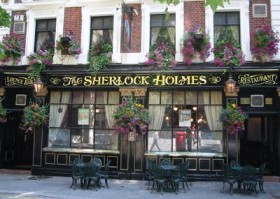
The Sherlock Holmes Public House and Restaurant

history_study


history_outside

In 1957, Whitbread and Co. purchased an entire exhibition that had been put together for the Festival of Britain, following its return from a world tour.

A permanent home was required for its homecoming to London, and Whitbread’s plan was to open up a themed pub in the centre of the city that would attract enthusiasts from around the world.

The subject of this exhibition was of course, Sherlock Holmes, and it was not only the first, but also the most important collection in the world to be based on the famous detective.

The Inn that had been known as “The Northumberland Arms”, standing on Northumberland Street, soon became “The Sherlock Holmes”. With the enthusiastic support and help of Sir Arthur Conan Doyle’s family, the pub was filled throughout with various artifacts and pieces recording the adventures of the Master Detective, including such diverse items as Dr Watson’s old service revolver, original cartoons and the stuffed and mounted head of none other than the Hound of the Baskervilles.

The main attraction however is a replica of Holmes’ and Watson’s sitting room and study, which relate to Sherlock Holmes and his exciting escapades. This room is given pride of place adjacent to the restaurant, where diners are able to view the whole area through a large glass partition, with additional viewing space through windows located in the hallway.

The exhibition items have not changed since they were first installed, and are now complemented by an interesting and nostalgic collection of television and film stills, featuring the famous actors who have played the Great Detective and his trusty sidekick, Watson, down the years.

It was also at this venue where Holmes tracked down Francis Hay Moulton in “The Noble Bachelor”. Old Scotland Yard is just across the other side of Northumberland Avenue, and the Turkish baths that Holmes and Watson used to enjoy were right beside the Hotel. It is still possible in fact to see the entrance, which now forms part of the wall of the bank in Craven Passage. With Charing Cross Station immediately beside the pub, one can just imagine the duo dashing off to catch a train into the countryside on one of their hair-raising adventures!

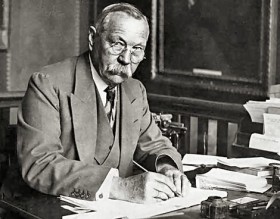
Interesting Facts about Arthur Conan Doyle

Sherlock Holmes’s creator Sir Arthur Conan Doyle embraced football, fairies and public feuds. Here are things that you may not know about the writer.

1. Doyle was one of the earliest motorists in Britain

He reportedly bought a car without ever having driven one before. In 1911, he took part in the Prince Henry Tour, an international road competition organized by Prince Henry of Prussia to pit British cars against German ones. Doyle paired up with his second wife, Jean, as one of the British driving teams.

2. Conan is not part of his surname

It is, in fact, only one of his two middle names. He is Sir Arthur Ignatius Conan Doyle. Shortly after he graduated from high school he began using Conan as part of his surname.

3. Doyle was on the same cricket team as ‘Peter Pan’ writer J.M. Barrie

They also worked together on a comic opera, Jane Annie, which Barrie begged his friend to revise and finish for him.

4. He could have discussed Dracula and Treasure Island with their authors

Doyle was also friends with Bram Stoker, and Robert Louis Stevenson was a fellow classmate at the University of Edinburgh.

5. He helped to popularize skiing

He not only liked cricket and football, but Doyle helped to popularize the winter sport. Following a move to Davros, Switzerland in 1893 (the mountain air was prescribe to aid his wife’s health), he mastered the basics with the help of the Brangger brothers, two locals who had taken to practising the sport after dark to avoid being teased by the townsfolk. Together, they were the first people to make the 8,000ft pass through the Maienfelder Furka, which separated Davos from the neighbouring town of Arosa. Doyle was also the first Englishman to document the thrill of skiing: “You let yourself go,” he said. “Getting as near to flying as any earthbound man can. In that glorious air it is a delightful experience.” Doyle correctly predicted that in the future hundreds of Englishmen would come to Switzerland for the “skiing season”.

Conan Doyle was the first to bring skiing from Scandinavia to Switzerland.

 6. He was a goalie

Under the pseudonym AC Smith, the writer played as a goalkeeper for amateur side Portsmouth Association Football Club, a precursor of the modern Portsmouth FC.

7. Doyle ran for parliament… twice!

Doyle ran for parliament (representing the Unionist Party) once in Edinburgh (in 1900) and once in the Border Burghs (in 1906). Although he received a respectable vote both times he was not elected. In the 1900 general election, Doyle was defeated by CM Brown of the Liberal Party, who received 3,028 votes against 2,459 cast for Doyle.

8. Ophthalmology’s loss was literature’s gain

Arthur Conan Doyle set up an ophthalmology practice in London. Doyle wrote in his autobiography that not a single patient ever crossed his door. Although, the silver lining was that he could dedicate his time to writing.

9. He believed in fairies

Sherlock might have been a skeptic but Arthur Conan Doyle believed in fairies. Well, he was convinced by the Cuttingly Fairy photographs, the famous 1917 hoax. He even spent a million dollars promoting them and wrote a book, The Coming of the Fairies (1921), on their authenticity.

One of the Cottingley Fairies photographs, taken by Elsie Wright (15) and her cousin Frances Griffiths, which caused a storm in 1917.

10. And also believed in a number of mediums

But this came at the cost of his friendship with Harry Houdini, who at the same time was trying to disprove the claims of the Spiritualist movement.

11. Why he killed off his most famous creation?

Sherlock Holmes was far from being Doyle’s own favorite character and was killed off in 1893, only to be resurrected 10 years later after public demand and monetary persuasion. He had earlier told a friend: “I couldn’t revive him if I would, at least not for years, for I have had such an overdose of him that I feel towards him as I do towards pâté de foie gras, of which I once ate too much, so that the name of it gives me a sickly feeling to this day.” However, there may have been other reasons for the writer killing off his famous creation, as it happened in the same year that Doyle’s alcoholic father died in an asylum.

12. Doyle and George Bernard Shaw had a spat about the Titanic

After the Titanic sank in 1912, Doyle and George Bernard Shaw had a very public disagreement about the disaster. Doyle was outraged by the dismissive and bitter comments made by the playwright regarding the many acts of heroics that took place aboard the ship as it went down.

13. There’s a square in Switzerland named after him

The town of Meiringen in Switzerland was the location of The Adventure of the Final Problem, the novel in which the author killed the detective off. In 1988, a statue of Sherlock Holmes was placed in the village square, now named Conan Doyle Place.

14. Sir Arthur Conan Doyle didn’t just write mysteries, he actually solved a few

One of particular interest to him was The Curious Case of Oscar Slater – for the murder of Marion Gilchrist, a wealthy 82-year-old woman from Glasgow. Doyle applied the “Holmes method”, in which he uncovered new evidence, recalled witnesses and questioned the prosecution’s evidence. His findings were published as a plea for Slater’s pardon. It caused a sensation and there were calls for a retrial, but all this was promptly ignored by the Scottish authorities. The desperate and incarcerated Slater later smuggled messages out of prison and Doyle’s interest in the case was reignited. He wrote to politicians and used his own money to fund Slater’s legal fees. One politician, Ramsay McDonald – Britain’s first Labour prime minister – informed the Scottish Secretary that the police and the legal authorities had colluded to withhold evidence and influence witnesses. Slater was subsequently released from prison with £6,000 compensation but never shared it with Doyle.

15. Doyle died holding a flower

Doyle died on July 7, 1930. He collapsed in his garden, clutching his heart with one hand and holding a flower in the other. His last words were to his wife. He whispered to her: “You are wonderful.”

16. A séance was organized for him to make an appearance from beyond the grave

Following his death, a séance was conducted at the Royal Albert Hall. Thousands attended, including his wife and children. A row of chairs were arranged on the stage for the family, with one left empty for Sir Arthur. Even though he did not appear, there were many people in the audience who claimed they had felt his presence among them.

Which Book Would You Like To Read?

რომელ წიგნს ისურვებდით რომ წაგეკითხათ?

Which book would you like to read?Books

[iphorm_popup id=”1″ name=”მოითხოვე სასურველი წიგნი”]Order Sherlock Holmes[/iphorm_popup]

[button color=”blue” size=”small” link=”http://englishbookgeorgia.com/catalogue/shop/penguin/david-copperfield-3/” target=”blank” ]Buy David Copperfield[/button]

[button color=”blue” size=”small” link=”http://englishbookgeorgia.com/catalogue/shop/englishlibrary/jane-eyre-2/” target=”blank” ]Buy Jane Eyre[/button]