Tag Archives: publishers

Frankfurt Calls on Publishing Community to Go Global

Go-Global-Image

Publishers worldwide are promoting the benefits of globalism, despite the recent rise in popularity of nationalist politics. The “Go Global” campaign, launched by the Frankfurter Buchmesse, aims to unite publishers from all across the world to defend the “freedom to publish”, and the “freedom of speech”, according to Juergen Boos, a representative.

With this campaign, the Frankfurter Buchmesse offers a number of one-year programs that help publishers exchange ideas internationally. They also help support the publishers’ global rights and their licensing platforms with the help of IPR Licence.

“Go Global” will have its final event in Frankfurt, where, alongside French guests, a number of international authors, politicians and artists will share their cultural and political experiences. Additionally, the Frankfurter Buchmesse will organize German stands at 17 international book fairs (including the London Book Fair).

With the world seemingly becoming more and more isolated by the month, it’s refreshing to still see a celebration of international bonds that hold Europe together.

Source: “Frankfurt Calls on Publishing Community to ‘Go Global’”, Juergen Boos, Publishing Perspective, Spring 2017, p.5

How Should Publishers Adjust Modernity


528662_9fda_2

Provide alternatives to current printed learning materials.

For centuries, printed materials have served us well. They have been a great way to get information out to everyone. By now, the content development cycles have almost been perfected. However we’re still unable to adapt the content to the requirements of different learners. There are some who require a faster or a slower pace.

One possibility is to focus on work books, which enabled Finland’s success in Pisa rankings. These books encouraged the students to learn more by engaging them and providing their teachers with an efficient way of assessing their skills. The same general idea can be applied to digital learning as well. Though short, fun videos are useful, there need to be alternatives.

Recognize the role of teachers in the digital world

Though machines are great at providing real time feedback to users as well as showing them possible learning paths, teachers are still necessary. They should support learners, giving them personal advice to motivate them in their learning journey.

Retrain teachers

Teachers need to be shown new ways of using digital content and data to make their classes more effective. Yet we shouldn’t get carried away by new trends. Technology should support teachers, not replace them.

Become relevant again

Publishers need to be in the middle of the learning process. They should make content as easily accessible as possible instead of hiding it away behind clunky online interfaces. That requires rethinking the field.

Source: “Learning: We will do better”, Teuvo Sankila, London Show Daily, P.16

Inside the classroom of the future

Tomorrow’s classrooms will be collaborative workspaces, featuring 3D printers  “immersive “ work stations and hybrid  textbooks in which content is generated on the fly.  By Mark Piesing

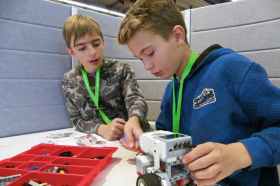
In  the classroom of the future, small groups of children work messily together on a number of “expeditions”  to create amazing machines out of LEGO , scan seashells to be printed in  3D to help them explore under the sea, and tell them their own stories using sound.

By using the latest technology , such as 3D printers, fully  immersive work stations – which are rather like working on two screens with one of them a touch screen projected onto the table in front of you- and hybrid text books, it’s hoped that teachers and publishers will be shifted from being providers of information to being supporters and  prompters of the learning experience.

The hybrid textbook is much like a traditional textbook with text and  pictures but also connects to a world of students -, teacher and publisher – generated digital  material with the wave of a smartphone over an invisible watermark.

Its creator Hewlett Packard believes  that this will help the students of today prepare for their own future  in the knowledge economy- if in a rather controlled way that keeps parents and teachers happy.

Education can be innovative and international, and publishers can find new ways of delivering material in the future.


Author:  Mark Piesing 

Source: Frankfurt Show Daily