Tag Archives: kindergarten

The World’s Best Kindergarten

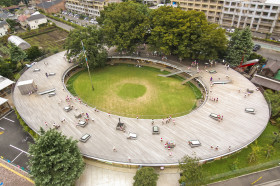
At Fuji Kindergarten outside Tokyo, kids make the most of a magical environment designed just for them. The roof of their oval-shaped school, designed by Tokyo-based firm Tezuka Architects, is an endless playground, and trees grow right through classrooms. He made everything  with the help and support of his wife. Their inspiration was their children.

The main thing that the architect did is that he thought like a kid. He  mentioned: “ I built to let children be children”.

The playground lets kids run forever

“We designed the school as a circle, with a kind of endless circulation.”

takaharu_tezuka_14

Kids can slide to class

“We put in a small mound of dirt at the bottom of the stairs leading from the roof — this was a trick to make the stairs shorter. But then the children started taking away the dirt to make mud bowls — 6oo kids take mud away, and the mound started to disappear! The school had to keep asking the construction company to put mud back. (As the soil got harder, the kids stopped taking it home.)” 

takaharu_tezuka_06

A chair can be a train

“Every month at Fuji the teachers and kids rearrange the classroom furniture. This little boy and girl were supposed to help make a new configuration, but they’re useless! They’re playing train instead.“

takaharu_tezuka_07

Safety drills are super cute

“Japan gets ten percent of the world’s big earthquakes, so children have these earthquake drills. They take these cotton hats from under the table to protect their heads in case something falls. It’s a very Japanese thing.”

takaharu_tezuka_13


[button color=”grey” size=”medium” link=”http://ideas.ted.com/inside-the-worlds-best-kindergarten/” ]Source[/button]

Is your Child Ready for School?

By law, children must be enrolled in school by a particular age. Just as children begin to work or talk at different ages, they also develop the psychological and social aptitudes necessary for school at varying ages.

In addition, many parents and educators feel that schools need to be ready for children. Of course, the reality is that a match between your child’s development and the school’s resources and adaptability may not exist.

When you’re deciding when your child should start school, consider your child’s unique abilities and local circumstances. Gather accurate information about your child’s development, especially communication skills, including language development and the ability to listen; social skills and the ability to get along with other children and adults; and physical skills from running and playing to using a crayon or pencil. Talking with your child’s pediatrician, preschool teacher, and/or childcare provider can provide some useful, objec­tive observations and information.

Some schools may conduct their own tests to evaluate your youngster’s abilities. So-called readiness tests tend to concentrate on academic skills, but most usually evaluate other aspects of development.

When you or the school identify some areas of your child’s development that seem to lag behind, use this information to help you and the school plan for the special attention that your child may need.

Parents can encourage their children’s cognitive, physical, and emotional development before they enter school. Kindergarten teachers appreciate having children who are enthusiastic and curious in approaching new activities, can follow directions, are sensitive to other children’s feelings, and can take turns and share. Some specific skills that will make your child’s first year at school go smoothly include her ability to:

  • Play well with other children with minimal fighting or crying.
  • Remain attentive and quiet when being read a story.
  • Use the toilet on her own.
  • Successfully use zippers and buttons.
  • Say her name, address, and telephone number.

There are great benefits to reading to your child beginning in infancy. Help your child acquire some basic skills, like recognizing and remembering letters, numbers, and colors. Expose her to enriching and learning experiences like trips to the museum, or enroll her in community art or science programs. To promote social-skills development, encourage her to play with other children of both sexes in the neighborhood and to participate in organized community-sponsored activities.


[button color=”grey” size=”medium” link=”https://www.healthychildren.org/English/ages-stages/preschool/Pages/Is-Your-Child-Ready-for-School.aspx” target=”blank” ]Source[/button]