Tag Archives: Ernest Hemingway

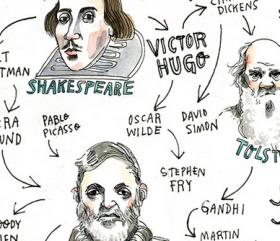
Who Inspired Whom?

Many authors inspired or influenced people throughout the world. For example, English poet Lord Byron inspired the author Bram Stoker who then inspired film director Tim Burton. Everyone is connected. Take a look!

circlesofinfluence1


[button color=”blue” size=”small” link=”http://www.brainpickings.org/” target=”blank” ]Source[/button]


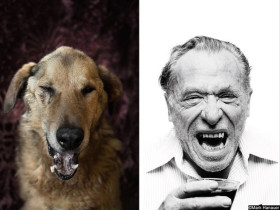
A Photographer Made These Rescue Dogs Look Like Famous Writers

Photographer Dan Bannino recently adopted a dog from a rescue shelter and it changed his life forever.

To celebrate, he decided he wanted to give his new pet, Rothko, and millions of other rescue dogs a voice by creating a new photo series entitled Poetic Dogs.

Bannino wrote on the project’s IndieGoGo page: “#POETICDOGS is a photo-project where dogs are besides famous writers: Speaking through their expressions, sounds and movements, they’re telling you everything saying nothing, just like an author would do with words in a fine poem.”

All the dogs featured in the series are from the same kennel near Turin, in Italy, where Bannino’s dog, Rothko, was adopted from.


Charles Dickens

Charles Dickens

Charles Pierre Baudelaire

Charles Pierre Baudelaire

Edgar Allan Poe

Edgar Allan Poe

Emily Dickinson

Emily Dickinson

Ernest Hemingway

Ernest Hemingway

James Joyce

James Joyce

Leo Tolstoy

Leo Tolstoy

Mark Twain

Mark Twain

Oscar Wilde

Oscar Wilde

William Shakespeare

William Shakespeare

You can see more of the pictures and learn about the dogs’ stories on Bannino’s Facebook and Instagram pages.


On this day…

Frédéric Passy, Henry Dunant – The first winners of the Nobel Peace Prize in 1901

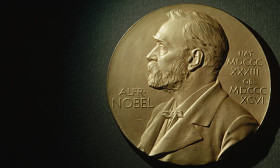
On this day in 1901, the first Nobel Prizes are awarded in Stockholm, Sweden, in the fields of physics, chemistry, medicine, literature, and peace. The ceremony came on the fifth anniversary of the death of Alfred Nobel, the Swedish inventor of dynamite and other high explosives. In his will, Nobel directed that the bulk of his vast fortune be placed in a fund in which the interest would be “annually distributed in the form of prizes to those who, during the preceding year, shall have conferred the greatest benefit on mankind.” Although Nobel offered no public reason for his creation of the prizes, it is widely believed that he did so out of moral regret over the increasingly lethal uses of his inventions in war.

Alfred Bernhard Nobel was born in Stockholm in 1833, and four years later his family moved to Russia. His father ran a successful St. Petersburg factory that built explosive mines and other military equipment. Educated in Russia, Paris, and the United States, Alfred Nobel proved a brilliant chemist. When his father’s business faltered after the end of the Crimean War, Nobel returned to Sweden and set up a laboratory to experiment with explosives.

In 1875, Nobel created a more powerful form of dynamite, blasting gelatin, and in 1887 introduced ballistite, a smokeless nitroglycerin powder. Around that time, one of Nobel’s brothers died in France, and French newspapers printed obituaries in which they mistook him for Alfred. One headline read, “The merchant of death is dead.” Alfred Nobel in fact had pacifist tendencies and in his later years apparently developed strong misgivings about the impact of his inventions on the world. After he died in San Remo, Italy, on December 10, 1896, the majority of his estate went toward the creation of prizes to be given annually in the fields of physics, chemistry, medicine, literature, and peace. The portion of his will establishing the Nobel Peace Prize read, “[one award shall be given] to the person who has done the most or best work for fraternity among nations, for the abolition or reduction of standing armies, and for the holding and promotion of peace congresses.” Exactly five years after his death, the first Nobel awards were presented.

Past Nobel Prize winners

Today, the Nobel Prizes are regarded as the most prestigious awards in the world in their various fields. Notable winners have included Marie Curie, Theodore Roosevelt, Albert Einstein, George Bernard Shaw, Winston Churchill, Ernest Hemingway, Martin Luther King, Jr., the Dalai Lama, Mikhail Gorbachev, and Nelson Mandela.

The Royal Swedish Academy of Sciences

The Royal Swedish Academy of Sciences decides the prizes in physics, chemistry, and economic science; the Swedish Royal Caroline Medico-Surgical Institute determines the physiology or medicine award; the Swedish Academy chooses literature; and a committee elected by the Norwegian parliament awards the peace prize. The Nobel Prizes are still presented annually on December 10, the anniversary of Nobel’s death. In 2006, each Nobel Prize carried a cash prize of nearly $1,400,000 and recipients also received a gold medal, as is the tradition.

Happy Birthday, Ernest Hemingway!

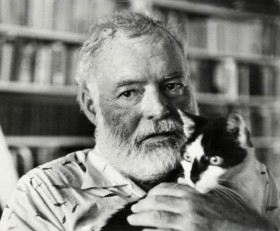
Ernest Miller Hemingway was born on July 21, 1899. He was a famous American author and journalist, whose economical and understated style had a strong influence on 20th-century fiction, while his life of adventure and his public image influenced later generations.

http://i664.photobucket.com/albums/vv9/francomac123/Aalbum/ErnestHemingway2.jpg

Here are some interesting facts about him:

  • In the 1940′s, Hemingway worked closely with the Soviet KGB. He went under the cover name “Argo.” Edgar Hoover and many FBI officials spied on him for much of his later life. Some even claim this added level of pressure deepened his depression and later led him to take his own life
  • After World War II, he was accused of War Crimes by Geneva surrounding an event where Ernest lead a group of French Militia against the Nazis. He was not convicted
  • During his 62 years, he married four times and divorced three times (Hadley Richardson, Pauline Pfeiffer, Martha Gellhorn, Mar Welsh Hemingway)
  • Hemingway wrote a 6 word short story because of a bar room bet. It read, “For sale: baby shoes, never worn.”

Source